
Phased Construction ESC Plans in Ontario
A phased construction ESC plan coordinates soil protection, temporary drainage and handovers as each work area changes.
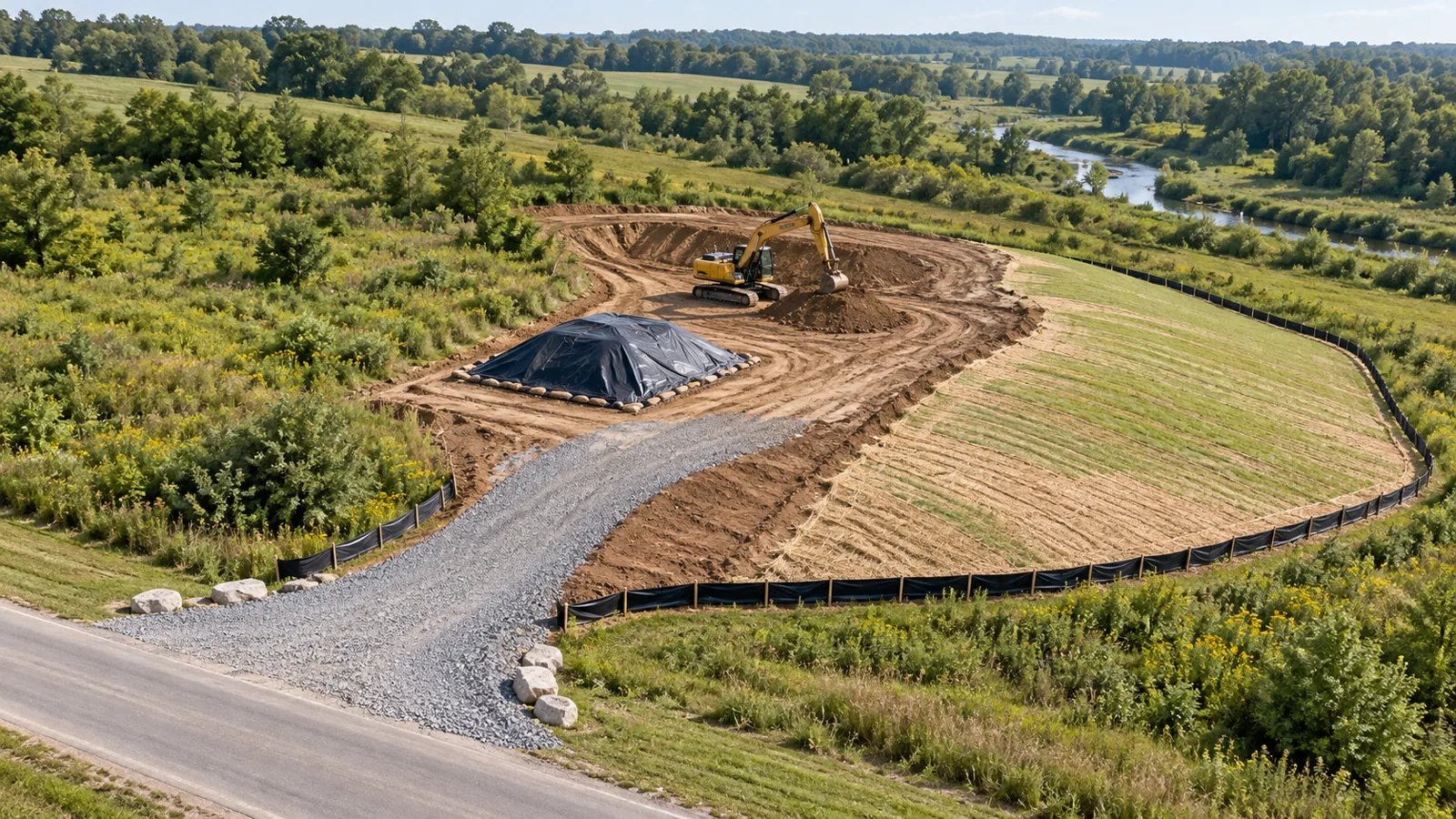
The plan shows what protects each disturbed area, how temporary drainage changes, and what must happen before the next phase begins. In Ontario, it also needs to reflect the municipality, conservation authority and other requirements that apply to the property.
This guide explains the decisions behind a coordinated plan, from early clearing through servicing, building construction and final stabilization.
Key Takeaways
- Match disturbance limits and temporary drainage to each phase, not only final grading.
- Install the next stage of protection before removing controls that still serve an active area.
- Define responsibilities, inspection requirements and release conditions before work changes.
- Keep excavation-water permissions, excess-soil obligations and permanent stormwater approvals distinct from the ESC drawing.
- Update the coordinated design when the real sequence differs from the assumptions.
What a Phased Construction ESC Plan Does
A phased construction ESC plan explains how erosion prevention and sediment control remain effective while a project changes shape. It connects exposed soil, temporary drainage, access and control measures to recognizable construction stages. Consequently, the drawing becomes a sequence the team can follow rather than a collection of symbols.
Erosion prevention limits soil detachment at its source. Sediment controls address particles carried by runoff after detachment. Both matter, but preventing unnecessary disturbance can reduce the load that downstream measures must manage. The appropriate combination depends on soil, slope, drainage, weather exposure and the receiving environment.
Phasing does not necessarily mean dividing a property into equal areas. A useful phase might instead follow a servicing corridor, a building platform or an access change. The boundary should make sense for the proposed work and the protection that can realistically remain in place.
Why the final grading plan is not enough
The finished site may direct water toward a completed drainage system. During construction, that system may be incomplete, obstructed or deliberately isolated. Excavations and temporary haul routes can also create drainage paths that do not appear on the final plan.
Therefore, review the interim ground conditions separately. Ask where runoff starts, where it travels and what receives it at each stage. A phase-specific review can reveal an unprotected low point even when the finished grading design is sound.
For small lots, the available working space may be the main constraint. For larger developments, the harder question may be how several active areas share an outlet. Our residential infill ESC guide addresses the first situation; this article focuses on transitions between construction phases.
Establish the Applicable ESC Requirements First
Start with the actual property, proposed activities and approval pathway. Municipal engineering standards, site-alteration requirements, development conditions and conservation authority requirements may all affect the submission. However, a technical guide is not itself permission to begin work.
The TRCA technical guidelines and checklists identify its erosion and sediment control resources. Credit Valley Conservation also publishes the Erosion and Sediment Control Guideline for Urban Construction. Confirm which guidance the relevant reviewer expects for the project, including any local supplements.
Where TRCA jurisdiction may apply, review its permit process with the project team. Other conservation authorities have their own application processes. Do not transfer one authority’s conditions to another site without checking applicability.
Identify requirements that sit outside the ESC drawing
An ESC submission does not automatically authorize excavation dewatering, sewer discharge, work near water or soil movement. These issues may require separate assessments, approvals or professional input. Identify the interfaces early rather than leaving them as a general note.
Record the authority contact, applicable document version and outstanding questions in the design brief. This makes it easier to distinguish a confirmed requirement from a working assumption when the programme changes.
Site Information for a Phased Construction ESC Plan
The designer needs current survey information, proposed grading and servicing, and a realistic construction sequence. Include existing drainage features, sensitive areas, vegetation to remain and known access restrictions. A drawing base that omits a receiving ditch can undermine an otherwise detailed control layout.
Also provide the anticipated disturbance limits and the contractor’s preliminary logistics where available. Stockpiles, haul roads, staging areas and temporary utilities compete for space. Consequently, these are design inputs, not matters to postpone until mobilization.
State uncertainties plainly. If the construction programme is preliminary, identify which phase assumptions require confirmation before work begins. If groundwater conditions are unknown, identify the investigation or specialist review needed rather than implying that ordinary surface controls resolve the issue.
Use one phase register for the staged ESC plan
A phase register links each drawing stage to its purpose, disturbance area, temporary outlet and completion conditions. It can also identify the responsible installer, inspection lead and person authorized to request a design change. The register should reference the current drawing issue.
Keep the labels consistent across civil drawings, the construction programme and field records. For example, “Phase 2” should not mean road servicing in one document and building excavation in another. Clear naming prevents a seemingly minor communication error from removing protection too early.
The register need not become a second specification. Its value is to make the essential interfaces visible. Detailed design criteria, installation notes and approval conditions remain in their appropriate documents, with clear cross-references.
One Continuous Chain of Protection
- Prepare: confirm limits, access and receiving drainage before disturbance.
- Protect: install the measures required for the first active area.
- Transition: verify the next arrangement before changing drainage or removing a control.
- Stabilize: protect completed areas while other work continues.
- Close out: confirm the required release conditions before final removal.
The engineered plan and applicable conditions determine the actual controls and hold points.
Phased ESC Plan: Preparation Before Clearing and Stripping
Early works can expose soil before the main construction team is fully established. Therefore, the phased construction ESC plan should identify which protection, access arrangements and notifications must precede clearing, stripping or demolition. It should also show the limits of areas that must remain undisturbed.
The Sustainable Technologies Evaluation Program ESC resource emphasizes planning for construction phases and implementing controls before disturbance. Apply that principle to the actual work sequence rather than copying a standard start-up note without checking the layout.
Review how crews reach the first work area without damaging the measures just installed. An entrance, fence line or storage zone can conflict with delivery movements. Resolve these conflicts before equipment arrives so that protection does not depend on improvised gaps.
Keep undisturbed areas genuinely protected
An area marked “future phase” may still attract temporary storage or vehicle traffic. If the plan relies on its vegetation remaining intact, that assumption needs a practical boundary and a clear site instruction. Otherwise, the design may overestimate the amount of stable ground.
Discuss how the team will recognize the disturbance limit and report a proposed change. Tree protection, environmental buffers and other restrictions may impose additional constraints. The ESC plan should coordinate with them, not authorize work within areas controlled by another approval.
Staged ESC Planning for Earthworks and Temporary Drainage
During earthworks, the landform can change faster than the permanent drainage network develops. Temporary catchments may grow, split or discharge toward a different low point. Accordingly, review the interim slopes and outlets that exist during the operation, not just those at completion.
The engineer should assess whether the selected measures suit the contributing area, expected flow conditions and soil characteristics. A perimeter measure is not automatically appropriate for concentrated flow. Likewise, placing a familiar detail at every low point does not establish adequate performance.
Consider access for maintenance when locating controls. Sediment removal, repair and inspection need space that remains usable. A measure that becomes trapped behind a stockpile or deep excavation may be difficult to maintain when it is most needed.
Coordinate stockpiles with the next stage
A stockpile location may work during stripping but conflict with a future trench or road. Identify how long it will remain, how runoff interacts with it and where material handling will move next. The transition should preserve the intended protection.
Also distinguish ESC planning from excess-soil compliance. Soil testing, characterization, reuse and movement can involve separate obligations. Confirm the responsible consultant and applicable process rather than implying that an ESC note resolves the whole soil-management scope.
Phased ESC Planning for Servicing, Roads and Changing Access
Servicing introduces trenches, crossings, temporary spoil and changes to site access. These activities can cut through established controls or alter the drainage path they protect. Review each interface before the work reaches it.
For example, a trench crossing a temporary swale may interrupt the intended route. The response depends on the site’s design and work method. The team should obtain coordinated direction rather than assuming that an open trench can serve as temporary drainage.
Road construction can also change the balance between exposed soil and hard surfaces. New runoff routes may develop before final inlets or outlets are ready. As a result, protection should follow the actual commissioning sequence, including unfinished connections.
Protect permanent stormwater features during construction
A permanent stormwater feature may not be ready to receive construction runoff. Its intended function, construction status and susceptibility to sediment need review. Do not assume that using the permanent facility temporarily is acceptable simply because it lies downstream.
Clarify any approved temporary use, protection measures, maintenance requirements and restoration responsibilities. Where a separate stormwater design governs the feature, coordinate with its designer. The final inspection should distinguish permanent-system readiness from temporary ESC closeout.
The same coordination applies to landscaped treatment areas and infiltration features. Protecting their future function may require keeping construction traffic and sediment away until the surrounding work reaches an appropriate stage.
Phased ESC Planning Beside Completed Areas
Building construction may continue after roads or neighbouring areas appear complete. Deliveries, excavations and landscaping can repeatedly disturb the remaining soil. Therefore, do not treat substantial building progress as automatic evidence that ESC protection can end.
Review how occupied or completed areas interact with the active work. Pedestrian access, emergency routes and neighbouring drainage must remain functional. Control placement should address those interfaces without relying on unauthorized obstruction of public or private access.
Temporary works may also need adjustment as the available space shrinks. Ask the contractor to identify upcoming changes early, particularly where a control occupies the next work area. A planned transition is preferable to removing the measure and discussing replacement afterward.
Handle excavation water as a separate decision
Water in an excavation requires attention to its source, quality, quantity and proposed destination. Surface sediment controls do not by themselves authorize pumping or discharge. Confirm the applicable permissions and specialist requirements before relying on a route.
Keep any dewatering or discharge plan coordinated with the phased ESC drawings. A changed discharge location can affect downstream controls and inspection needs. If unexpected conditions arise, the site team should follow a defined escalation process instead of improvising a connection.
Define Handovers in the Phased Construction ESC Plan
A phase handover is the point where responsibilities and physical protection need to stay aligned. The next area may become active while the previous area still needs maintenance. Therefore, the handover should identify both the new requirements and the controls that remain in service.
Use clear release conditions rather than a date alone. Depending on the approved design, these may concern installation, stabilization, inspection, drainage continuity or authority acceptance. The relevant professional and approval conditions determine what evidence is needed.
Record unresolved items and who will close them. If a condition has not been met, the team needs explicit direction on what work may proceed. A meeting note that simply says “Phase 2 complete” is not enough to explain the remaining protection.
Questions to resolve at each transition
- Which disturbed areas still drain to the existing controls?
- Is the replacement arrangement installed and ready for its intended role?
- Can the responsible team inspect and maintain every retained measure?
- Have changes to access, stockpiles and temporary drainage been coordinated?
- Are required reviews and release conditions documented?
Manage design changes without losing version control
A changed sequence can require a revised drawing even when the building design stays the same. Record the proposed change, affected area and reason. Then assess the consequences for contributing drainage, controls, access and other approved plans.
Issue clear design direction through the agreed project process. Identify the superseded sheet and keep the current field copy accessible. Where approval conditions require reviewer acceptance, obtain it through the appropriate channel rather than treating an informal conversation as approval.
Inspecting and Maintaining the Staged ESC Plan
The phased construction ESC plan needs a usable inspection and maintenance process, not just installation details. Confirm the required frequency, event triggers, documentation and responsible parties from the applicable criteria and project conditions. There is no single inspection interval that this article can prescribe for every Ontario site.
Inspection records should identify the location, observed condition, needed response and closure evidence. Photographs can help explain a problem, but a photograph alone does not show that the response was completed. Track significant issues until the responsible person confirms the outcome.
Also plan for shutdowns, heavy rainfall, freeze-thaw conditions and delayed stabilization. A site that pauses between phases still needs protection. Review the expected exposure and access for maintenance before crews leave, rather than relying on the original production schedule.
Respond to the cause, not only the visible damage
Repeated overtopping, erosion or sediment accumulation may indicate a design or sequencing issue, not simply poor housekeeping. Report the observation to the appropriate professional. Adding more of the same material without understanding the flow path can leave the cause unresolved.
Similarly, damage after a storm should prompt a review of the affected upstream area. A new stockpile or changed slope may have increased the load on an unchanged measure. Useful inspection connects field observations back to the current phase assumptions.
Stabilization and Final Removal of Temporary Controls
Finishing earthworks does not necessarily mean a surface is stable. The design should identify the stabilization approach and applicable completion criteria. Seasonal conditions and the remaining work may affect when those criteria can realistically be achieved.
Before removing a temporary control, confirm that it no longer serves an active or inadequately stabilized area. Also review how the permanent drainage system will function after removal. A control that appears redundant locally may still protect a downstream receiving feature.
Closeout records should explain what was reviewed, which requirements were satisfied and what responsibilities remain. Where another party must accept the work, keep that acceptance separate from a contractor’s completion statement. This provides a clearer basis for the final transition.
Close out the staged ESC plan and transfer maintenance
Some permanent drainage or stormwater features require maintenance after construction. Identify the receiving owner or operator and the relevant records. Temporary ESC closeout should not leave uncertainty about who looks after the completed system.
Provide the appropriate final drawings, inspection information and outstanding-item record within the agreed scope. These documents should reflect the actual completed arrangement, not an early design that the team informally changed during construction.
Illustrative Design Scenario: Two Work Areas, One Outlet
Consider a hypothetical development with an early servicing area and a later building area. Both eventually drain toward the same downstream system. Initially, the building area remains vegetated while the contractor installs services. The ESC design must account for the servicing disturbance without assuming that the finished road drainage already exists.
Next, the contractor proposes opening the building area before completing the servicing area. That change can increase the exposed ground contributing runoff at the same time. The engineer would need to review the temporary catchments, downstream protection and maintenance access against the changed sequence.
The original drawing may still contain the correct control symbols, yet its assumptions may no longer hold. This illustrates why phasing review should examine actual coverage and timing, not merely whether the field installation resembles the drawing.
For this type of phased construction scenario, Elmid Design Inc. can prepare erosion and sediment control drawings that coordinate temporary catchments, control locations and phase-transition notes within the agreed engineering scope.
A practical way to evaluate the change
First, identify the precise overlap period and the activities planned in both areas. Then compare the temporary elevations, drainage routes and exposed surfaces with the design basis. Include any new stockpile or access requirement that could obstruct maintenance.
Next, determine what design adjustment or additional information is needed before the overlap begins. The answer might involve revising the sequence, changing the temporary arrangement or completing a prerequisite activity. It should come from the site-specific assessment, not a universal instruction to add more fencing.
Finally, record the agreed sequence and any required acceptance in the controlled drawing set. Communicate which controls remain, which change and who checks the transition.
Separate Design Decisions From Site Operations
- Engineering design
- Defines the site-specific protection strategy, relevant criteria, design assumptions and coordinated drawings within the professional scope.
- Contractor operations
- Address installation, equipment, day-to-day activities and maintenance responsibilities under the contract and applicable requirements.
- Authority review
- Determines the submissions, permissions and acceptance required under the authority’s jurisdiction.
These responsibilities interact, but one does not replace another. An engineer’s drawing does not transfer all site duties to the designer, and a contractor’s programme does not override approval conditions.
Include the Staged ESC Plan in Procurement
Owners can reduce avoidable scope gaps by including the phased construction ESC plan in the construction procurement package. The contractor needs to understand the intended sequence, maintenance obligations and potential interfaces before pricing the work. Otherwise, essential temporary protection may become a disputed extra after mobilization.
Ask bidders to identify assumptions that conflict with the proposed programme. For example, a price based on disturbing the whole site at once may not fit a design that relies on limited open areas. Resolve the difference before treating the price and design as compatible.
Also clarify how the contract handles maintenance, replacement, weather damage and phase transitions. The engineering proposal and construction contract serve different purposes. Review their boundaries together so neither party assumes the other has included a necessary task.
Make the record useful after the meeting
A short decision log can record the issue, affected drawing, responsible party and next action. Keep engineering questions separate from commercial decisions while cross-referencing them where necessary. This avoids losing design direction inside a general progress meeting record.
When a proposed change affects cost or timing, document that consequence without treating it as technical approval. Conversely, a design response does not automatically settle the contractor’s commercial entitlement. Maintaining these distinctions helps owners make informed decisions without blurring professional, contractual and regulatory roles.
Before starting the next phase, circulate the current information to the people doing the work. Confirm that obsolete drawings are no longer the field reference. A technically sound revision provides little protection if the crew follows an earlier issue.
How Elmid Design Inc. Can Help With Phased Construction ESC Plans
Elmid Design Inc. can help organize a phased ESC design around the information the project team actually needs to build and review. The starting point is the property, proposed disturbance and construction programme, together with the current civil drawings and applicable submission requirements.
For an agreed engineering assignment, the work may include reviewing existing drainage, defining phase-specific design assumptions and preparing ESC drawings and notes. It can also include coordinating temporary measures with grading and servicing proposals so that one drawing does not depend on an arrangement another drawing removes.
The useful deliverable is more than a perimeter line. It explains the relevant phase limits, control locations, installation sequence, maintenance access and transition requirements. Where supporting details or calculations are needed, the proposal should identify their scope and the information required to prepare them.
Coordinate the design, submission and construction interfaces
Elmid Design Inc. can review how a proposed sequence affects engineering design assumptions and address review comments within the retained scope. This helps owners distinguish a drawing revision from a contractor’s means-and-methods decision or a separate regulatory approval.
Construction-phase engineering support, site visits and review of changed conditions should be expressly included where needed. They are not automatically continuous supervision. The owner should know which professional services are retained, which observations are planned and who remains responsible for installation, maintenance and site operations.
Elmid Design Inc. provides engineering and design consulting. The contractor carries out installation and site operations, while municipalities and other authorities make approval decisions.
What to provide when requesting a proposal
Send the property address, current survey, proposed grading and servicing drawings, preliminary construction sequence and any reviewer comments. Include known constraints such as sensitive features, limited access, active neighbouring areas or expected dewatering. If information is incomplete, describe the gap rather than delaying the conversation.
A clear proposal can then identify design deliverables, dependencies, coordination responsibilities and optional construction support. This allows the owner to compare scope meaningfully and helps the project team avoid assuming that every later review is included in the initial drawing fee.
Frequently Asked Questions
Does every phased project need separate ESC sheets?
Not necessarily. The appropriate presentation depends on complexity and reviewer requirements. Separate sheets can clarify materially different drainage conditions; a simple project may use clear stage notes and details. The test is whether the team can understand each phase without conflicting instructions.
Can the contractor change the sequence after approval?
A sequence change needs review where it affects the ESC design or approval conditions. The contractor should identify the proposed change before removing protection or opening a new area. The responsible professionals and authorities determine the required design and approval response.
Can completed landscaping replace temporary controls immediately?
Only when the applicable stabilization and release conditions are satisfied. New landscaping may still be vulnerable, and upstream work may continue. Review the actual surface condition and remaining drainage contribution before removing protection.
Is a phased construction ESC plan the same as a stormwater plan?
No. ESC planning addresses erosion and sediment during construction, while permanent stormwater design addresses the completed development’s stormwater functions. The two must be coordinated, especially where construction could affect a permanent facility.
What determines the cost of phased ESC design?
Scope and complexity drive the fee. Relevant factors include site information, phase count, temporary drainage complexity, supporting analysis, review requirements and construction support. Request a project-specific proposal rather than relying on an unsupported universal price.
Official Resources and Project-Specific Review
ESC requirements vary by municipality, approval authority and construction stage. Elmid Design Inc. can review your project details and prepare an erosion and sediment control plan suited to the proposed work.
Geographic Locations That We Service:
Elmid Design Inc. provides erosion and sediment control engineering and design services to support applicable site and development submissions in Ontario. The project scope and review requirements depend on the property and responsible authorities.
We provide engineering services across a wide range of municipalities, each with its own requirements and review processes.
Toronto and Surrounding Areas
We provide engineering services in Toronto and provide grading engineering resources through our Toronto grading plan page.
Our service area also includes Oshawa, Pickering with our Pickering grading plan resources, and Clarington.
We also provide engineering services in Ajax through our Ajax grading plan resources, Whitby, Brock, Scugog, and Uxbridge, including our Uxbridge grading plan resources.
Halton Region
Within Halton Region, we provide engineering services in Burlington, including projects requiring Burlington grading plans.
We also provide engineering services in Halton Hills, supported by our Halton Hills grading plan resources.
Our service area also includes Milton and Oakville, including our Oakville grading plan resources.
Peel Region
Within Peel Region, we provide engineering services in Brampton, including projects requiring Brampton grading plans.
We also provide engineering services in Mississauga through our Mississauga grading plan resources and Caledon through our Caledon grading plan resources.
York Region
Within York Region, we provide engineering services in Vaughan and provide information about Vaughan grading plans.
We also provide engineering services in Aurora through our Aurora grading plan resources and East Gwillimbury through our East Gwillimbury grading plan resources.
Additional service areas include Georgina with our Georgina grading plan resources, Markham with our Markham grading plan resources, and Newmarket with our Newmarket grading plan resources.
We also provide engineering services in Richmond Hill with our Richmond Hill grading plan resources, Whitchurch-Stouffville through our Whitchurch-Stouffville grading plan resources, and King through our King grading plan resources.
Our service area also includes Bradford West Gwillimbury.
Other Southern Ontario Cities and Towns
We provide engineering services in many additional Southern Ontario communities, including Hamilton, St. Catharines, Niagara-on-the-Lake, Brant, Cambridge, Kitchener, Waterloo, and Woodstock.
We also provide engineering services in Guelph, Centre Wellington, Shelburne, Orangeville, New Tecumseth, Essa, Collingwood, Wasaga Beach, and Barrie, including our Barrie grading plan resources.
Additional service areas include Midland, Orillia with our Orillia grading plan resources, Ramara, Minden Hills, North Kawartha, Kawartha Lakes, Peterborough, Selwyn, and Brighton.