
Winter ESC Planning: Shutdown to Spring Thaw
A winter ESC plan coordinates exposed-soil protection, drainage and inspections through shutdown, cold-weather work and spring restart.
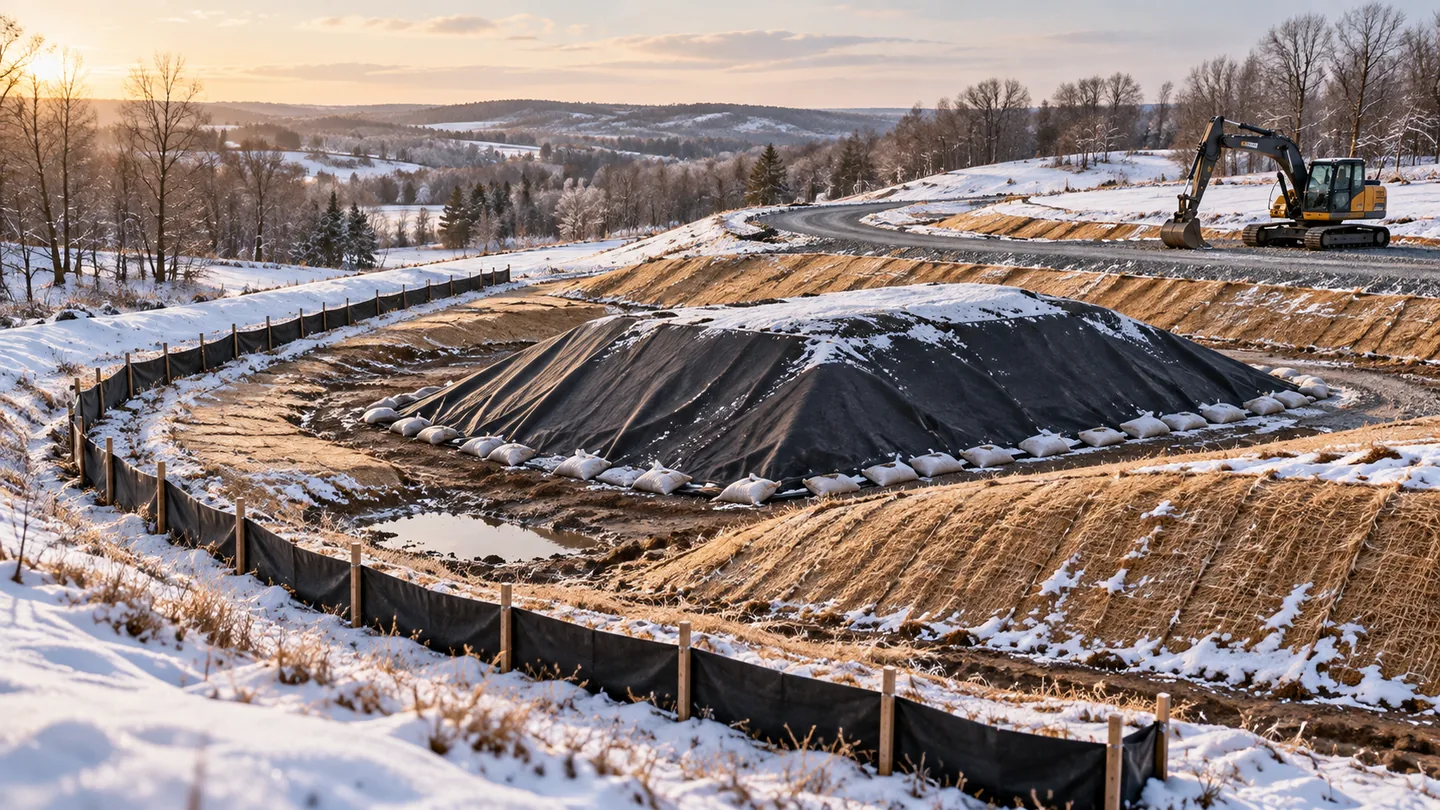
Plan the shutdown. Prepare for the thaw. Snow cover does not replace stabilization or an accountable response team.
In Ontario, winter ESC planning means protecting exposed soil, preserving drainage routes and assigning inspections before snow hides the conditions that matter. The useful question is how the site will handle water while crews are away and when work resumes.
One winter ESC plan. Three seasonal checkpoints.
Before shutdown
Record exposed soil, complete the planned protection and confirm drainage routes.
During winter
Keep inspection and repair access available. Respond when weather or site conditions change.
At spring restart
Review thaw conditions and damaged controls before the next construction phase begins.
Three decisions before the first hard freeze
- Decide which areas will remain active, which will close and how each area will shed water.
- Arrange protection that can work before vegetation establishes, with room for inspection and repairs.
- Name the people responsible for weather checks, site access, corrective work and restart decisions.
Why a winter ESC plan needs its own review
Seasonal preparation is more than adding a winter note to a summer drawing. The contractor may reduce staffing, move a haul route or leave a stockpile unused for months. Meanwhile, the land continues to receive rain and snow. Those changes can alter both the water route and the ability to respond.
The Toronto and Region Conservation Authority’s urban-construction ESC guidance identifies snowmelt over frozen soils as a late-winter and early-spring erosion risk. It also notes the challenge of stabilizing disturbed ground when growing conditions are poor. Therefore, seasonal planning should consider the surface that will actually exist at thaw, not just the intended finished landscape.
Winter erosion control on frozen ground
A firm surface during one visit can give a misleading impression of stability. Sun exposure, rainfall and changing temperatures may produce different conditions across the same property. A south-facing slope, shaded access road and compacted low point can respond differently.
For planning purposes, separate the condition observed today from the condition the controls must manage later. Record exposed soil, drainage restrictions and unfinished restoration before they become difficult to see. Then identify the changes that require another inspection rather than assuming the initial shutdown review lasts all winter.
Winter ESC planning for shutdown and active work
A closed work area needs protection and a maintenance arrangement. An active area also needs coordination with deliveries, excavation, stockpile use and snow clearing. Combining both under one vague instruction can leave gaps between the drawing and daily operations.
Show those two conditions clearly on the winter ESC plan. If only part of the property closes, identify the access and drainage connections between the active and inactive areas. For example, a delivery route should not cross a protected surface simply because the usual gate becomes snowbound.
Prepare the winter ESC plan before shutdown
Start with a current plan and a site walk-through, where that forms part of the agreed assignment. Compare the actual disturbed area with the latest drawings. A winter drawing based on an earlier excavation stage may miss the stockpile, temporary ramp or unfinished trench now controlling runoff.
Bring the contractor’s intended shutdown date and winter activities into that review. The design team needs to know whether deliveries, pumping or utility work will continue. Also identify areas that cannot receive their final surface before the break, so temporary protection can be planned deliberately.
Collect the inputs for winter ESC planning
Useful inputs include the current survey, grading plan, ESC drawing, construction staging and applicable approval conditions. Add dated photographs of drainage paths, exposed slopes, inlets and stockpiles. Photographs help explain conditions, but they do not replace levels or other information needed for engineering design.
Ask which temporary works will remain and which the contractor intends to remove. In addition, confirm who controls adjacent land and receiving infrastructure. A water route that looks convenient on a drawing may cross property the project has no right to use.
Sequence the winter erosion control work
List the tasks that need to happen before the site becomes difficult to access. These may include completing approved surface protection, clearing accumulated sediment and making control locations visible. Agree how the team will check completion before crews leave.
Do not treat ordering material as completing stabilization. The installed arrangement must match the selected detail and actual surface. If weather prevents the intended approach, refer the issue back for a suitable alternative. A last-minute material substitution can change anchorage, drainage or maintenance needs.
Match winter erosion control plans to exposed soil
Erosion controls protect soil at its source, while sediment controls manage material after water has carried it away. The Sustainable Technologies Evaluation Program’s ESC resource explains this distinction and the value of using multiple barriers. A perimeter fence alone is not a substitute for protecting an exposed slope.
The winter ESC plan should identify what remains bare and why. Consider the surface gradient, soil characteristics, flow concentration and expected duration of exposure. Then select compatible protection with the responsible designer, rather than assuming one blanket or mulch product suits every location.
Plan for protection before vegetation establishes
Newly placed seed is not the same as established ground cover. If the site relies on future growth, explain how the soil will remain protected in the meantime. Temporary protection and final restoration should connect without leaving an unplanned gap.
Confirm the selected product’s installation conditions and anchorage details. A measure that cannot contact the ground properly may not function as intended. Also identify how the site team will recognize displacement, exposed edges or damage and arrange repairs without disturbing neighbouring controls.
Plan winter erosion control for stockpiles
A stockpile needs a defined location, protection method and runoff route. Allow for the way the contractor will use it during winter. If material remains in demand, the plan should explain how access and re-protection will work rather than showing a cover that cannot remain in place.
Keep inspection and maintenance access practical. A stockpile squeezed against a fence or drainage feature can leave little room to repair either. Before shutdown, compare the actual pile footprint with the drawing and confirm that its protective measures remain accessible.
Shutdown walk-through: a practical record
- Mark the current disturbed limits and photograph unfinished surfaces.
- Record installed protection and any defects needing correction.
- Check the intended water route through to its accepted destination.
- Confirm control locations, snow storage and maintenance access.
- Assign outstanding actions, responsible parties and follow-up checks.
Use this record alongside the project’s approved inspection requirements, not as a replacement for them.
Show drainage routes in the winter ESC plan
Trace water through the site instead of reviewing each control in isolation. Begin with the upslope catchment, follow the temporary route and identify the receiving point. This exercise often reveals whether a stockpile, access ramp or snow-storage area conflicts with the intended flow.
Where feasible, the design can keep cleaner runoff separate from disturbed ground. However, diversion still needs a suitable destination. The objective is not to send a problem beyond the site boundary. Review potential effects on neighbours, public access and sensitive features.
Coordinate snow storage in the winter ESC plan
Snow storage is a layout decision, not leftover space on the drawing. Identify where snow-clearing equipment will travel and where accumulated snow can remain without covering controls or obstructing the planned route. Review that arrangement with the contractor responsible for clearing.
Where snow contains soil from active work areas, consider the sediment that may remain after melting. The storage arrangement should fit the site’s ESC approach and receiving conditions. Avoid assuming that every apparently open corner of the property is a suitable place to push snow.
Review inlets, low points and overflow routes together
An inlet protection measure can affect how water approaches or bypasses an inlet. Therefore, its location should be considered with surrounding levels and the consequences of ponding. An isolated standard detail does not explain where excess water goes.
Record the intended bypass or overflow route where the design requires one. Also identify what the inspector should report if that route becomes obstructed. Clearing or changing a route can affect downstream conditions, so substantial alterations need coordinated review rather than an improvised field fix.
Include ongoing winter work in the ESC plan
When construction continues, the seasonal arrangement needs to keep pace with actual disturbance. A protected area may reopen, a delivery route may move or a new excavation may collect water. Each change should feed back into the working plan and inspection record.
Discuss space requirements before mobilizing another activity. Materials, equipment and snow can compete for the same area reserved for runoff treatment or maintenance. A coordinated layout makes those conflicts visible while there is still an opportunity to resolve them.
Do not let traffic erase the protection strategy
Identify access routes that the contractor can maintain without driving across protected soil. The site team should report rutting, displaced controls and sediment tracking so the responsible parties can respond. Repeated damage at the same location suggests a layout or operational problem, not just a recurring repair task.
If access changes, review the drainage consequences as well. A temporary track can become an unintended water route through the site. Therefore, a winter ESC plan should connect vehicle movement with surface protection and runoff management, rather than treating traffic as a separate drawing layer.
Where sediment accumulates, the maintenance arrangement needs to preserve the control’s intended function and safe access. Ice or snow can make a visual estimate incomplete. Record what could actually be inspected and arrange follow-up when the hidden area can be assessed safely. An inaccessible component should not receive an unsupported pass in the inspection record.
Keep pumping within its agreed scope
If temporary pumping continues, review the operating arrangement, treatment needs and accepted discharge location. A nearby inlet does not by itself establish permission to discharge. Water-taking and discharge requirements depend on the activity and receiving system.
Coordinate winter access and equipment limitations with the responsible specialist and contractor. The ESC drawing can show the interfaces, but it should not replace a required water-taking or discharge assessment. If the source, quantity or destination changes, obtain the relevant review before relying on the earlier arrangement.
Inspection and response in a winter ESC plan
Set the inspection arrangement before shutdown, including who can enter the site and who can authorize corrective work. A telephone number alone is not a response plan if nobody has access to equipment, materials or the current drawings.
The Sustainable Technologies Evaluation Program’s ESC guidance includes inspection before winter shutdown to prepare for freezing conditions and thaws. Apply the project’s permit conditions and authority requirements when establishing the actual inspection frequency and weather-response triggers; do not adopt one province-wide timetable from a general article.
Make winter ESC plan inspections actionable
A useful record identifies the location, observed condition, likely consequence and action required. Add photographs where they help, together with the date and responsible person. “Fence damaged near gate” is less useful than a marked location linked to a repair assignment and follow-up record.
Separate an observation from a design change. The inspector can identify a recurring problem, while the appropriate professional evaluates changes that affect the approved arrangement. This distinction helps the contractor correct defects without silently redesigning the drainage system.
Prepare for a thaw before it starts
Use forecast information to prompt a site-specific readiness check, particularly when rain may coincide with melting snow. Confirm access, the visibility of controls and the ability to respond if conditions change. The forecast supports planning; it does not establish the quantity of runoff a design must accommodate.
After the event, compare actual water movement with the intended route. Look for bypassing, newly exposed soil and sediment accumulation that changes control performance. Where safe observation during an event is possible under the site’s procedures, it can help explain a recurring issue.
A simple response chain
- Observe: record the condition and its location using the site’s reporting procedure.
- Escalate: contact the responsible site lead and relevant professional or authority where required.
- Correct: carry out authorized measures through the parties responsible for the work.
- Verify: check the result, update the record and identify any further design review.
Keep emergency arrangements separate and clear
The winter ESC plan should refer to the site’s response procedures for releases, spills and other urgent events. Those procedures need current contacts and responsibilities. They should also identify the reporting duties that apply to the particular event and jurisdiction.
Routine maintenance and an environmental incident are not interchangeable. If water leaves the intended treatment route or affects a sensitive receiver, follow the established escalation process. Do not wait for the next routine progress meeting to decide who owns the issue.
Use spring restart as a new inspection point
A restart date on the construction programme does not establish that the ground and controls are ready. Review the actual site after thaw, including exposed surfaces, drainage routes and accumulated sediment. Check for changes hidden by snow during earlier visits.
Compare the proposed restart activity with the winter ESC plan. New equipment movements or excavation can disturb protection that was suitable during shutdown. Agree which controls stay, which need repair and which changes require an updated drawing before the work expands.
Restore protection before reopening more ground
Where the seasonal review identifies damaged measures, include their correction in the restart sequence. Also check whether temporary surface protection remains suitable until permanent restoration can take over. Avoid removing a temporary measure merely because the calendar says spring.
Consider how access for repairs fits with the first planned deliveries. If the same route serves both activities, coordinate them rather than forcing the repair crew to work around uncontrolled traffic. A clear sequence can make the plan easier to implement without adding unnecessary complexity.
Document the handover back to active construction
Record the inspection outcome, completed corrective actions and any remaining restrictions. Give the contractor the current drawing issue and explain what changed. Withdraw superseded instructions from the working set through the project’s normal document-control process.
The handover should name the next inspection responsibilities and the conditions that require another review. This closes the winter period without losing lessons from thaw events. Repeated bypassing or damage should inform the active-stage arrangement rather than disappearing into an archived checklist.
Resolve the approval and document questions early
Before issuing a seasonal update, identify the documents that govern the work. The owner may have a municipal site-alteration approval, an approved site plan, conservation-authority conditions or other project requirements. The applicable set depends on the location and activity; not every site has the same approvals.
Make a short register of the relevant drawing numbers, approval dates and conditions that affect ESC. Then identify the person who can confirm whether a proposed change needs submission. This is especially helpful when the original project team and the winter contractor are different organizations.
Separate a clarification from a changed design
A request to explain an existing note is different from moving a drainage outlet or altering the protected area. Describe the proposed change clearly, including why the contractor wants it and when it would occur. That gives the responsible reviewer enough context to decide the next step.
Keep the response with the current drawing set. Verbal instructions can become unclear when crews change or a site closes for several weeks. A dated written record helps the returning team distinguish an accepted revision from an option discussed but never adopted.
Plan the resources needed to carry out the design
The owner and contractor should allow for installation, access, inspection and corrective work when planning the winter budget. A low initial material cost does not describe the full effort if a control needs repeated repairs or becomes difficult to reach. Ask the construction team to consider those practical costs alongside the drawing requirements.
Engineering fees also depend on the information available and the work required. Updating a coordinated current plan differs from resolving missing survey information or reviewing a substantially changed site layout. A proposal should identify the included deliverables, assumptions and additional services, without implying a universal fixed fee or completion period.
Three seasonal decisions, three different records
| Stage | Decision | Useful record |
|---|---|---|
| Before shutdown | What protection remains while staffing reduces? | Current drawing, installation check and assigned outstanding actions. |
| Midwinter thaw | Does actual runoff follow the intended route? | Event observations, maintenance actions and any design referral. |
| Spring restart | Can the next activity proceed with suitable controls? | Restart inspection, repaired measures and current drawing issue. |
A shutdown handover example: stockpile access and snow storage
Consider a hypothetical site where most excavation stops for winter but a small crew still needs material from one stockpile. The contractor proposes pushing snow into the same corner used to reach the downslope sediment controls. That creates a coordination question before shutdown: can the stockpile remain usable without blocking maintenance access or disturbing protected ground?
Mark the stockpile access, intended snow-storage area and inspection route together on the current plan. Check them against the temporary drainage route and receiving point. If the spaces conflict, resolve the layout with the responsible designer and contractor before snow clearing begins.
What belongs in the handover record?
Record which face of the stockpile will remain accessible and how protection will be restored after use. Identify the route inspectors will use and who will keep it available. Attach photographs of installed measures, together with outstanding actions and the people responsible for completing them.
Elmid Design Inc. can help coordinate these interfaces in a winter ESC drawing and supporting notes. The engineering package can identify protected areas, drainage connections and installation details relevant to the proposed work. The owner and contractor can then use the current drawing to organize access, maintenance and spring restart.
How Elmid Design Inc. can help with your winter ESC plan
Elmid Design Inc. provides engineering and design consulting for erosion and sediment control, grading and related site drainage. A seasonal assignment starts by understanding the proposed work, current site condition and review requirements. The aim is a coordinated package that addresses the actual shutdown and restart sequence.
For an existing project, the review can compare current drawings with updated contractor information. It can identify where a changed stockpile, access route or unfinished surface affects the seasonal approach. The resulting design work should focus on those relevant interfaces rather than recreating unrelated parts of the project.
Winter ESC plan drawings and design deliverables
Depending on the assignment, deliverables may include a winter ESC plan, protection details, temporary drainage coordination and notes for inspection or maintenance responsibilities. Supporting design information can explain the assumptions behind selected measures and identify the specialist inputs still required.
Where the authority requests clarification, Elmid Design Inc. can prepare drawing revisions and responses within the agreed scope. The package should distinguish confirmed site information from matters requiring further investigation. That distinction helps the owner obtain the right input before the contractor relies on the design.
Coordination without confusing responsibilities
Engineering design, construction supervision and routine ESC inspections are separate services unless the proposal expressly combines them. Any site attendance, monitoring or construction-stage review should have a defined purpose, frequency and reporting arrangement. Clear scope prevents a drawing assignment from being mistaken for continuous site coverage.
The contractor remains responsible for its construction methods, installation and maintenance obligations. Municipalities and other authorities make their own review and approval decisions. Elmid Design Inc. supports that process with appropriate engineering documents; it does not issue municipal permits or guarantee approval.
What to send when requesting a proposal
Provide the property address, current site and grading plans, latest ESC drawings and relevant approval conditions. Include the intended shutdown period, work continuing through winter and the expected restart activities. Dated photographs can help explain practical issues that are difficult to describe.
Also identify your main concern, such as an exposed slope, constrained snow-storage area or changing drainage route. Elmid Design Inc. can use that information to clarify the engineering scope and required inputs. A focused brief makes the proposal more useful than a request for a generic winter note.
Frequently Asked Questions
Does every Ontario project need a separate winter ESC permit?
No single permit name applies to every project. The required documents depend on the proposed work, existing approvals, municipality and other reviewing authorities. Ask whether a seasonal drawing update or additional submission is needed for your particular site.
Can we stop inspections when construction shuts down?
Do not assume that stopping construction ends inspection duties. Check the applicable approvals and agreed inspection programme, including inactive periods and weather-related triggers. Arrange access and response responsibilities before the usual site team leaves.
Is snow cover enough to stabilize exposed soil?
Snow cover should not be treated as the project’s stabilization method. The winter ESC plan needs to address the soil condition when snow melts and runoff occurs. Select suitable protection with the responsible designer and check it against actual installation conditions.
Can silt fence be installed after the ground freezes?
The installation method needs review where frozen ground prevents the specified detail. TRCA’s guide discusses a frozen-soil alternative when trenching cannot be achieved, but suitability still depends on the site and selected system. Do not simply omit the anchorage or ground-contact requirements.
Useful distinction: a shutdown inspection checks the site left behind; a restart inspection checks the site the next construction activity will enter. Both belong in the seasonal handover.
Should controls come out as soon as spring construction begins?
No. Keep the required protection until the approved sequence and stabilization conditions support its removal or replacement. Restart may increase disturbance, so it is often a point for renewed review rather than automatic decommissioning.
Can Elmid Design Inc. install the winter controls?
Elmid Design Inc. provides engineering and design consulting, not installation contracting. The company can prepare and coordinate relevant drawings and define any separately agreed review services. The owner should arrange installation and maintenance through the appropriate construction parties.
Official guidance and project-specific requirements
ESC requirements vary by municipality, approval authority and construction stage. Elmid Design Inc. can review your project details and prepare an erosion and sediment control plan suited to the proposed work.
Start with TRCA’s technical guidelines and ESC submission resources and the STEP erosion and sediment control resource. For a site within another jurisdiction, confirm the corresponding authority’s current requirements and the conditions already attached to the project.
Geographic Locations That We Service:
Elmid Design Inc. provides erosion and sediment control planning, grading coordination and related engineering design services for proposed construction in Ontario. The project-specific scope reflects the work, site conditions and applicable authority requirements.
We provide engineering services across a wide range of municipalities, each with its own requirements and review processes.
Toronto and Surrounding Areas
We provide engineering services in Toronto and provide grading engineering resources through our Toronto grading plan page.
Our service area also includes Oshawa, Pickering with our Pickering grading plan resources, and Clarington.
We also provide engineering services in Ajax through our Ajax grading plan resources, Whitby, Brock, Scugog, and Uxbridge, including our Uxbridge grading plan resources.
Halton Region
Within Halton Region, we provide engineering services in Burlington, including projects requiring Burlington grading plans.
We also provide engineering services in Halton Hills, supported by our Halton Hills grading plan resources.
Our service area also includes Milton and Oakville, including our Oakville grading plan resources.
Peel Region
Within Peel Region, we provide engineering services in Brampton, including projects requiring Brampton grading plans.
We also provide engineering services in Mississauga through our Mississauga grading plan resources and Caledon through our Caledon grading plan resources.
York Region
Within York Region, we provide engineering services in Vaughan and provide information about Vaughan grading plans.
We also provide engineering services in Aurora through our Aurora grading plan resources and East Gwillimbury through our East Gwillimbury grading plan resources.
Additional service areas include Georgina with our Georgina grading plan resources, Markham with our Markham grading plan resources, and Newmarket with our Newmarket grading plan resources.
We also provide engineering services in Richmond Hill with our Richmond Hill grading plan resources, Whitchurch-Stouffville through our Whitchurch-Stouffville grading plan resources, and King through our King grading plan resources.
Other Southern Ontario Cities and Towns
Our service area also includes Bradford West Gwillimbury.
We provide engineering services in many additional Southern Ontario communities, including Hamilton, St. Catharines, Niagara-on-the-Lake, Brant, Cambridge, Kitchener, Waterloo, and Woodstock.
We also provide engineering services in Guelph, Centre Wellington, Shelburne, Orangeville, New Tecumseth, Essa, Collingwood, Wasaga Beach, and Barrie, including our Barrie grading plan resources.
Additional service areas include Midland, Orillia with our Orillia grading plan resources, Ramara, Minden Hills, North Kawartha, Kawartha Lakes, Peterborough, Selwyn, and Brighton.