Construction Dewatering Plan Coordination
Construction Dewatering ESC Plan Ontario
A construction dewatering ESC plan coordinates temporary pumping, sediment treatment, monitoring and the discharge route. In Ontario, water-taking requirements, environmental rules and sewer permissions need separate checks.
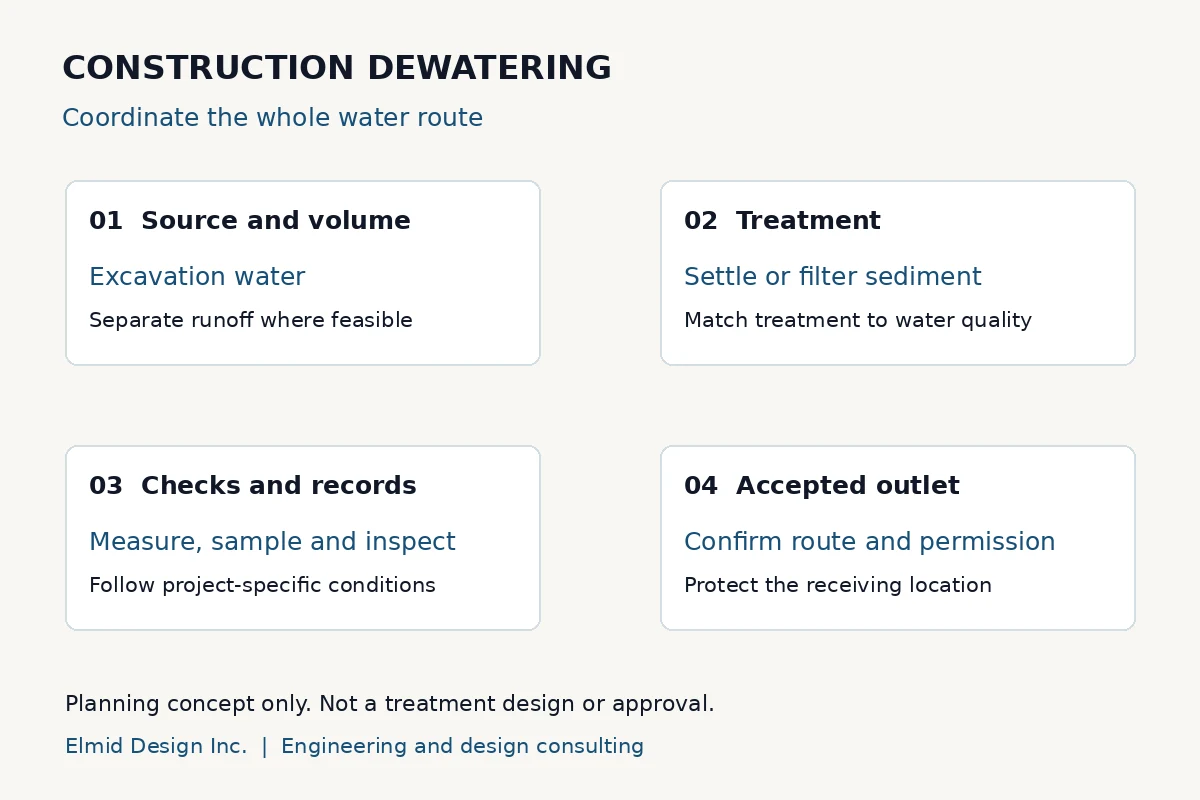
Construction Dewatering Plan: Key Decisions
- Identify the water source, expected quantity and quality before selecting a pumping or discharge arrangement.
- Coordinate the dewatering layout with excavation stages, ESC measures, grading, access and receiving infrastructure.
- Check current Ontario registration or permit requirements; an old pumping-volume chart can give the wrong answer.
- Obtain the applicable discharge permissions and define monitoring before pumping begins.
- Assign specialist reports, installation, inspections and response duties to named parties.
Water taking
Confirm source, quantity and the applicable Ontario route.
Treatment and outlet
Match water quality and flow to a permitted destination.
Site coordination
Align drawings, specialist reports and operating roles.
What Is a Construction Dewatering ESC Plan?
A construction dewatering ESC plan explains how temporary water removal fits into the site’s erosion and sediment controls. It should connect the excavation or collection point to treatment, monitoring and the proposed outlet. That connection matters because a pump can move sediment beyond the work area very quickly.
The package may include a drawing, supporting reports and operating requirements. However, this article uses the phrase as a practical description, not the name of one universal Ontario permit. The exact submissions depend on the water-taking activity, discharge destination, site conditions and reviewing authorities.
For example, an ESC drawing can show the space reserved for treatment equipment and the protected discharge route. A separate qualified-person report may establish the water-taking assessment or discharge recommendations. These documents should agree, while retaining their distinct purposes and professional responsibilities.
Temporary pumping and permanent drainage need separate decisions
Construction dewatering removes water during excavation or other temporary work. Permanent foundation drainage serves the completed building. Likewise, a permanent storm connection and a temporary discharge agreement address different operating conditions.
Do not assume that approval for one arrangement authorizes the other. Instead, identify when temporary pumping starts, how it changes through construction and when it ends. If water removal will continue after construction, investigate that long-term arrangement separately before relying on the temporary plan.
Start the Dewatering Plan With the Water Source
The first design question is where the water comes from. Rainfall collecting in an excavation can behave differently from groundwater entering through soil or rock. A mixed source may need a different assessment from stormwater alone.
Ask the relevant consultant to identify the evidence behind the proposed source classification. An excavation that looks dry during one visit may encounter different conditions later. Similarly, a clear-looking stream from a hose does not establish acceptable water quality.
Existing borehole information, groundwater observations, excavation levels and construction staging can help define the next investigation. Where information is incomplete, record the gap rather than treating an assumption as a measured result. Then confirm who will obtain the missing evidence and when the design can proceed.
Keep clean runoff away where feasible
A practical ESC strategy seeks to reduce avoidable contact between clean runoff and exposed soil. Where the site permits, temporary grading or diversion can help keep external runoff out of the excavation. This may reduce the volume requiring pumping and treatment.
Any diversion still needs a safe destination. Moving water away from the excavation must not create a problem at a neighbouring property, public walkway or unstable slope. Therefore, coordinate temporary routes with the grading plan and access arrangements rather than drawing an isolated arrow toward the boundary.
Estimate the quantity that the system must handle
The team needs a defensible estimate of expected pumping rates, daily quantities and duration. Pump capacity alone is not the same as predicted water taking. A large pump may operate intermittently, while a smaller pump may run for long periods.
Consider how the excavation footprint, depth, weather and construction sequence affect the estimate. Also identify whether several areas will operate at the same time. These assumptions inform regulatory screening, treatment selection, storage needs and the capacity discussion with the receiving authority.
Ontario Water-Taking Rules for Construction Dewatering
Water taking and discharge are separate regulatory questions. Taking more than 50,000 litres on any day generally requires a Permit to Take Water unless an exemption or registration requirement applies. The threshold concerns a single day, not an average. Qualifying construction dewatering above that threshold can require Environmental Activity and Sector Registry registration, commonly called EASR.
The ministry also identifies a distinct treatment for stormwater-only construction dewatering. Qualifying stormwater-only takings above 50,000 litres per day are exempt from registration and a Permit to Take Water, but still require a qualified-person discharge report and implementation of its recommendations. Review the current Ontario water-taking guide rather than reusing an old threshold table.
Confirm the applicable route before mobilization
Ask the responsible specialist to document the water source, relevant criteria and chosen regulatory route. Some activities fall outside EASR eligibility. A threshold calculation alone does not settle every case, and the project team must consider the full regulatory framework.
Keep the supporting reports and registration information aligned with the actual construction arrangement. If the source, taking area or predicted activity changes, seek review before assuming the existing assessment remains valid. This is particularly important when excavation work reveals conditions that differ from the original investigation.
For the governing text, consult Ontario Regulation 63/16 together with the water-taking framework. The ministry’s final 2025 decision explains the removal of the former upper limit.
Check Sewage-Works Approval Exemptions Separately
Ontario has separate approval exemptions for qualifying temporary stormwater ESC works and qualifying construction-dewatering sewage works. These provisions answer a different question from water-taking registration. They also do not remove other environmental duties or municipal discharge conditions.
Section 3.1 of Ontario Regulation 525/98 addresses temporary stormwater works used solely for erosion and sediment control during construction. Its conditions include removal or decommissioning within 90 days after construction ends. The site must not be directly associated with mining, mine development, mine reclamation, pits or quarries.
This provision took effect on September 1, 2026. Check the enacted amendment, Ontario Regulation 250/26, and the current approval-exemption regulation before relying on it. The word “temporary” alone does not establish eligibility.
Groundwater dewatering works have a different provision
Section 6 addresses systems collecting, conveying, treating and disposing of groundwater and stormwater solely to create and maintain dewatered work areas. Where a Permit to Take Water is required, that permit must have been issued for the exemption to apply. Review the complete conditions for the actual system.
Do not automatically transfer section 3.1’s 90-day condition to every groundwater treatment system. Equally, do not call a mixed groundwater-treatment installation a stormwater ESC facility simply because it contains a sediment tank. The water source and purpose matter to the assessment.
Keep a short approval record identifying the provision relied on, supporting evidence and responsible reviewer. This helps later team members understand why the selected route applies. If the intended use changes or becomes permanent, revisit the assessment rather than extending a construction-stage assumption.
Who Prepares the Dewatering Reports?
A civil engineering drawing and a hydrogeological water-taking assessment are different deliverables. The team should identify the required professional qualifications for each report before commissioning the work. Do not assume that every engineering licence establishes eligibility for every regulated dewatering assessment.
For a construction-dewatering water-taking report, Ontario Regulation 63/16 identifies a qualifying professional geoscientist or a professional engineer meeting the relevant geoscience criterion. The discharge-report qualification provisions are broader. In both cases, the author must have the applicable competence and meet the governing requirements.
A hydrogeological consultant may assess groundwater conditions, predicted water taking and potential effects on surrounding receptors. An environmental consultant may assess water quality and treatment or disposal considerations within the assignment. Geotechnical and structural specialists may address ground behaviour and excavation-related risks.
Define Elmid Design Inc.’s civil engineering interface
Elmid Design Inc. provides professional engineering and design consulting, including ESC planning and related civil design. A project proposal should define the drawing coordination and engineering services included. It should also identify the separate specialist information that the owner must provide.
Elmid Design Inc. holds a Certificate of Authorization from Professional Engineers Ontario (PEO). The company’s About Us page provides its professional background. This credential does not replace the project-specific qualification requirements for specialist reports or imply approval of a particular dewatering scheme.
The contractor’s role remains distinct. Equipment supply, installation, pumping, maintenance and construction operations belong in the construction scope. Agree separately on any engineering review or site attendance; a design assignment does not automatically include continuous supervision.
Choose the Discharge Destination Before the Pump
The outlet can control the entire construction dewatering plan. A site may have limited room for treatment, a restricted sewer connection or no acceptable nearby discharge point. Resolving that issue early can prevent an otherwise workable excavation plan from becoming impractical.
Potential routes require different investigations. A municipal sewer needs the receiving authority’s permission and conditions. Discharge to land or surface water raises questions about receiving conditions, erosion, water quality and applicable environmental requirements. Off-site removal introduces separate receiving-facility and transport arrangements.
Do not treat these options as interchangeable. First identify the preferred destination and who controls it. Then obtain the evidence needed to assess that route. Only after those conditions are understood should the team finalize equipment space, hose routing and the operating plan.
Treatment and Sediment Control in the Dewatering Plan
Treatment should respond to the actual water and the receiving requirements. Sediment removal may involve settling, filtration or a combination of measures. However, a standard detail does not establish that a particular device can handle the site’s flow or water-quality conditions.
Ask the designer or treatment specialist to state the assumed flow, performance basis and maintenance needs. Also identify what happens when treatment capacity falls or the collected sediment needs removal. The plan should reserve enough accessible space for operation, inspection and servicing.
The TRCA urban-construction ESC guide discusses multi-barrier dewatering controls. Its technical examples are useful, but older regulatory thresholds must be checked against current law.
A filter bag is not a universal treatment solution. Fine particles can remain suspended, and dissolved contaminants require a different assessment from visible sediment. Where sampling identifies a concern beyond sediment, obtain appropriate environmental advice before selecting a treatment train or discharge route.
Prevent erosion at the outlet
Water that meets a quality requirement can still erode the discharge area. Outlet protection therefore needs to consider flow concentration, velocity, ground condition and the receiving route. A hose aimed at bare soil can undermine nearby controls or carry newly disturbed material away.
Show the intended receiving location and protection on the coordinated plan. Check whether the route crosses pedestrian areas, haul roads or property boundaries. Where an outlet must move as work progresses, establish how the revised location will be reviewed before use.
Keep ESC controls and treatment accessible
Treatment equipment competes for space with shoring, stockpiles, deliveries and machinery. A layout that works on paper may fail once materials occupy the access aisle. Therefore, check the proposed arrangement against the contractor’s current staging information.
Allow access for sediment removal and equipment servicing without dismantling unrelated controls. Also consider how hoses and temporary lines remain protected from traffic. These are coordination questions, not permission to improvise a new treatment arrangement after pumping has started.
What Should the Construction Dewatering ESC Drawing Show?
A useful drawing makes the water route and its limits understandable to the site team. It should reference the supporting reports and avoid conflicting instructions. If a report controls a design criterion, identify the relevant document and current revision clearly.
Typical coordination items include:
- Excavation limits, stages, collection points and nearby sensitive features.
- Pumping and treatment locations, with the required operating space.
- Temporary conveyance routes and the proposed accepted discharge point.
- ESC measures, outlet protection and clean-water diversion arrangements.
- Monitoring locations, inspection access and responsibility notes.
- References to the applicable reports, permissions and response procedures.
The final contents depend on the assignment and reviewing authority. Do not copy every item into a drawing if it creates unsupported design commitments. Instead, confirm who owns each component and coordinate the relevant information into one consistent package.
Use one current set of assumptions
Check that the excavation level agrees with the groundwater assessment. Confirm that the discharge point agrees with the permit application. Then compare treatment space with the current construction logistics plan.
A revision register helps the team track these interfaces. For example, a deeper excavation may affect predicted inflow and the treatment arrangement. A changed crane or delivery area may block maintenance access. Identify those changes early so the responsible designer can assess them before the site relies on superseded information.
Construction Dewatering Plan Monitoring and Response
A construction dewatering ESC plan needs an operating framework as well as a layout. The team should know what to check, where to record results and who has authority to respond. These duties must remain clear during shift changes, weekends and changes in subcontractors.
The applicable report, permit or agreement should establish the required measurements and acceptance conditions. Depending on the project, the records may address pumping quantities, water quality, equipment condition and the receiving location. Avoid inventing one sampling schedule or numerical discharge limit for all Ontario sites.
Make the monitoring locations usable
A sampling point should represent the discharge being assessed and remain accessible during operation. If the layout changes, confirm whether the original point still serves that purpose. Similarly, measurement equipment needs an arrangement that allows reliable readings and routine checks.
Record the date, operating conditions and relevant observations with each result. Those details help explain changes over time. A result without context may be difficult to interpret, particularly after heavy rain, an equipment adjustment or a change in the excavation stage.
For work near fish-bearing water, also review the federal measures to protect fish and fish habitat. These address sediment controls and their maintenance; they do not replace Ontario or municipal permissions.
Plan the response before a problem occurs
The project team should establish what happens if treatment stops performing, water quality changes or the receiving location shows distress. Identify the responsible contact and the appropriate escalation route. The response must account for both environmental protection and excavation safety.
Construction Stages, Weather and Closeout
The temporary water-management arrangement should follow the construction sequence. Early excavation, foundation work, backfilling and site restoration may each create different collection points and discharge needs. A single unchanged sketch may not describe the full project.
Before a stage changes, review the current ESC layout and treatment access. Confirm that new work does not block the outlet or remove a control still needed elsewhere. Then issue the relevant revised information to the parties responsible for operating and inspecting the system.
Weather planning also needs a site-specific approach. Consider how forecast rainfall, freezing conditions or reduced access could affect the arrangement. The objective is to identify constraints early, not to assume one generic winter or storm detail will suit every property.
Separate temporary works from the permanent system
At closeout, confirm when temporary pumping and treatment can end and who authorizes each removal step. Restore affected areas and address accumulated sediment through the appropriate project arrangements. Keep the applicable records and closeout evidence with the project file.
If a temporary facility will remain in service, assess its permanent role separately. Do not assume that construction-stage permission continues indefinitely. The owner, consultants and receiving authority should agree on the required transition before construction is considered complete.
Inputs for a Construction Dewatering Plan
A focused inquiry helps define a realistic engineering scope. Send the available information rather than waiting for a perfect package, but identify what is preliminary. This allows the consultants to distinguish existing evidence from work still required.
Useful starting documents include:
- The survey
- The proposed site layout and excavation depths
- Geotechnical or groundwater information
- The construction schedule
- Relevant municipal comments and any earlier discharge correspondence
- An environmental report, if one exists, so the appropriate consultant can review its relevance
Explain the proposed outlet and whether permission has been discussed. Also identify who will provide specialist reports and who will operate the pumping system. These decisions affect coordination effort, review timing and the information that the civil designer can reasonably rely on.
A practical pre-start review
Before mobilization, bring the owner, civil designer, relevant specialists and contractor together around the same drawing set. Confirm that the reports describe the proposed excavation and that the selected outlet matches the receiving authority’s conditions. Then review how the contractor will implement the agreed arrangement.
A short review can identify conflicts that separate document checks miss. For example, the treatment location may occupy the only delivery route, or the planned sampling point may become inaccessible behind a stockpile. Resolve those constraints before they become daily operating problems.
Close the review with a record of decisions and outstanding items. Assign each unresolved question to a person and identify the evidence needed to close it. An item marked “to be confirmed” should not silently become an accepted construction assumption.
What affects fees and timing?
There is no reliable universal fee for a construction dewatering ESC plan. Costs depend on the evidence available, complexity, consultant scopes, review requirements and construction-stage changes. Sampling, specialist investigations and treatment operations may sit outside the civil drawing fee.
Ask for a proposal that separates the deliverables and identifies assumptions, exclusions and review allowances. Likewise, distinguish the consultant’s design schedule from authority review and contractor mobilization. An unresolved discharge destination can influence the programme more than the time needed to prepare a drawing.
Dewatering Plan Coordination Mistakes to Avoid
One frequent mistake is choosing a pump before confirming an outlet. Another is treating a general ESC drawing as proof that water taking and discharge are authorized. Both approaches leave critical questions unresolved until equipment reaches the site.
A third mistake is using clear appearance as a substitute for water-quality evidence. Sediment treatment and environmental assessment answer different questions. Accordingly, the team should use the testing and review required for the actual destination, rather than relying on visual inspection alone.
Finally, avoid leaving responsibility notes vague. “Contractor to comply” does not identify who prepares a required report, applies for permission or reviews changed conditions. Set out those roles in the proposal, construction documents and project coordination record before work begins.
Construction Dewatering Plan FAQs
Is an ESC plan the same as a dewatering permit?
No. An ESC plan describes erosion and sediment measures, while water-taking and discharge requirements follow their applicable regulatory processes. A coordinated project may need several documents and permissions. Confirm each requirement rather than treating one stamped drawing as blanket authorization.
Does every construction taking above 400,000 litres per day need a permit?
No. Ontario removed that former upper limit for eligible construction-dewatering EASR registration in July 2025. The correct route depends on the current eligibility criteria and site-specific activity. Ask the responsible qualified person to confirm the applicable process before pumping.
Can a contractor discharge into the nearest catch basin?
Only where the proposed discharge and connection have the necessary permission and meet the applicable conditions. The presence of a catch basin does not establish that it is an acceptable outlet. Confirm the receiving sewer, authority requirements, water quality and operating conditions first.
Does a sediment filter remove every contaminant?
No. A sediment-control device does not establish treatment for every dissolved or other contaminant. Water-quality evidence and the receiving requirements determine the necessary assessment. If contamination is a concern, involve the appropriate environmental specialist before selecting the treatment approach.
Can Elmid Design Inc. install or operate the pumps?
Elmid Design Inc. provides professional engineering and design consulting. Pump supply, installation and operation are contractor activities. The engineering proposal should identify the civil coordination included and any separate specialist assessment, construction review or site attendance required.
What if groundwater conditions change during excavation?
Refer the changed conditions to the responsible specialists and review the existing assumptions. The team may need revised estimates, treatment arrangements or regulatory documentation. A safe response should consider excavation stability as well as discharge protection, rather than relying on an unreviewed field change.
Illustrative Coordination Scenario: A Tight Excavation Site
Consider a hypothetical infill project with limited equipment space and groundwater entering the excavation. This is an illustration of the review sequence, not an Elmid Design Inc. project or a ready-to-build design.
-
The hydrogeological assessment first establishes the relevant groundwater assumptions and water-taking considerations. Meanwhile, the civil team checks how the proposed treatment footprint fits the excavation, access and ESC layout. The owner confirms the intended receiving route with the appropriate authority.
-
Suppose the original equipment location blocks the only safe maintenance access. The team should revise the layout and check the effect on hose routes, treatment access and sampling. Moving the equipment without that review could solve one problem while creating another at the outlet.
-
Now suppose excavation conditions differ from the investigation. The contractor reports the observation, and the responsible specialists assess its implications. The existing drawings, reports and permissions are reviewed together rather than treating the difference as a pump-selection issue alone.
The lesson is straightforward: a workable construction dewatering plan depends on coordinated evidence and responsibilities. The drawing, treatment arrangement, regulatory route and daily operations must describe the same project.
Related Engineering Experience: Clinton Drive Extension
Elmid Design Inc.’s published portfolio includes the Clinton Drive Extension subdivision project in Richmond Hill. It lists functional servicing, stormwater management, water supply analysis, grading and servicing, plan-and-profile, and sanitary and storm drainage work. This is relevant experience in coordinating related civil engineering documents.
The public portfolio does not establish construction-dewatering design, a water-taking approval or pumping operations for that project. Therefore, the example illustrates the wider civil coordination interface only. Any new dewatering assignment needs its own confirmed scope, specialist input and site-specific review.
See the published project portfolio and subdivision ESC service discussion for that context. No private project drawings, client information or approval claims are needed to explain the relationship.
Geographic Locations That We Service:
Explore our Ontario service areas
Our Licensed Professional Engineers provide civil engineering and design consulting, including erosion and sediment control plans, grading, drainage and site servicing. Construction dewatering coordination and any specialist reports are defined separately for each project; service coverage does not establish approval or specialist availability.
We provide engineering services across a wide range of municipalities, each with its own requirements and review processes.
Toronto and Surrounding Areas
We provide engineering services in Toronto and provide grading engineering resources through our Toronto grading plan page.
Our service area also includes Oshawa, Pickering with our Pickering grading plan resources, and Clarington.
We also provide engineering services in Ajax through our Ajax grading plan resources, Whitby, Brock, Scugog, and Uxbridge, including our Uxbridge grading plan resources.
Halton Region
Within Halton Region, we provide engineering services in Burlington, including projects requiring Burlington grading plans.
We also provide engineering services in Halton Hills, supported by our Halton Hills grading plan resources.
Our service area also includes Milton and Oakville, including our Oakville grading plan resources.
Peel Region
Within Peel Region, we provide engineering services in Brampton, including projects requiring Brampton grading plans.
We also provide engineering services in Mississauga through our Mississauga grading plan resources and Caledon through our Caledon grading plan resources.
York Region
Within York Region, we provide engineering services in Vaughan and provide information about Vaughan grading plans.
We also provide engineering services in Aurora through our Aurora grading plan resources and East Gwillimbury through our East Gwillimbury grading plan resources.
Additional service areas include Georgina with our Georgina grading plan resources, Markham with our Markham grading plan resources, and Newmarket with our Newmarket grading plan resources.
We also provide engineering services in Richmond Hill with our Richmond Hill grading plan resources, Whitchurch-Stouffville through our Whitchurch-Stouffville grading plan resources, and King through our King grading plan resources.
Our service area also includes Bradford West Gwillimbury.
Other Southern Ontario Cities and Towns
We provide engineering services in many additional Southern Ontario communities, including Hamilton, St. Catharines, Niagara-on-the-Lake, Brant, Cambridge, Kitchener, Waterloo, and Woodstock.
We also provide engineering services in Guelph, Centre Wellington, Shelburne, Orangeville, New Tecumseth, Essa, Collingwood, Wasaga Beach, and Barrie, including our Barrie grading plan resources.
Additional service areas include Midland, Orillia with our Orillia grading plan resources, Ramara, Minden Hills, North Kawartha, Kawartha Lakes, Peterborough, Selwyn, and Brighton.