
Watermain Material Selection in Toronto
Watermain material selection in Toronto connects the proposed asset, site evidence and current specifications. Coordinate pipe components, specialist findings and drawing details without assuming that one material suits every property.
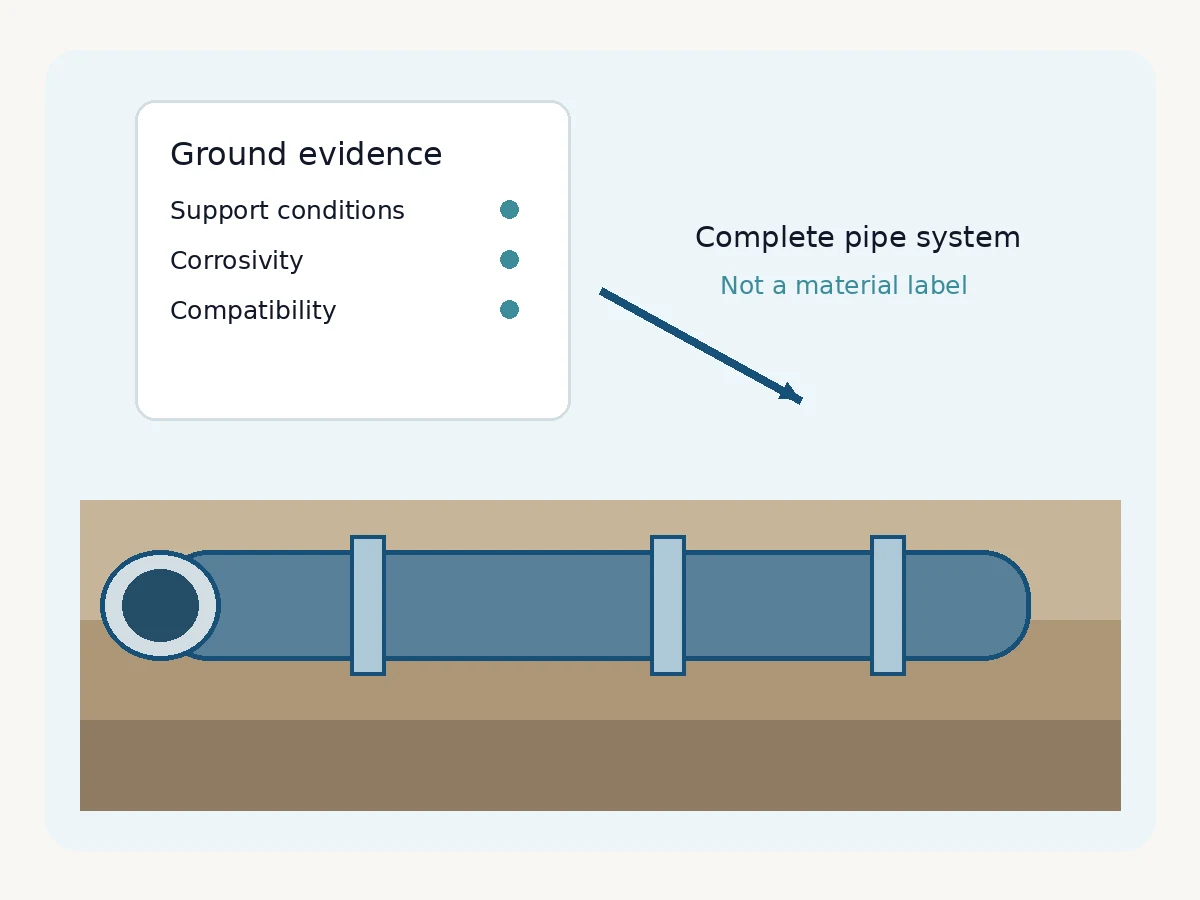
Key takeaways
- Watermain material selection needs a defined asset, site evidence and the applicable specifications.
- Soil corrosivity, contamination and structural support are separate questions, even when one investigation supplies relevant information.
- A pipe material does not establish water capacity, ownership or permission to connect.
- Coordinate fittings, joints, protection and transitions rather than specifying only the pipe barrel.
- Keep specialist investigation, construction methods and authority acceptance separate from civil drawing coordination.
Start watermain material selection with the asset boundary
Before comparing pipe materials, identify exactly which infrastructure the project is proposing. A municipal distribution main, a private network and a building service connection can have different governing requirements. The location of a pipe on a drawing does not settle those distinctions. Establish the asset boundary and intended function before selecting a specification.
This Toronto guide concerns watermain material selection as an engineering information and drawing-coordination task. It does not provide a universal preferred pipe, installation method or permission to substitute products. The responsible designer must use the applicable project criteria and specialist evidence, with authority review where required.
For a development owner, the useful early question is not simply “PVC or ductile iron?” It is whether the team has enough information to evaluate the proposed system. The answer involves its route, operating conditions, surrounding ground, connections and maintenance context. A material name alone says little about how those conditions will be addressed.
Define the decision that the project actually needs
A concept comparison, an engineering submission and a contractor’s proposed substitution are different decisions. State the purpose of the current review and the information available. A preliminary option can remain useful without being treated as a final specification. Conversely, a late substitution needs more than the same high-level comparison used at concept stage.
Elmid Design Inc. prepares site servicing drawings and civil engineering coordination within an agreed scope. Geotechnical testing, environmental investigation, specialist corrosion assessment and contractor installation procedures need their own qualified responsible parties. Their findings can inform the civil package without implying that one consultant performs every activity.
Private Watermain or Water Service: Define the Network FirstCheck watermain materials against current Toronto specifications
Toronto’s current infrastructure standards index identifies the third edition of the Design Criteria for Sewers and Watermains, dated July 2026. It also links a separate July 2026 Chapter 6 material-specifications document. Use the current index and applicable contract requirements rather than assuming an older downloaded manual remains the controlling reference.
The index describes the design manual’s use for City infrastructure and private-development engineering submissions. That does not mean every provision applies identically to every pipe inside a building or private property. Confirm the scope of the particular asset and review route. Keep the document edition and applicable references visible in the design basis.
The July 2026 material specifications distinguish material types and their associated product requirements. A product category is therefore not a complete specification. The required dimensions, classification, referenced standards and compatible components must come from the applicable design and specifications, not a generic internet comparison.
Resolve conflicting references before issue
A consultant’s standard note, supplier sheet and municipal specification may use different terminology or editions. Identify the difference rather than silently choosing the most convenient wording. Ask the responsible reviewer which requirement governs the proposed work. Record the resolution in the controlled design documents so that the tender package does not retain contradictory instructions.
Also check whether the project has an accepted exception or project-specific condition. Preserve its exact scope and source. An exception for one location or earlier phase does not automatically apply to another section. Where the acceptance basis is unclear, keep the decision open instead of calling the alternative approved.
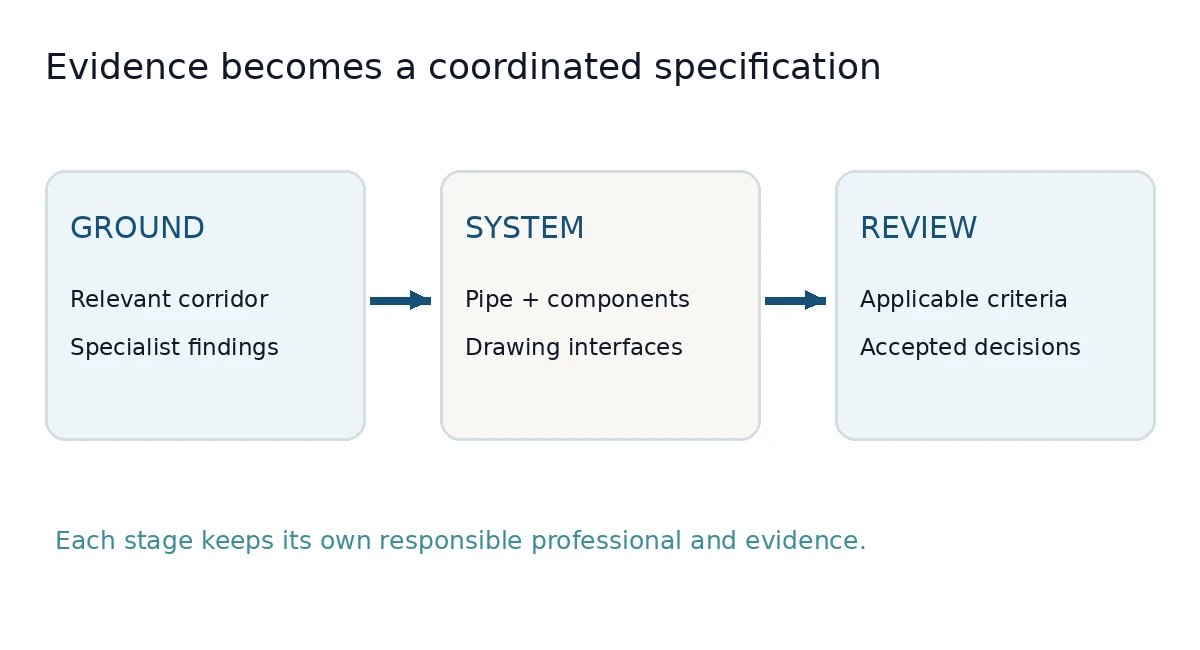
Review ground conditions for watermain material selection
Ground information can answer several different questions. Bearing and support conditions relate to how the pipe and surrounding works behave physically. Corrosivity relates to the interaction between the ground environment and susceptible materials. Contamination raises another set of compatibility and environmental questions. One favourable finding does not settle the others.
Ask the qualified investigation team which parts of its report apply to the proposed route and depth. A result from another part of a large property may not represent the pipe corridor. Similarly, a report prepared for a building foundation may not address every question needed for watermain material selection. Confirm the scope rather than assuming that any geotechnical report is sufficient.
The civil designer should show the proposed route clearly enough for the specialist to relate evidence to the work. Provide the current plan, relevant levels and intended asset description. Where the route changes, ask whether the existing investigation still supports the decision. A shifted line on a plan can move the work beyond the area addressed by the original evidence.
Make missing information specific
“More soil information required” is less useful than a question tied to the proposed design. Identify the unresolved condition, the affected segment and the specialist who should address it. Explain why the answer matters to the material or detail under consideration. This helps the owner arrange appropriate investigation without ordering an unrelated generic report.
Keep factual observations separate from interpretation. A record of fill, an unusual odour or an old industrial use can prompt a qualified review, but it is not itself a complete characterization. Do not turn a site photograph or historical description into a laboratory result. The project file should preserve the original evidence and its limitations.
Engineering design support from Elmid Design Inc.
Elmid Design Inc. provides professional engineering and design consulting for residential, commercial and land development projects in Toronto and the Greater Toronto Area. Site servicing assignments connect the proposed infrastructure with the surrounding site, building interfaces and applicable review documents.
Elmid Design Inc. holds a Certificate of Authorization from Professional Engineers Ontario. This credential does not replace a project-specific authority decision, a specialist’s investigation or a contractor’s responsibility for its assigned work.
Connect corrosivity findings to the watermain drawings
The current Toronto design manual, in its soil-resistivity and corrosiveness section, calls for relevant ground assessment and addresses corrosion-protection appraisal for metallic watermains. It also links the resulting protection details to construction drawings. The project team should use the complete applicable provisions, not isolate one sentence as a universal design rule.
For the owner, the practical task is to connect the specialist’s conclusion to the intended pipe segment. Identify which report and recommendation support the proposed protection approach. Then confirm that the drawing and specification express the same decision. A report left in a folder does not help the contractor if the issued documents omit its applicable requirements.
Do not prescribe a generic protection detail solely because a material is metallic. The responsible professionals must establish the design for the actual conditions and applicable standards. Equally, selecting a non-metallic pipe does not mean the complete system contains no metallic components. Fittings, valves and other interfaces still need coordinated review.
Keep design and verification responsibilities distinct
The drawing should identify the required design information within its scope. Construction verification and any specialist testing need a defined appointment and record. Avoid describing a detail as verified in the field merely because it appears on the plan. The final record should distinguish design intent, installation information and evidence of the required checks.
If a proposed substitution changes a component relevant to corrosion protection, raise it before installation. The supplier’s statement that two products are equivalent may not address every system interface. Send the complete proposal to the responsible designer and reviewer, with enough information to understand the change and its consequences.
Review watermain material compatibility with contamination
Watermain material selection in potentially contaminated ground requires specific evidence, not a general assumption that plastic or metal is always preferable. Identify the contaminants, their relevant conditions and the proposed materials through the appropriate specialist process. Keep the environmental investigation separate from the civil drawing that uses its conclusions.
Toronto’s current manual contains a dedicated discussion of PVC in contaminated soil and calls for identification of contaminants and appropriate manufacturer consultation. Treat that discussion as part of a qualified design review. Do not turn a broad label such as “brownfield” into a product specification, or assume that a generic gasket description resolves every compatibility concern.
The proposed system includes more than the pipe wall. Joints, seals and transitions may have different compatibility questions. Ask whether the submitted product information covers the complete assembly and actual exposure conditions. A statement about the pipe material alone may leave important components outside the review.
Coordinate environmental and civil information carefully
Use only the project information needed by the relevant participants, with appropriate permission. A public article should not disclose private site investigation results or client details. Within the project, keep the current specialist report linked to the decision so that later reviewers can understand its assumptions rather than rely on a short informal email summary.
Where the investigation changes, identify the affected design assumptions. The response may involve further specialist advice, revised material details or another route review. The responsible parties should establish the appropriate action. Do not continue using an earlier compatibility conclusion after the conditions on which it relied have materially changed.
Utility Crossings: Coordinate the Route and Its ConstraintsSelect watermain materials for the complete pipe system
A drawing note containing only a material abbreviation leaves many questions unanswered. The design needs a consistent relationship between the pipe, joints, fittings, connections and applicable protection measures. Use the project’s specifications and standards to establish the required details. A readable schedule can help organize the information without replacing the technical specification.
Consider the transitions between existing and proposed infrastructure. The existing record may identify a material without establishing every dimension or condition needed for the connection. The responsible team should confirm the necessary information through appropriate investigation and review. Do not treat an old schematic as proof of a field condition that has not been checked.
Where a system crosses an ownership or design boundary, make that interface visible. The civil and building designers need to agree on the relevant connection information. A line ending at a building wall should not conceal an unresolved transition. Record who designs each part and how the adjoining documents identify the same point.
Keep pressure and hydraulic decisions in their own analysis
Material selection does not establish water capacity or adequate fire flow. Those conclusions depend on the applicable hydraulic assessment and its evidence. Likewise, a pressure-class notation is not a substitute for checking the system’s design conditions. Coordinate the analyses, but keep their purposes and conclusions distinct.
An owner comparing alternatives should ask whether the same operating assumptions were used. If the pipe size, route or connection changes between options, the comparison is not only about material. Explain those differences before drawing a cost or performance conclusion. Otherwise, a seemingly simple choice can conceal several unrelated design changes.
Watermain material selection: a document chain
- Define the asset and applicable review route.
- Relate specialist ground evidence to the proposed corridor.
- Coordinate the complete material and component specification.
- Resolve interfaces and obtain the required review.
- Carry accepted changes into the final drawings and records.
Make watermain material selection traceable on drawings
The plan, profile, details and specification should describe one coherent arrangement. Use consistent segment identifiers and show where a material or detail changes. The drawing should help a reader locate the relevant requirement without searching several sheets for a disconnected note. Clarity is especially important where existing and proposed works sit close together.
Check that a typical detail actually suits its labelled location. A detail copied from another project can carry assumptions about ground, asset type or authority requirements that do not apply. Review its notes and references, not only its shape. Retain only the detail that the responsible designer has selected for this assignment.
Where a specialist recommendation informs the design, identify its controlled reference in the project package. Avoid copying a fragment of technical advice without its qualifications. The issued civil documents should contain the requirements appropriate to their purpose, while the full supporting report remains available to authorized reviewers.
Use a focused drawing review
Compare the material schedule with every labelled segment. Then check transitions, component references and relevant protection details. Confirm that the plan and profile use the same revision and that a changed alignment has not left an obsolete detail in place. These checks are organizational, but they can reveal significant technical inconsistencies.
Also review the legend and abbreviations. Similar-looking abbreviations can refer to different products or requirements in different documents. Define them once and use them consistently. A clear note is preferable to an unexplained office shorthand that the receiving reviewer must interpret.
Review watermain material substitutions as design changes
A proposed alternative can be reasonable, but it needs review against the actual project requirements. Ask the proposer to identify exactly what changes and what remains the same. Include the relevant product data, component details and stated limitations. A brochure describing a product family may not establish the suitability of the specific proposed assembly.
Do not accept a substitution solely because the material name is familiar or the nominal diameter matches. The designer must consider the applicable specification and affected interfaces. If the alternative changes another design assumption, identify that change explicitly. The review should address the system rather than one isolated item.
Maintain a clear status record: proposed, under review, accepted with conditions or not accepted. A product submission is not permission to install. Where an authority or another designer must review the change, preserve that dependency. Keep the accepted documents together so that the final record does not contain two competing specifications.
Coordinate schedule pressures without bypassing review
Availability can become a real project constraint. Ask the owner and contractor to raise potential supply issues early, with the information needed for review. That gives the team time to assess an alternative. It does not justify treating an unreviewed product as acceptable because a delivery date is approaching.
When an answer depends on missing specialist information, state the precise dependency and responsible party. Avoid an ambiguous “no objection” note that recipients may interpret more broadly than intended. The record should make clear what was reviewed, what was not and which conditions remain outstanding.
Watermain Layout: Why Network Configuration Is a Separate DecisionPreserve accepted watermain materials at handover
The owner’s final record should connect the installed asset information with the accepted design and relevant changes. Use the required project record format and responsible preparers. A final-looking drawing does not by itself prove that every field condition was observed or tested. State the basis and limits of each record accurately.
Keep the relevant product and component information organized by asset or segment. A folder of undifferentiated supplier documents is difficult to use for future maintenance. The owner should be able to identify which information relates to which part of the system without relying on the memory of someone who attended construction meetings.
Commissioning and acceptance records remain separate from the material-selection decision. A suitable specified material does not prove that installation, disinfection or other required procedures were completed. Conversely, a commissioning record does not erase an unresolved design substitution. Keep the documents connected while preserving their distinct purposes.
Project Support
Coordinate site servicing with the building connection, grading, utilities and the evidence supplied by geotechnical and environmental specialists. A clear civil engineering scope identifies the drawings, calculations, review interfaces and construction-stage services actually included.
Compare watermain materials on a like-for-like basis
A useful comparison starts with a common design basis. Record the asset limits, proposed route and operating assumptions once, then identify any differences introduced by an option. If one option requires a different alignment or connection arrangement, make that change visible. Otherwise, the review may attribute an advantage to material when it actually comes from another design choice.
Separate required characteristics from preferences. Applicable specifications and accepted project conditions establish requirements. The owner’s preferences may concern procurement, maintenance familiarity or other project priorities. Both deserve attention, but a preference cannot override a mandatory requirement. Mark unresolved acceptance questions before comparing costs or recommending procurement.
Include the components needed to make each option complete. A bare pipe price is not the same as a system comparison. Relevant fittings, transitions, protection details and review requirements can affect the proposal. Obtain project-specific information from the responsible parties rather than adding a universal cost allowance from an unrelated project.
Do not turn an estimate into a durability guarantee
Service-life claims depend on conditions and supporting evidence. A manufacturer’s general statement may not describe the actual ground, installation or operating environment. Keep any quoted claim attached to its source and limitations. A development article should not promise that a material will last a fixed number of years at an uninvestigated property.
The same care applies to maintenance statements. Ask the intended owner or operator what information and access they need for the selected system. Their requirements can inform the design discussion, but an engineer should not invent an operator’s preferences. Where the receiving owner has established standards, identify and apply the relevant ones.
Resolve watermain material uncertainty before procurement
Watermain material selection often develops in stages. At concept stage, the team may have enough information to reserve a corridor but not enough to finalize every component. State that distinction clearly. The next issue should identify what evidence has become available and which earlier assumptions have been confirmed or changed.
A simple decision register can prevent uncertainty from disappearing between meetings. For each open item, record the affected segment, the missing input and the responsible discipline. Add the design consequence that cannot yet be resolved. This is more useful than a general disclaimer that leaves readers unsure which part of the drawing is conditional.
Keep the register proportional to the work. A small project may need only a few clearly written questions. A complex development may benefit from a more formal interface schedule. The objective is not administrative volume; it is to prevent a provisional choice from becoming an irreversible commitment without the necessary review.
Recognize changes that reopen the decision
A revised ground finding, changed route, different connection or new product proposal can affect the material review. Ask the responsible designer to identify which assumptions are touched. Some changes may leave the original decision valid, while others may require more analysis. The conclusion should be recorded, not inferred from silence.
Changes can also affect adjoining documents. A revised pipe detail may require an update to the plan, profile or specification. A changed connection may need coordination with the building designer. Close the issue only when the affected documents agree and the necessary reviewers have addressed the actual revised arrangement.
What an owner can assemble before requesting design support
Start with the latest site plan and available servicing records, identifying their source and date. Include the relevant municipal correspondence and the current ground-investigation documents where you are authorized to share them with the project team. Do not rewrite specialist conclusions into a short summary that drops the conditions attached to them.
Describe the decision needed in ordinary terms. For example, the team may need to evaluate a proposed new corridor, reconcile conflicting material notes or review a supplier’s alternative. Include the relevant drawing references and the deadline that prompted the question. This helps the consultant distinguish an urgent coordination issue from a request for a complete new design.
Finally, identify the appointed designers, specialist investigators and intended asset owner or operator. Their roles determine which interfaces need attention. A complete brief cannot guarantee approval, but it can make the first engineering discussion more useful and reduce time spent discovering that critical information sits with another participant.
Hypothetical watermain material-selection scenarios
A route moves after the ground investigation
Assume the project team shifts a proposed main to avoid a new landscape feature. The alternative route is only a short distance away, but the investigation report describes the original corridor. The useful next step is to ask the relevant specialist whether the existing evidence supports the new location and depth.
This does not mean every alignment adjustment requires the same investigation. It means the design team should not make that determination from distance alone. Record the specialist’s conclusion and any resulting design condition. Then update the plan and supporting references together so that the package describes one route.
A non-metallic pipe proposal retains metallic components
Assume an owner prefers a non-metallic pipe option and believes corrosion no longer needs discussion. The system still includes fittings and other components that require their own consideration. The review should identify the complete assembly and apply the relevant requirements rather than treating the pipe wall as the whole system.
The result may be an acceptable arrangement with coordinated details. However, the decision needs to come from the applicable design and review process. This example is not a recommendation for a particular material or protection method, and it does not establish the conditions at an actual Elmid Design Inc. project.
A supplier offers an apparently similar replacement
Assume a specified product is unavailable and the contractor proposes another product with the same nominal diameter. The designer first needs the exact proposed component information and the applicable specification. The review then considers the affected connections, details and design assumptions rather than accepting similarity as equivalence.
If the alternative is accepted, the final package should identify it and preserve any conditions. If it remains unresolved, the record should say so. This prevents a product email from becoming an undocumented design change and gives the owner a clearer account of what the team actually reviewed.
How Elmid Design Inc. supports watermain material selection
Elmid Design Inc. prepares site servicing plans and civil engineering coordination documents for agreed development assignments. For watermain material selection, the work can connect the proposed route and asset boundary with applicable specifications, specialist findings and the drawing details needed for review.
Provide the current site layout, available survey and servicing records, relevant ground reports and any municipal comments. Identify whether the question concerns a new design, an existing connection or a proposed substitution. This helps define a useful engineering scope instead of treating every enquiry as a generic pipe comparison.
Specialist investigations, product supply, installation and authority acceptance remain distinct responsibilities. The firm’s design support does not promise that one material suits every Toronto property. It aims to make the selected arrangement technically clear and traceable to the evidence and requirements that apply.
Watermain material selection: frequently asked questions
Is PVC always preferable to ductile iron?
No universal answer applies. The designer must consider the actual asset, site evidence, operating conditions and applicable requirements. Compare complete systems on the same basis rather than choosing by a material label alone.
Does a geotechnical report automatically settle every material question?
No. Confirm the investigation’s scope, locations and relevant findings. Environmental compatibility, specialist corrosion questions or a changed alignment may require separate input from the appropriate qualified parties.
Does a non-metallic pipe eliminate every corrosion-protection question?
No. The complete network may still include metallic components. The responsible designer must review the actual assembly and applicable requirements rather than infer a conclusion from the pipe barrel alone.
Can a contractor substitute a similar product without review?
A proposed substitution needs the review required by the project and governing specifications. Similar appearance or nominal size does not establish equivalence. Keep proposal, acceptance and installation status separate.
Does selecting the pipe material prove adequate fire flow?
No. Hydraulic capacity and fire-flow questions require their own applicable assessment. Material specifications and hydraulic calculations must be coordinated, but one does not replace the other.
Does Elmid Design Inc. install watermains?
Elmid Design Inc. provides engineering and design consulting. Construction, product supply and regulated operational activities belong to the appropriately appointed and qualified parties.
Geographic Locations That We Service:
Elmid Design Inc. provides site servicing engineering and civil design coordination for the agreed project scope and applicable review requirements.
We provide engineering services across a wide range of municipalities, each with its own requirements and review processes.
Toronto and Surrounding Areas
We provide engineering services in Toronto and provide grading engineering resources through our Toronto grading plan page.
Our service area also includes Oshawa, Pickering with our Pickering grading plan resources, and Clarington.
We also provide engineering services in Ajax through our Ajax grading plan resources, Whitby, Brock, Scugog, and Uxbridge, including our Uxbridge grading plan resources.
Halton Region
Within Halton Region, we provide engineering services in Burlington, including projects requiring Burlington grading plans.
We also provide engineering services in Halton Hills, supported by our Halton Hills grading plan resources.
Our service area also includes Milton and Oakville, including our Oakville grading plan resources.
Peel Region
Within Peel Region, we provide engineering services in Brampton, including projects requiring Brampton grading plans.
We also provide engineering services in Mississauga through our Mississauga grading plan resources and Caledon through our Caledon grading plan resources.
York Region
Within York Region, we provide engineering services in Vaughan and provide information about Vaughan grading plans.
We also provide engineering services in Aurora through our Aurora grading plan resources and East Gwillimbury through our East Gwillimbury grading plan resources.
Additional service areas include Georgina with our Georgina grading plan resources, Markham with our Markham grading plan resources, and Newmarket with our Newmarket grading plan resources.
We also provide engineering services in Richmond Hill with our Richmond Hill grading plan resources, Whitchurch-Stouffville through our Whitchurch-Stouffville grading plan resources, and King through our King grading plan resources.
Other Southern Ontario Cities and Towns
Our service area also includes Bradford West Gwillimbury.
We provide engineering services in many additional Southern Ontario communities, including Hamilton, St. Catharines, Niagara-on-the-Lake, Brant, Cambridge, Kitchener, Waterloo, and Woodstock.
We also provide engineering services in Guelph, Centre Wellington, Shelburne, Orangeville, New Tecumseth, Essa, Collingwood, Wasaga Beach, and Barrie, including our Barrie grading plan resources.
Additional service areas include Midland, Orillia with our Orillia grading plan resources, Ramara, Minden Hills, North Kawartha, Kawartha Lakes, Peterborough, Selwyn, and Brighton.