
Stormwater Pond Retrofit vs Maintenance in Ontario
A pond retrofit vs maintenance assessment connects rehabilitation planning, retrofit evidence and sediment removal or redesign.
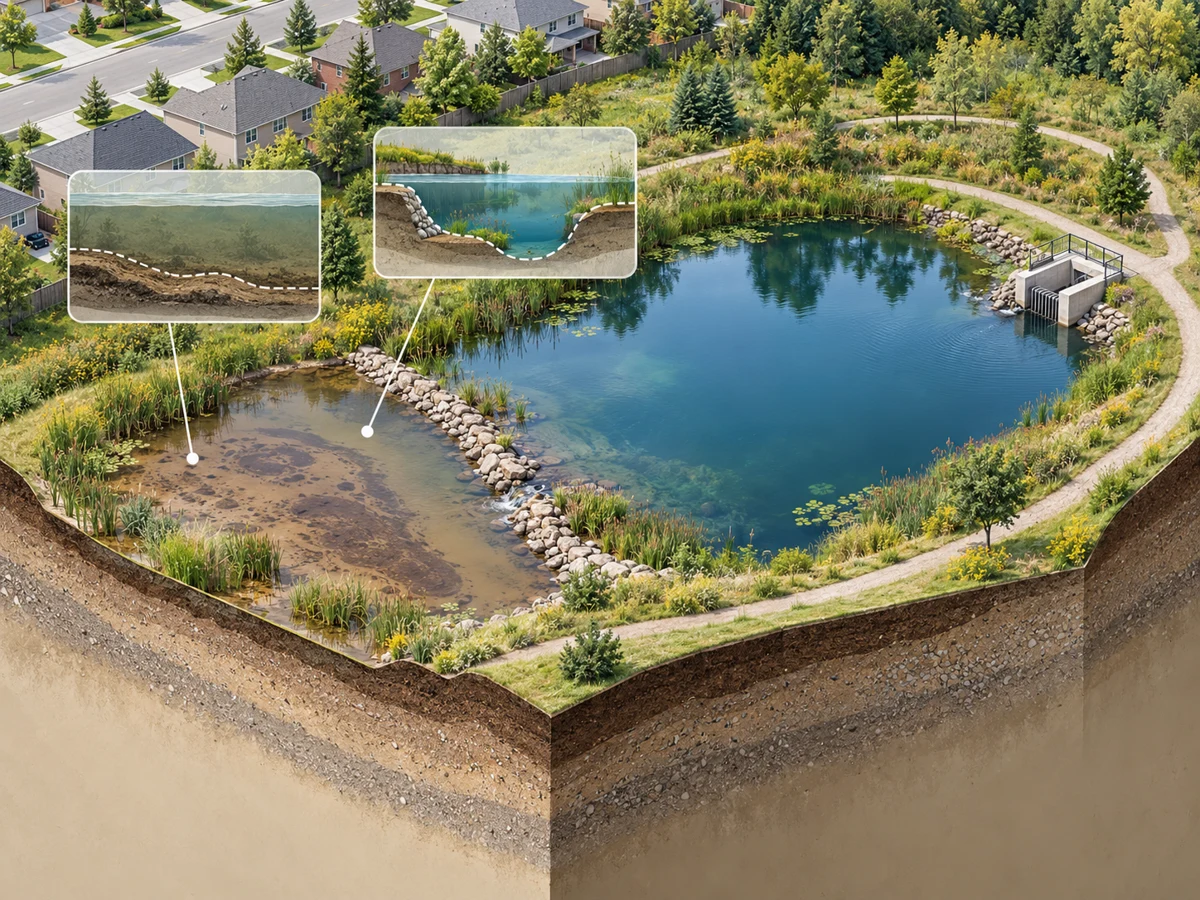
Stormwater Pond Retrofit vs Maintenance: The Short Answer
This is a scope decision, not simply a choice between cleaning and construction. Owners need to establish the existing design, the observed concern and the intended result. This guide explains how to separate restoration from proposed functional changes, organize the evidence and request an engineering assessment without assuming an approval exemption or a predetermined solution.
Stormwater pond maintenance generally seeks to keep an existing facility working as intended. A retrofit proposes a change to its arrangement or performance. Repairs can sit within either project. Therefore, the useful starting point is not the project label. It is the difference between the documented existing function and the proposed result.
A sediment cleanout, for example, may seek to recover storage that accumulated material has displaced. Adding a new treatment stage asks a different question. A combined project might include both tasks, along with repairs to damaged structures. Each component needs an identifiable purpose and an appropriate evidence basis.
This distinction helps an owner commission the right engineering work. It does not determine a legal exemption or permission to proceed. Existing approvals, current conditions and the responsible authorities still govern the actual property and proposed activity.
- Establish the original design purpose before describing work as restoration.
- Separate observed deterioration from a proposed increase or change in performance.
- Identify missing survey, asset, sediment and receiving-system information.
- Agree which investigations, engineering documents and authority decisions the assignment requires.
Define Maintenance, Repair and Pond Retrofit Separately
Maintenance: preserve an established function
Routine care addresses conditions that interfere with the facility’s intended operation. The approved operating documents and actual asset condition help establish what that means. A general landscaping specification is not a substitute for the pond’s own operating requirements.
Vaughan’s public explanation describes debris removal, management of obstructive invasive vegetation and care of inlet and outlet structures. It also distinguishes operational access from the vegetation that supports pond functions. These are municipal examples, not a universal schedule for every Ontario facility. See Vaughan’s stormwater pond maintenance explanation.
Repair: address a damaged component
A repair responds to deterioration or damage. Its scope should identify the affected component and the intended restored condition. Replacing a broken part does not automatically establish that the replacement has the same dimensions, operating characteristics or design effect.
Consequently, the project team should describe what stays unchanged and what needs engineering confirmation. A quotation that simply says “repair outlet” may leave the important distinction unresolved. Ask which drawing, detail or verified condition defines the work.
Retrofit: assess a proposed functional change
A stormwater pond retrofit may alter storage, treatment, flow paths or other aspects of the facility. Its purpose should be stated as a question that the assessment can answer. “Improve the pond” is too broad to establish which evidence, alternatives or design criteria are needed.
For example, restoring the documented arrangement differs from evaluating an added pretreatment feature. The latter needs consideration of the proposed feature and its relationship to the remaining facility. Neither its name nor an attractive concept image proves suitability.
Observed condition → compare with the documented facility → identify restoration tasks → separately assess proposed performance changes.
A combined programme can contain several branches. Keep their purposes and review requirements distinguishable.
Build the Baseline for Stormwater Pond Rehabilitation Planning
Stormwater pond rehabilitation planning begins with a reliable account of what exists and why it was built. Gather the original report, approved drawings, subsequent revisions and available record information. Also identify operating documents, inspections and previous work that may explain the current condition.
Do not assume that the newest file is the governing design. It could be an unaccepted option or a partial update. A useful document register identifies the issue, date, status and relationship to the facility. Where records disagree, keep the discrepancy visible.
Recover the design intent, not only the outline
A plan showing a pond boundary does not explain all its functions. The engineer may need the drainage areas, storage relationships, controlling levels and intended receiving connection. The relevant information depends on the question under review.
Ask what each available record establishes. An approved drawing describes an accepted design. A construction record may document installed work within a stated scope. A recent observation describes a present condition. These sources complement one another but are not interchangeable.
Record later changes and unresolved assumptions
Identify later development, changed drainage connections and alterations near the pond. An old assessment may remain useful while no longer representing every current input. The review should state which assumptions need confirmation before they support a conclusion.
Where a record is missing, assign a specific next action. That might involve an owner archive, a municipal enquiry or an appropriately scoped investigation. Avoid filling the gap with a precise-looking value copied from a nearby facility.
Condition Evidence for Pond Retrofit vs Maintenance
A useful condition record describes what was observed, where and when. Include relevant photographs from safe, permitted locations and identify the weather or operating context. “The pond looks full” does not establish whether the observation reflects its intended water level, accumulated material or another condition.
The owner should distinguish immediate operational concerns from longer-term improvement objectives. A future retrofit study does not automatically include investigation of an urgent defect. Tell the responsible team about both, then agree how each concern will be addressed.
Survey and geometry
Current geometry may be important when the decision concerns storage or changed levels. The investigation scope should identify which surfaces, structures and reference elevations need measurement. A surface photograph cannot establish submerged geometry or the elevation of concealed connections.
Ask how new measurements will relate to the historical drawings. Different datums, incomplete survey limits or unclear reference points can undermine a comparison. The engineer should identify these issues before treating two sets of numbers as directly comparable.
Structures and access
Condition information should identify relevant inlets, outlets, access routes and visible erosion or damage. However, an external observation is not a structural assessment of a concealed component. Where specialist investigation is needed, define that additional scope explicitly.
Owners and untrained staff should not enter structures or approach unsafe pond edges to obtain information. Qualified personnel must determine appropriate access and safety arrangements. The planning task is to identify the evidence required, not to improvise an inspection procedure.
Pond Sediment Removal vs Redesign: Identify the Actual Objective
Pond sediment removal and redesign can involve similar-looking construction activity while addressing different engineering questions. The distinction depends on the intended final condition. Identify whether the work seeks to restore a documented geometry or establish a different configuration.
A cleanout scope should therefore have a defined reference. Otherwise, “remove sediment” can leave uncertainty about the limits of work and the condition to retain. The appropriate professional team should establish the necessary information and documentation before the owner relies on a proposed quantity.
Separate quantity information from material information
An estimate of material volume does not establish its characteristics or destination requirements. Likewise, a material assessment does not establish the geometry needed for the pond’s intended function. These are related but different inputs to the work.
Ask which specialists will address characterization, handling and applicable disposal or reuse requirements where needed. Do not assume that sediment can go to a convenient part of the property. The proposed management approach needs an appropriate evidence and permission basis.
Avoid changing the design while describing only cleaning
If the proposal changes the pond bottom, treatment arrangement or controlling structure, identify that change plainly. A maintenance label should not conceal a different final design. The team needs to assess the relevant effects and confirm the applicable review route.
Conversely, do not presume that every substantial cleanout is a redesign. The scale of the contractor’s work and the engineering purpose are different matters. Compare the documented before-and-after conditions rather than deciding from the size of the equipment or quotation.
- Restore an established condition
- What reliable record defines the condition, and what evidence shows the departure from it?
- Change the intended performance
- What objective, criteria and assessment support the proposed change?
The same project can require answers to both questions.
Set a Specific Stormwater Pond Retrofit Objective
Before comparing options, identify the performance issue the owner wants to address. It may concern a documented capacity constraint, treatment objective, maintenance difficulty or changed contributing area. Different objectives can require different investigations and professional input.
Define the assessment boundary as well. A question about one component differs from a review of the complete drainage system. If an adjacent channel or upstream development affects the decision, explain whether that interface is included or requires separate work.
Compare alternatives on the same basis
Use a common baseline for a pond retrofit vs maintenance comparison. If one option assumes a changed drainage area and another does not, the comparison may obscure the real reason their results differ. Record the assumptions beside each alternative.
Also identify what each alternative leaves unresolved. A concept can improve access while still needing structural input. Another may depend on land outside the owner’s control. A preferred option should state these dependencies rather than hide them behind a general recommendation.
Describe the limits of a conclusion
A pond maintenance or retrofit assessment supports conclusions only within its stated information and scope. Avoid promises that a retrofit prevents every future flood or permanently eliminates maintenance. A useful report explains the assessed conditions, remaining risks and decisions still required.
If critical evidence is missing, the immediate deliverable may be a focused investigation brief rather than a selected design. That is a useful result when it explains exactly what must be established before the next decision.
Review the Pond and Its Receiving System Together
The pond does not operate in isolation. Its inflows, outlets and receiving conditions form connected interfaces. A proposed change at one location may require information from another part of the system. The engineer should define the relevant extent of that review.
For owners, the practical question is whether the proposal relies on an unconfirmed assumption outside the visible pond boundary. An available outlet drawing may not establish current downstream conditions. Similarly, a historic catchment may no longer describe every contributing connection.
Keep development changes visible
Identify proposed development that could change the basis for a pond retrofit vs maintenance assessment. This includes planned works as well as alterations already present in the records. Keep existing, approved future and unconfirmed future conditions separate.
A possible later project should not silently become today’s design input. If an option depends on it, record that dependency and the party responsible for confirmation. The owner can then understand whether the next decision concerns the pond itself or an external coordination issue.
Coordinate different disciplines
Some projects raise ecological, geotechnical, structural or other specialist questions beyond a general drainage-design scope. Identify those interfaces early and assign the appropriate professionals. One consultant’s report should not imply that every specialist matter has been assessed.
The coordination record should state which input is needed and how it will affect the design. A broad note saying “subject to others” is less useful than a named deliverable with a clear purpose and required stage.
Confirm the Review Route for Pond Maintenance and Retrofit Work
Do not infer permission from the word maintenance, rehabilitation or retrofit. Establish the facility owner, existing authorizations and proposed work first. Then confirm the applicable municipal, provincial and other authority requirements with the responsible professionals.
Ontario’s stormwater operation and maintenance guidance discusses recordkeeping, observations and clear maintenance responsibilities. It is useful background, not a project-specific authorization. Read the provincial operation, maintenance and monitoring chapter alongside the facility’s own documents.
Ontario also publishes separate reporting guidance for works within its Environmental Activity and Sector Registry framework. Its operations and maintenance requirements belong to that defined framework; they should not be applied indiscriminately to every pond. Confirm applicability before relying on that route. See the current stormwater report guidance.
Ask a precise authority question
Supply a description of the existing facility, proposed change and available approval records. Ask which submission or confirmation is needed for that scope. An enquiry without these details can produce a general answer that does not resolve the actual project.
Retain written direction with the relevant drawing version. If the proposed work changes later, check whether the earlier answer still applies. A response about restoration should not be treated as acceptance of a subsequently added functional modification.
Plan Access and Temporary-Control Interfaces Before Selecting a Scope
A permanent design concept should acknowledge the space and interfaces needed to implement it. Access routes, nearby utilities and occupied areas can affect the project. However, identifying those constraints is not the same as designing a contractor’s complete means and methods.
Ask who will address temporary water management, erosion and sediment controls, work sequencing and specialist environmental requirements where applicable. The engagement should identify the necessary deliverables and responsibility boundaries before the owner assumes that the permanent pond drawing includes them all.
Preserve the distinction between design and operations
A report can identify a required interface without authorizing field staff to improvise it. Changes to operating structures or temporary discharges need the appropriate design, authority and contractor coordination. Owners should not test a theory by altering the existing outlet.
Similarly, a construction access concept does not grant permission to use neighbouring land. Confirm ownership and access rights through the relevant advisers. The engineering arrangement should reflect the rights actually available, not assume that an agreement will appear later.
Identify the handover information
Discuss the records the owner will need after the work. The appropriate package may include current drawings, component information, operating requirements and records collected within the agreed construction-review scope. Specify the deliverables rather than relying on the word certification alone.
Record drawings and engineering review statements have different purposes and limitations. Their usefulness depends on the evidence collected. Agree the required information before work is concealed or access becomes difficult.
Before commissioning detailed work, connect five items: the observed problem, documented baseline, proposed objective, missing evidence and responsible reviewer. An unresolved item should have an assigned next step.
What Public Pond Projects Illustrate About Scope
Public examples show why maintenance and retrofit work should be separated into identifiable tasks. They do not establish the requirements or outcome for another property. Nor should a municipal example be presented as Elmid Design Inc. project experience.
Clarington: one project, different intervention purposes
Clarington’s Eiram project description combines accumulated-sediment removal, a new forebay and repairs to existing structures. It also identifies outlet restoration and access work. The description illustrates a mixed programme: not every task has the same purpose. See the Municipality’s Eiram pond project page.
The useful owner lesson is to request a similarly clear scope breakdown. It is not to copy the project’s quantities, dimensions or schedule. Those details belong to its own assessed site and should not become assumptions for another pond.
Richmond Hill: a historical rehabilitation example
STEP’s historical Rumble Pond description identifies sediment accumulation, thermal concerns and fish-passage constraints among the rehabilitation issues. Its proposed measures addressed several connected functions. The page is historical project context, not a current performance certificate. Read the STEP Rumble Pond case description.
The lesson is that a rehabilitation brief may need more than a sediment quantity. The responsible team must identify which functions matter for the actual facility. Avoid claiming a measured benefit unless the relevant evaluation establishes it.
Turn Uncertain Pond Observations Into Answerable Questions
A useful pond maintenance or retrofit assessment separates an observation from its explanation. Water standing near an inlet is an observation. The statement that sediment has caused inadequate capacity is a hypothesis until the relevant levels, operating condition and design information support it. Keeping those statements separate prevents an early site impression from becoming an unsupported design instruction.
Use an evidence register rather than an unqualified defect list
Record the location, date, available photograph and source of each concern. Add the condition under which someone observed it, where known. A photograph taken after prolonged rain answers a different question from an undocumented image. If timing is unknown, say so rather than inferring the rainfall event from the appearance of the water.
Next, identify what the observation cannot establish. A visible accumulation near an inlet does not measure sediment throughout the pond. A clear outlet opening does not demonstrate the condition of a concealed pipe. An apparently intact embankment does not replace the investigations needed for a proposed alteration. These limitations help define the next inquiry without dismissing the concern.
Assign a specific evidence task to each unresolved question. That task might be recovering an approved drawing, comparing surveyed elevations or obtaining a specialist assessment. Name the party responsible for providing it and the decision it supports. Avoid commissioning a broad investigation without explaining how its results will affect the proposed scope.
Keep condition and performance conclusions separate
A condition assessment may support replacing a damaged component. It does not necessarily establish whether the wider facility meets a different performance objective. Conversely, a modelling exercise does not establish that an inaccessible component is physically sound. A proposal should explain whether it addresses condition, performance or both, and identify the evidence used for each conclusion.
This distinction matters when an owner receives different recommendations. One adviser may be describing repairs to restore a documented arrangement. Another may be evaluating a changed drainage area or a new objective. Before comparing their recommendations, confirm that they are answering the same question. Different scopes can both be reasonable without being interchangeable.
- Record what was observed and what remains unknown.
- Identify the record, measurement or specialist input needed.
- State the decision that this evidence can support.
- Keep restoration and proposed performance changes distinguishable.
Compare Pond Retrofit vs Maintenance Proposals on Deliverables, Not Labels
The phrase “pond rehabilitation assessment” can cover very different assignments. Ask for a deliverable list that identifies the records review, site information, analysis, drawings and coordination included. A short condition memorandum and a design package for a functional alteration should not be compared as though they provide the same result.
Identify the decision at the end of each stage
An initial stage might establish whether the available records support a restoration-only scope. Another might identify missing information that prevents that conclusion. The next stage could compare defined alternatives once those gaps are resolved. This staged approach does not remove necessary work; it makes the purpose of each task visible before the owner commits to a more detailed assignment.
Request a clear statement of exclusions. Surveying, sediment characterization, geotechnical input, ecological review and construction operations should not disappear into the phrase “by others” without a named coordination responsibility. The appropriate disciplines depend on the facility and proposed work. Their inclusion in this checklist is not a claim that every project requires every investigation.
Also distinguish a preliminary option sketch from a document intended for authority review or construction. Each should identify its intended use and limitations. A sketch used to compare access arrangements must not quietly become the instruction for changing pond grades. The drawing status should remain clear when information passes between the owner, consultants and prospective contractors.
Make the pond retrofit vs maintenance comparison reproducible
When alternatives are assessed, record the common baseline and assumptions. If one option uses a different contributing area or downstream condition, explain why. Otherwise, an apparent improvement may reflect changed inputs rather than the proposed intervention. Keep the assumptions with the comparison so that a future reviewer can understand what produced the conclusion.
Record unresolved decisions alongside the preferred option. These may include confirmation of an outlet condition, access rights or an authority’s interpretation of the proposed activity. A recommendation with explicit dependencies is more useful than a confident conclusion that hides them. It allows the owner to direct the next effort toward the decision that actually controls progress.
Finally, agree the handover format. The owner should be able to identify the accepted scope, current drawings, supporting assessment and outstanding conditions without reconstructing a long email chain. Keep superseded concepts distinguishable from the current proposal. A clear record supports future maintenance planning without claiming that a planning document proves construction quality or future performance.
What a Decision-Ready Pond Assessment Should Explain
A pond maintenance or retrofit assessment should connect the owner’s question to its evidence and recommendation. Its opening should describe the facility, the concern and the intended use of the document. A reader should be able to tell whether it supports a maintenance brief, a comparison of retrofit options or the next stage of investigation.
Show the baseline and the proposed difference
Describe the existing arrangement using identified records and current information. Mark gaps explicitly. Then explain what would remain unchanged and what each option would alter. This is especially important when a project combines sediment removal with a changed structure. The owner needs to see which part restores the baseline and which part introduces a different design intent.
For example, consider a hypothetical pond with documented original grades, visible inlet sediment and a proposal to alter the outlet. The sediment concern and outlet proposal require separate explanations. The first may involve comparing present and intended conditions. The second asks how the proposed change affects the wider system. This illustration is a scope comparison, not a conclusion that either activity is permitted or suitable for a real pond.
Explain why a recommendation is conditional
If the recommendation depends on information not yet obtained, identify that information beside the conclusion. A general disclaimer at the end is less useful than a clear statement that a particular decision cannot be finalized until an input is confirmed. Explain how the missing information could change the scope or the preferred option.
Distinguish a recommendation to investigate from a recommendation to carry out work. The former may be the correct result when reliable records are missing. It should still be actionable: identify the question, the information needed and the appropriate next coordination step. Do not turn an incomplete assessment into a definite construction recommendation merely to produce a more decisive ending.
Keep the owner-facing summary consistent with the technical package
A summary should use the same option names, drawing references and assumptions as the supporting material. If an alternative was rejected, explain the relevant reason without implying that every other option has been fully designed. If cost information is included by a qualified contributor, identify its scope and basis rather than presenting an unsupported budget promise.
Close with the decisions that the owner can make now and those that remain dependent on other parties. This separates practical progress from false certainty. It also gives later reviewers a clear way to understand how the proposed assignment developed from the original concern.
Elmid Design Inc. Stormwater Reporting and Design Coordination
Elmid Design Inc. can review available stormwater records, identify drainage-design questions and prepare agreed reports or coordinated drawings. For an existing-facility enquiry, define the exact decision before assuming that the assignment includes specialist pond investigation or a complete retrofit design.
The firm’s stormwater management service describes site-specific reporting, runoff analysis, storage, outlet controls and coordination with related civil drawings. A proposal for your property should identify the relevant deliverables and any additional specialist input. Engineering consulting remains distinct from sediment removal, equipment supply and installation.
Elmid Design Inc.’s public portfolio documents stormwater reporting and infiltration-layout coordination for residential work in Markham. That is relevant evidence of drainage-report coordination, not evidence of a pond retrofit assignment. The scope of a pond-related engagement needs its own confirmation.
Prepare a Pond Retrofit vs Maintenance Enquiry
Send the facility location, ownership contact, available reports and drawings, and a concise description of the concern. Include previous maintenance records and authority comments where available. Identify what the owner wants to decide next and any time-sensitive operational issue.
Ask for a staged proposal when important information is missing. The first stage can define the evidence needed and the appropriate next assessment. Later design work can then follow a supported scope rather than a broad promise made before the facility is understood.
Frequently Asked Questions
Is sediment removal always maintenance?
No universal label settles the question. Compare the intended final condition with the documented facility and confirm the applicable requirements. A project may combine restoration with proposed design changes, and those components should remain distinguishable.
Does calling the project maintenance remove approval requirements?
No. The label does not establish an exemption. The existing authorizations, location, proposed activities and applicable rules determine the review needed. Obtain project-specific confirmation before relying on a general description.
Can a larger pond solve every drainage problem?
No. The relevant issue may involve the inlet, outlet, receiving system, contributing area or another constraint. Define the problem and obtain the necessary evidence before selecting a modification.
Can an old report be used for pond rehabilitation planning?
It can provide valuable background, but its assumptions and relationship to current conditions need review. Identify subsequent alterations and missing records. Do not present historical design information as a fresh condition assessment.
Who should investigate submerged or concealed components?
Appropriately qualified personnel should undertake the investigation under a defined scope and suitable safety procedures. Owners should not enter structures or unsafe areas to obtain measurements. Agree which information the engineering assessment actually needs.
Does Elmid Design Inc. remove sediment or install pond equipment?
Elmid Design Inc. provides engineering and design consulting within the agreed scope. Contractor operations, installation and specialist investigations are separate responsibilities. A proposal should identify those boundaries clearly.
How should owners begin a pond retrofit vs maintenance assessment?
Establish a reliable baseline and describe the desired result. Then separate restoration tasks from performance-change questions. This creates a useful brief for the responsible engineer and reviewing authority.
Geographic Locations That We Service:
Elmid Design Inc. provides stormwater management reporting and drainage design across Ontario service areas. The agreed scope depends on the project, available evidence and applicable review requirements.
We provide engineering services across a wide range of municipalities, each with its own requirements and review processes.
Toronto and Surrounding Areas
We provide engineering services in Toronto and provide grading engineering resources through our Toronto grading plan page.
Our service area also includes Oshawa, Pickering with our Pickering grading plan resources, and Clarington.
We also provide engineering services in Ajax through our Ajax grading plan resources, Whitby, Brock, Scugog, and Uxbridge, including our Uxbridge grading plan resources.
Halton Region
Within Halton Region, we provide engineering services in Burlington, including projects requiring Burlington grading plans.
We also provide engineering services in Halton Hills, supported by our Halton Hills grading plan resources.
Our service area also includes Milton and Oakville, including our Oakville grading plan resources.
Peel Region
Within Peel Region, we provide engineering services in Brampton, including projects requiring Brampton grading plans.
We also provide engineering services in Mississauga through our Mississauga grading plan resources and Caledon through our Caledon grading plan resources.
York Region
Within York Region, we provide engineering services in Vaughan and provide information about Vaughan grading plans.
We also provide engineering services in Aurora through our Aurora grading plan resources and East Gwillimbury through our East Gwillimbury grading plan resources.
Additional service areas include Georgina with our Georgina grading plan resources, Markham with our Markham grading plan resources, and Newmarket with our Newmarket grading plan resources.
We also provide engineering services in Richmond Hill with our Richmond Hill grading plan resources, Whitchurch-Stouffville through our Whitchurch-Stouffville grading plan resources, and King through our King grading plan resources.
Our service area also includes Bradford West Gwillimbury.
Other Southern Ontario Cities and Towns
We provide engineering services in many additional Southern Ontario communities, including Hamilton, St. Catharines, Niagara-on-the-Lake, Brant, Cambridge, Kitchener, Waterloo, and Woodstock.
We also provide engineering services in Guelph, Centre Wellington, Shelburne, Orangeville, New Tecumseth, Essa, Collingwood, Wasaga Beach, and Barrie, including our Barrie grading plan resources.
Additional service areas include Midland, Orillia with our Orillia grading plan resources, Ramara, Minden Hills, North Kawartha, Kawartha Lakes, Peterborough, Selwyn, and Brighton.