
Water Softener and Iron Filter Discharge in Ontario Septic Design
Water softener discharge can enter an Ontario sewage system only where the system has been designed to accept it. The same condition applies to iron filter discharge. Before adding equipment, confirm the design basis, operating cycles and discharge route with the sewage-system designer and the applicable approval authority.
Key Takeaways
- Conditional acceptance is not permission to connect any softener or filter to any existing septic system.
- Record each unit’s cycle volume, discharge rate, frequency and treatment process. A household water bill cannot replace these details.
- Keep water-treatment equipment selection, sewage-system acceptance and plumbing connections coordinated but separately documented.
- Do not assume a ditch, sump, soakaway or storm connection is an approved alternative.
- Seek a project-specific review before a new installation, equipment substitution or material change in operating settings.
What Ontario says about water softener discharge
Ontario’s 2024 Building Code Compendium lists Sentence 8.1.3.1.(6) in Part 8. For the November 2026 code context discussed here, that sentence makes acceptance of water softener and iron filter discharge conditional on the sewage system being designed for those discharges. It does not give every existing system spare capacity or approve a particular equipment model. See Ontario’s Part 8 sewage-system provisions.
Ontario lists new Part 8 requirements for combined treatment and dispersal systems that take effect January 1, 2027. This guide does not assess those new requirements. For work reviewed on or after that date, check the province’s Building Code updates and confirm which provisions apply to the project with the responsible authority.
The practical question is therefore specific: what evidence shows that this system can receive this equipment’s discharge? A permit drawing may contain the answer. Alternatively, the original design may be silent, or the equipment may have changed since approval. Those situations need different follow-up, even when the houses look similar.
This guide focuses on documenting and reviewing that interface for Ontario on-site sewage systems. It does not specify a disposal connection, size a leaching bed or establish a chemical acceptance limit. The responsible designer must confirm the applicable code edition, project conditions and reviewing authority’s requirements.
Why a yes-or-no online answer is incomplete
A softener brochure describes the product. A sewage permit describes approved work for a property. Neither automatically answers the other’s questions. Accordingly, an equipment supplier’s statement that a unit is suitable for homes with septic systems needs supporting details and a site-specific review.
Likewise, an existing discharge hose proves only that someone made a connection. It does not establish what the approved design considered. A house can have changed owners, water use or treatment equipment since the original application. Trace the current arrangement instead of assuming that its age establishes acceptance.
Start by separating three questions: what water needs treatment, what the treatment unit discharges, and what the receiving sewage system can accept. This keeps drinking-water performance claims from becoming unsupported wastewater-design claims.
Water softener discharge and iron filter backwash differ
A conventional cation-exchange softener treats hardness using resin and a regeneration process. That process uses water and salt and produces a waste stream. The U.S. EPA explains the technology in its water-softener overview. This is background on equipment operation, not an Ontario approval rule.
An iron filter may use a different treatment process and cleaning sequence. Identify its actual media, controls and manufacturer instructions. A product called an iron filter is not enough information to determine the volume or contents of its backwash. Some properties also have several treatment devices in series.
Document each waste-producing unit separately. Include equipment that serves only part of the building if its waste reaches the same receiving system. Conversely, do not add an assumed backwash allowance for a device that has no such cycle. The equipment schedule should reflect the actual proposed arrangement.
Keep drinking-water treatment and waste disposal distinct
The water-treatment specialist should explain why the equipment is needed and what operating conditions it requires. The sewage-system designer then needs the resulting discharge information. Coordination connects those responsibilities without turning one review into proof that the other is complete.
For example, satisfactory treated-water test results do not show that a septic system can receive a regeneration event. Similarly, an acceptable wastewater arrangement does not certify drinking-water quality. Keep both sets of records and their conclusions clearly labelled.
Ask about maintenance discharges too. A routine backwash cycle, a service flush and a cleaning procedure may involve different conditions. The review should identify which events the proposed design covers and which require separate advice before they occur.
Collect records for water softener discharge
A useful submission starts with the model number, manufacturer literature and proposed settings. Include the complete relevant manual pages rather than a screenshot of the product’s marketing claims. The reviewer needs the operating sequence and its assumptions, not just the unit’s advertised capacity.
For existing equipment, photograph the model label and control display from a safe, accessible position. Record the date. Do not remove covers, operate electrical components or trigger a regeneration merely to gather information. A qualified service provider can obtain details that are not safely available to the owner.
Keep the document versions together. A manual for a similar-looking valve or a different vessel size can create a misleading calculation. If the manufacturer lists a range, record the range and the condition that selects the relevant value. Do not choose its smallest value to make acceptance appear easier.
A water softener discharge schedule: required inputs
- Equipment purpose, manufacturer, model and treatment media or process.
- Water volume for each discharge stage and for the complete cycle, with units.
- Discharge flow rate, stage duration and the source of those values.
- Regeneration or backwash trigger, expected frequency and any override behaviour.
- Salt, treatment products or maintenance chemicals relevant to the waste stream.
- Existing or proposed drain route, receiving system and supporting drawing reference.
Mark unavailable information as unknown. Then assign the question to the manufacturer, supplier, plumber or designer who can answer it. An honest gap is easier to resolve than a plausible-looking number copied from another installation.
Water softener discharge: volume, rate and timing
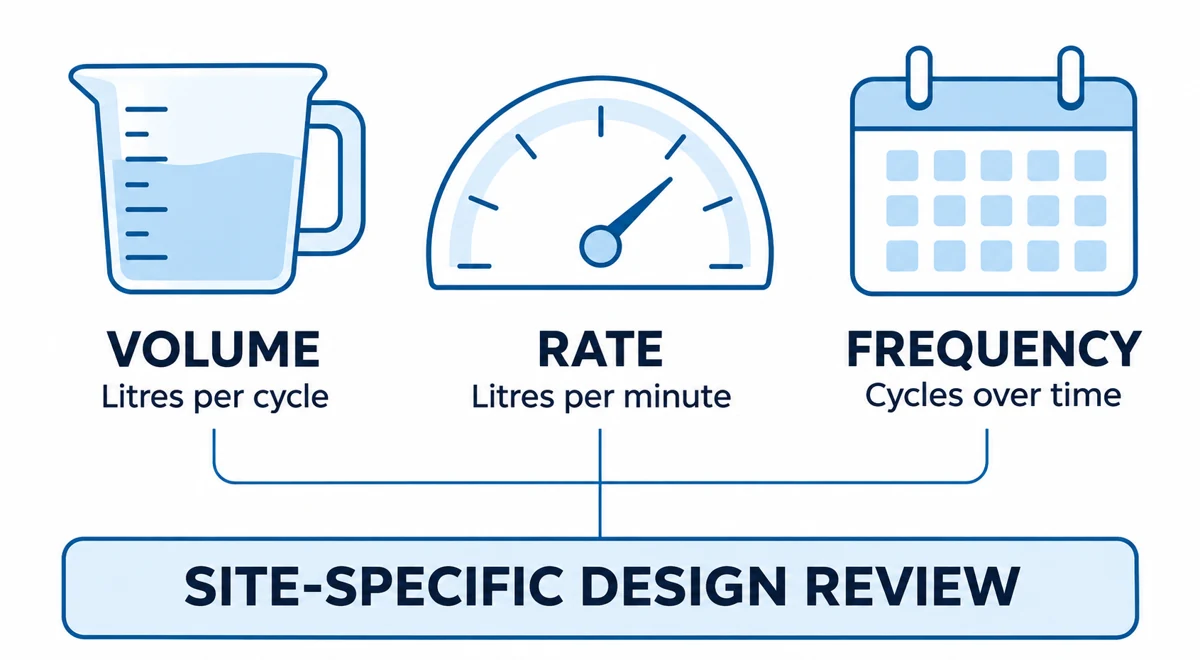
Water softener discharge has more than one useful measure. Volume describes how much water leaves during an event. Rate describes how quickly it arrives. Frequency describes how often the event repeats. Keeping these measures separate makes the review clearer and helps expose missing equipment information.
An average can help summarize a record, but it can hide a concentrated event. For example, spreading a weekly discharge evenly across seven days produces an arithmetic average. It does not change when the physical discharge occurs. The designer needs the event information as well as any useful summary.
Use consistent units throughout the equipment schedule and calculations. Clearly distinguish litres per cycle, litres per minute and litres per day. Also identify whether a quoted gallon is a U.S. or Imperial gallon before converting it. Ambiguous units should remain an open question, not an assumed conversion.
Consider more than one unit and more than one operating mode
Where a softener and iron filter share a receiving system, document both operating schedules. Ask whether cycles can overlap, follow one another or restart after a power interruption. Those are equipment-specific questions. Do not assume that two control clocks always maintain their intended separation.
Then describe foreseeable changes in household use. Guests, seasonal occupancy or a revised treatment setting may affect how often equipment operates. These observations support the review but do not replace the applicable sewage-flow design calculations or justify reducing their required basis.
A coordinated schedule may be one operating consideration. However, simply moving regeneration to night does not prove hydraulic capacity or chemical compatibility. Any proposed control strategy needs to remain consistent with the equipment requirements and the sewage-system design.
A calculation example that does not set a design allowance
Suppose a hypothetical equipment schedule lists a total discharge of 180 litres every three days. Dividing the event volume by the interval gives an average of 60 litres per day. However, the equipment still releases 180 litres during its operating event, rather than 60 litres on each day.
Now suppose one stage releases 12 litres per minute for ten minutes. That stage accounts for 120 litres. The remaining stages must account for the other 60 litres if the total is correct. This arithmetic helps check whether the schedule is internally consistent.
Neither calculation establishes that a particular septic system can accept the discharge. The figures are invented solely to explain units and timing. They are not typical equipment specifications, a recommended design addition or an Ontario acceptance threshold.
Also ask how a demand-controlled unit differs from this simplified three-day example. Its interval may vary with actual use and settings. A designer should identify the operating case used for assessment and explain its basis. An owner’s brief observation period may not capture the relevant case.
Assess water softener discharge beyond its volume
A design review also needs to know what the water carries. Identify the treatment process and products used rather than describing every discharge as clean water. The relevant information may include manufacturer data, source-water testing and the equipment specialist’s explanation of the operating sequence.
Do not infer wastewater composition directly from the colour of the discharge. Clear-looking water can still contain dissolved substances. Likewise, a stain or cloudy sample does not establish a measured concentration. If testing is needed, the responsible professional should define what to sample, when and why.
The EPA’s May 2026 softener guide advises checking septic-system compatibility and relevant manufacturer conditions. Its U.S. guidance helps explain why product details matter. Ontario’s governing requirements and the property’s design still control the local decision.
Water softener discharge and septic performance claims
Broad statements that all softener discharge is harmless, or that it always destroys a septic system, are poor substitutes for review. The question concerns a particular waste stream and receiving design. Document the basis of the assessment rather than relying on a general sales claim or an unrelated example.
Where a treatment unit forms part of the sewage system, obtain the relevant manufacturer’s requirements. Ask whether the proposed waste stream fits those conditions and whether written clarification is needed. Keep that response with the drawings instead of relying on a verbal assurance passed between suppliers.
Cleaning products and one-time service procedures deserve specific attention. Do not add chemicals, change treatment media or alter regeneration settings to test an assumed solution. Ask the responsible equipment professional and designer to review a proposed change before it becomes part of normal operation.
Check the septic design for water softener discharge
For an existing property, request the approved sewage-system drawings, permit records and available inspection information. Look for references to water softener discharge, iron filter backwash or other treatment equipment. A missing note does not by itself prove acceptance or rejection; it identifies a question for the review.
Next, reconcile the records with the current installation. Confirm which tank, treatment unit, pump arrangement and disposal area serve the building. Record known modifications and equipment replacements. Where documents disagree, retain both versions and ask the designer to resolve the difference.
Design capacity and current condition are separate considerations. A drawing can show the intended system without proving its present condition. Maintenance records can describe service work without demonstrating design acceptance of a new discharge. The reviewer may need both types of evidence.
When the record is incomplete
Start with the available file and identify the missing decision-critical information. The next step may involve obtaining municipal records, locating components or arranging a qualified assessment. Its scope should be proportionate to the uncertainty and the proposed change.
Do not turn an incomplete file into a confident capacity statement based solely on tank size. The receiving system includes more than its tank, and the review must address the applicable components. Nor does recent pumping establish unused treatment or dispersal capacity.
If an addition, new dwelling unit or change of use is also planned, disclose that work at the outset. Those changes belong in the wider septic assessment. This article addresses the water-treatment discharge interface rather than replacing that broader review.
Distinguish evidence from assumptions
Label each important input by its source. An approved drawing, a manufacturer data sheet, a service report and an owner’s recollection have different purposes. The review becomes easier when the reader can see which facts are documented and which still need confirmation.
For example, a service invoice might identify a replacement control valve without recording its programmed settings. A photograph might show the model label without confirming the concealed drain route. Use each record for what it actually establishes, then obtain the missing evidence through the appropriate professional.
Keep an assumption register short and useful. State the assumption, why it matters and how it will be checked. If the decision depends on an unresolved assumption, identify that dependency in the conclusion. Do not quietly turn an assumed condition into an observed fact when assembling the final report.
Water softener discharge routing and approvals
The proposed route should be identifiable from the equipment to its receiving system. A line disappearing into a floor or wall is not enough to establish the endpoint. Ask the appropriate professional to confirm concealed or uncertain connections without relying on assumptions from nearby fixtures.
Plumbing connection details require their own review. The waste-discharge arrangement must coordinate with the applicable plumbing provisions, equipment instructions and sewage design. A designer’s capacity assessment should not be interpreted as a complete installation detail where none was provided.
If the sewage system cannot accept the proposed discharge, do not improvise another destination. A sump, ditch, storm sewer, dry well or surface outlet is not automatically available. An alternative requires its own technical and regulatory assessment and any applicable approvals.
Ask focused questions before installation
Give the reviewing authority a clear description of the proposed equipment and existing system. Ask what documentation is required and whether the proposed work affects an existing approval. Avoid seeking a blanket answer for every product or every property.
Oro-Medonte’s sewage permit guideline provides one useful local example. Its Municipal Form 1 expressly asks whether a water softener or iron filter discharges to the sewage system. The document is dated January 2024; use the municipal guideline as evidence that this information matters, not as a province-wide submission checklist.
Record the response, who provided it and the information on which it relied. If the equipment changes later, return to that decision instead of assuming the earlier response still covers the revised proposal. Approval correspondence should remain attached to the matching drawing and equipment revision.
What a water softener discharge review package contains
A water softener discharge review package connects the equipment information to a documented design conclusion. Its purpose is to make the basis, limits and responsibilities understandable to the owner, reviewer and installation team. The required deliverable depends on the project and the authority’s process.
Start with a short description of the existing system and proposed change. Identify the equipment documents, drawings and operating assumptions used. Then show how the review addresses discharge quantity, timing, characteristics and the relevant receiving-system conditions.
The conclusion should state its limits. For example, it may depend on a specific model and operating setup, or require a design revision before connection. It should not read as open-ended permission to add any future water-treatment device.
Show existing and proposed work clearly on drawings
Where drawings form part of the assignment, distinguish existing equipment from proposed equipment. Identify the drawing revision and cross-reference the matching equipment schedule. A clear note should tell the reader which system is receiving the discharge and which details require coordination.
A simple process sketch can help communicate scope, but it should not masquerade as a complete plumbing detail. Missing pipe sizes, connection protections or component information cannot be supplied by copying a diagram from this article. The responsible designer must develop the actual details needed for the project.
Similarly, distinguish a proposed route from a verified existing connection. Use labels that accurately describe the information available. If field verification is required before final design, make that step explicit and assign responsibility rather than leaving an ambiguous line on the plan.
Make each handoff visible
The water-treatment supplier provides reliable equipment information. Within the assignment, the sewage-system designer assesses the receiving design. The appropriate plumbing professional addresses the connection, while the approval authority identifies its review requirements. A project may involve additional specialists where the conditions require them.
These roles should appear in the project record rather than remain implied. Identify who will confirm the installed model and settings, who will address substitutions, and who will retain the final documents. This prevents a drawing note from becoming a task that everyone assumes someone else completed.
Include operating conditions in an owner-friendly summary. Explain which changes require another review and where the equipment manuals are stored. Avoid burying the only important limitation in an email that does not accompany the final package.
Keep substitutions and purchasing decisions coordinated
Before ordering equipment, confirm that the model under consideration is the one described in the review. A supplier may offer an alternative with similar treatment capacity but a different cleaning sequence. Compare the discharge information before treating it as an equivalent product.
Ask for the proposed change in writing, including relevant manual pages and settings. The design team can then determine which parts of its earlier assessment remain applicable. This is more reliable than comparing only price, vessel dimensions or a product-series name.
Finally, keep a clear record of the accepted revision. Remove superseded equipment schedules from the active installation package while retaining them in the project file. That simple document-control step helps prevent an installer from following an old sheet after the design has changed.
A practical review sequence
- Identify the equipment and its complete discharge cycle.
- Reconcile the existing sewage-system records and current arrangement.
- Assess the proposed discharge and resolve missing information.
- Confirm the required approvals and coordinated connection details.
- Keep the installed equipment, operating conditions and final records consistent.
This sequence organizes the work. It does not authorize a connection or replace project-specific design.
Examples of water softener discharge decisions
Hypothetical example: replacing a softener
Consider a house with an existing softener whose drain already reaches the sewage system. The owner proposes a different model. Its cycle sequence differs, although the installer expects to reuse the existing drain connection.
The useful comparison is between the old documented design basis and the new equipment data. Confirm cycle volume, rate, frequency and relevant waste characteristics. If the old basis is unknown, say so. Reusing a pipe does not establish that the receiving design covers the substitution.
The outcome could involve confirming the existing design basis, obtaining further information or revising the proposal. This example does not predict which outcome applies. Its purpose is to show why a like-for-like description needs evidence beyond matching equipment size.
Hypothetical example: adding iron treatment
Consider a property with a softener where a water specialist recommends additional iron treatment. The new filter introduces another operating sequence. Its cleaning event may occur on the same day as softener regeneration, depending on the selected equipment and settings.
The owner should provide both equipment schedules and the reason for the proposed treatment. The review can then consider the combined events and any manufacturer conditions. Selecting different clock times alone does not establish a complete solution.
If the supplier changes the model during procurement, the revised information returns to the design team. Keep the accepted equipment schedule with the installation documents. Otherwise, an assessment of one product may mistakenly accompany a different installed unit.
Relevant Elmid Design Inc. septic design experience
The public Elmid Design Inc. portfolio includes a residential septic-system design in Ajax. Its documented scope included the septic tank and pump arrangement, leaching-bed layout, design calculations and review-response revisions. That example shows coordination across the receiving system; it does not establish water-softener discharge acceptance for that project.
For a water-treatment discharge assignment, Elmid Design Inc. can review available sewage-design information and define the engineering work needed. Depending on the agreed scope, deliverables may include an equipment-input schedule, design assessment, coordinated drawings and responses to technical review comments. Equipment supply, installation and drinking-water testing are separate services unless specifically included through the appropriate parties.
Water softener discharge records after installation
After authorized installation, retain the actual equipment details and final operating setup with the sewage-system records. Record any differences from the reviewed proposal and resolve them with the responsible professionals. An equipment invoice alone may not describe the control settings used in the assessment.
Also keep maintenance reports and significant setting changes. A new service contractor should be able to identify the conditions on which the earlier review relied. This is especially useful when ownership changes or equipment is replaced years later.
Continuous unexpected discharge, sewage backup, alarms or wet areas near the system warrant prompt professional attention. Do not enter a septic tank or open hazardous components to investigate. Avoid repeated test cycles or improvised diversions; obtain advice appropriate to the equipment and the sewage-system condition.
Use a simple operating log when requested
If a professional requests an operating log, agree on what to record before collecting data. Useful fields may include the date, indicated cycle, displayed settings and any service visit. Record observations without interpreting them as proof of a fault or a safe operating limit.
Do not create extra discharge events to fill the log. Likewise, avoid changing settings during the observation period unless the equipment professional directs the change. A log is most useful when its conditions are clear and it accompanies the manufacturer’s information rather than replacing it.
Water softener discharge: questions for the designer
Send a short, organized package rather than waiting until every record is complete. Describe what is changing, when the work is planned and whether any equipment is already connected. Include known gaps so the reviewer can identify the most useful next step.
- Property municipality and a clear description of the proposed work.
- Available septic permits, drawings, maintenance records and review correspondence.
- Existing and proposed equipment model information and relevant manual pages.
- Cycle volumes, rates, frequency, products used and known control settings.
- A description or professional record of the existing and proposed discharge route.
- Any planned addition, occupancy change, treatment-system change or unresolved operating problem.
Finally, ask for a defined scope and deliverable. A record review, a site assessment and a revised design are different assignments. Clear expectations help the owner obtain the right evidence without mistaking preliminary advice for permission to connect the equipment.
Frequently Asked Questions
Can water softener discharge go into a septic system in Ontario?
It may be directed to the sewage system where that system has been designed to accept it. Confirm the basis for the particular property and equipment. The conditional Part 8 provision does not give every existing system automatic acceptance.
Does an iron filter need the same review?
Yes, iron filter discharge is included in Ontario’s conditional provision. Identify the actual treatment process, cleaning sequence and discharge data. Do not assume an iron filter has the same waste characteristics or operating cycle as a softener.
Is there a universal extra daily-flow allowance?
This guide provides no universal allowance. The designer must establish the appropriate project-specific basis using the applicable requirements and equipment data. A simple daily average does not describe the complete discharge event.
Does demand-initiated regeneration prove septic compatibility?
No. The control type is relevant equipment information, but it does not establish receiving-system acceptance. Review the actual discharge cycle, settings and system design together.
Can I send the discharge to a sump or ditch instead?
Do not assume another outlet is permitted. Its suitability depends on the waste stream, site conditions and applicable approvals. Obtain a specific assessment before creating or changing a discharge route.
What if the original septic drawings do not mention a softener?
Treat that as a question requiring review, not proof of acceptance or failure. Gather the available records and equipment information. The designer can identify whether further investigation or revised documentation is needed.
Sources and further reading
Ontario 2024 Building Code Compendium, Part 8 provides the Ontario regulatory starting point. Confirm the current provisions and their application to the project with the responsible designer and authority.
Oro-Medonte Sewage System Permit Guidelines, January 2024 supplies the local form example. EPA’s cation-exchange overview and May 2026 water-softener guide explain equipment considerations. The U.S. documents do not determine Ontario approval requirements.
Geographic Locations That We Service:
Elmid Design Inc. provides septic engineering and design consulting for Ontario properties, including assessment and drawing coordination within an agreed project scope. Water-treatment discharge acceptance depends on the particular sewage-system design, equipment information and applicable review requirements.
We provide engineering services across a wide range of municipalities, each with its own requirements and review processes.
Toronto and Surrounding Areas
We provide engineering services in Toronto and provide grading engineering resources through our Toronto grading plan page.
Our service area also includes Oshawa, Pickering with our Pickering grading plan resources, and Clarington.
We also provide engineering services in Ajax through our Ajax grading plan resources, Whitby, Brock, Scugog, and Uxbridge, including our Uxbridge grading plan resources.
Halton Region
Within Halton Region, we provide engineering services in Burlington, including projects requiring Burlington grading plans.
We also provide engineering services in Halton Hills, supported by our Halton Hills grading plan resources.
Our service area also includes Milton and Oakville, including our Oakville grading plan resources.
Peel Region
Within Peel Region, we provide engineering services in Brampton, including projects requiring Brampton grading plans.
We also provide engineering services in Mississauga through our Mississauga grading plan resources and Caledon through our Caledon grading plan resources.
York Region
Within York Region, we provide engineering services in Vaughan and provide information about Vaughan grading plans.
We also provide engineering services in Aurora through our Aurora grading plan resources and East Gwillimbury through our East Gwillimbury grading plan resources.
Additional service areas include Georgina with our Georgina grading plan resources, Markham with our Markham grading plan resources, and Newmarket with our Newmarket grading plan resources.
We also provide engineering services in Richmond Hill with our Richmond Hill grading plan resources, Whitchurch-Stouffville through our Whitchurch-Stouffville grading plan resources, and King through our King grading plan resources.
Other Southern Ontario Cities and Towns
We provide engineering services in many additional Southern Ontario communities, including Hamilton, St. Catharines, Niagara-on-the-Lake, Brant, Cambridge, Kitchener, Waterloo, and Woodstock.
Our service area also includes Bradford West Gwillimbury.
We also provide engineering services in Guelph, Centre Wellington, Shelburne, Orangeville, New Tecumseth, Essa, Collingwood, Wasaga Beach, and Barrie, including our Barrie grading plan resources.
Additional service areas include Midland, Orillia with our Orillia grading plan resources, Ramara, Minden Hills, North Kawartha, Kawartha Lakes, Peterborough, Selwyn, and Brighton.