A Toronto building permit application brings defined scope, suitable design documents and property-specific approvals together. Elmid Design Inc. provides professional engineering design and permit support for Toronto projects; Toronto Building decides whether to issue a permit.
[toc]
Quick links: Project scope · Property and Code · Design team · Documents · Expectations · Construction
Key Takeaways
- Start with the actual work. Describe changes to structure, building use, plumbing, heating and the exterior, rather than relying on a general renovation label.
- Check the property early. Zoning and other applicable approvals can affect a design before the technical drawings are finished.
- Define professional responsibilities. Confirm who prepares each drawing, who coordinates the package and what services are included.
- Use current City instructions. The required forms and submission route depend on the project category.
- Plan for construction and closeout. Permit issuance does not remove inspection requirements or automatically close the file when work ends.
Start a Toronto building permit with a clear scope
The Toronto building approval process starts with a defined project, suitable design documents and property-specific approvals. Careful preparation helps the City understand the proposal and helps owners manage design decisions.
The useful first question is what will change. A kitchen renovation that retains the existing layout is different from one that removes a supporting wall. A basement finish is different from an additional dwelling unit or a project that lowers the floor. These distinctions affect the documents and expertise needed.
Write a short description of the existing building and proposed work. Identify the rooms and floors involved, exterior changes and any proposed change in use. Include work on heating, plumbing and structural elements. Share uncertainties rather than treating an assumption as an established fact.
Toronto’s permit-required guidance lists new buildings, additions and structural or material alterations among common permit-triggering work. It also identifies projects that may be exempt under stated conditions. An exemption for a particular activity does not establish that an entire renovation is exempt.
Ask Toronto Building about an unclear scope before work begins. A contractor’s price or a neighbour’s similar renovation does not establish the approval requirements for your property. Keep the answer with the project records so the owner, designer and people carrying out the work start from the same understanding.
Describe the full renovation before choosing a permit route
A Toronto building permit brief should explain how the finished space will be used. A family recreation room and a separate dwelling unit can require different design decisions. Tell the designer whether you plan a kitchen, separate entrance, added bedrooms or changes to shared circulation. Describe the intended use honestly, even if you have not settled the final layout.
For interior work, Toronto’s interior-alterations guide calls for drawings of existing and proposed conditions. It also identifies situations requiring site information, such as new openings or a second suite. Changes to HVAC, plumbing or drains may require related permit information. Use the guide for the complete proposal rather than submitting only the part that seems simplest.
Keep a separate list of optional work. If the addition depends on a later basement conversion, tell the team at the outset. Otherwise, the first design may overlook a future stair, service route or access need. Early coordination does not approve that future work; it helps everyone assess whether the present proposal should account for it.
Check zoning and the applicable Building Code
Zoning and technical building requirements answer different questions. Zoning addresses matters such as permitted use and building placement. The Building Code addresses technical requirements for the proposed work. A satisfactory structural design does not, by itself, establish that the proposed addition can occupy its chosen location.
Toronto’s preliminary zoning and property-information services provide routes for zoning review, property information and prior building records. Select the service that answers the actual question. An old drawing is useful background, but it may not show later changes or establish today’s permitted development envelope.
The province’s current Ontario Building Code resource directs users to the 2024 Building Code Compendium and current updates. Use the applicable Code and amendments for the project. Do not rely on an old article, drawing note or generic national-code reference as the complete Ontario requirement.
Where a property has additional constraints, ask which authority or approval applies. Heritage, tree protection, conservation-authority matters and planning approvals should be screened according to the site and work. They are not automatically the same review, and a building-permit application does not replace every other permission.
Establish a realistic design starting point
Before developing a preferred layout in detail, identify the information needed to test it. This may include an existing survey, available building drawings, photographs and previous City correspondence. Ask the consultant whether these records are adequate or whether further measurement or investigation is needed.
Describe a design preference separately from a confirmed constraint. For example, the desired room size belongs in the project brief; the property boundary belongs in verified site information. Keeping those categories clear makes it easier to revise a concept without losing track of the requirements it must meet.
Connect the zoning review to the design you intend to submit
Toronto’s Zoning Applicable Law Certificate, commonly called ZAP, assesses a proposal’s zoning and applicable-law compliance before a building permit application. The City’s published review streams use an issued ZAP and confirmation of applicable-law compliance among the conditions for a complete application. A certificate concerns the submitted proposal, so design changes should be checked against the basis of that review.
A useful starting file identifies the property boundaries, building position, existing structures and proposed work. Toronto’s ZAP requirements refer to a current land survey prepared by a licensed Ontario Land Surveyor. Ask the designer what existing survey information can support the submission and what needs updating. A real-estate floor plan, aerial image or fence line should not be treated as a verified property boundary.
Keep a short approval record showing each relevant requirement, the responsible person and the latest response. For example, record whether a question concerns zoning, tree protection or the technical building design. Attach the actual correspondence. This helps the design team distinguish an unanswered question from an approval already received, without assuming one authority’s decision settles every issue.
For Code research, start from Ontario’s official Building Code resource and check the applicable updates. The province directs readers to the 2024 Compendium and advises checking its filing date. Record the design basis with the project team instead of copying requirements from an earlier permit package.
Choose the team for your Toronto building permit
The appropriate design team depends on the building and proposed work. Architectural design, structural engineering, mechanical design and civil engineering can involve different responsibilities. A single consultant’s proposal should explain which services it includes and where another specialist is required.
Ask who is responsible for checking existing conditions, preparing each part of the submission and coordinating changes. Also confirm whether the proposal includes responses to municipal comments, additional design options, site visits or construction-stage reviews. Do not assume that every quotation mentioning a permit includes those services.
For an addition, Toronto’s current application guide describes designer information and required forms. It also requires an Assumption of Responsibility for Engineering Content Form when an application includes engineer-sealed drawings. Confirm the applicable documents with the people taking responsibility for the work.
Elmid Design Inc. provides engineering and design consulting. Construction, installation and trade work remain separate activities. A clear division of responsibilities helps the owner understand what is being designed, who will carry out the work and how construction questions will be handled.
PEO Certificate of Authorization
Elmid Design Inc. is an engineering and design consulting firm serving residential, commercial and land development projects in Toronto and the Greater Toronto Area. For a permit assignment, the firm connects the owner’s proposed work with defined drawings, engineering inputs and municipal review support. The project-specific proposal identifies the services involved, the information needed and the responsibilities that remain with other professionals or construction participants.
Elmid Design Inc. holds a Certificate of Authorization from Professional Engineers Ontario (PEO). PEO’s Certificate of Authorization guidance explains how this authorization relates to offering professional engineering services to the public. It is distinct from an individual engineer’s licence and does not imply PEO endorsement of a project or a permit outcome.
Coordinate the Toronto building permit documents
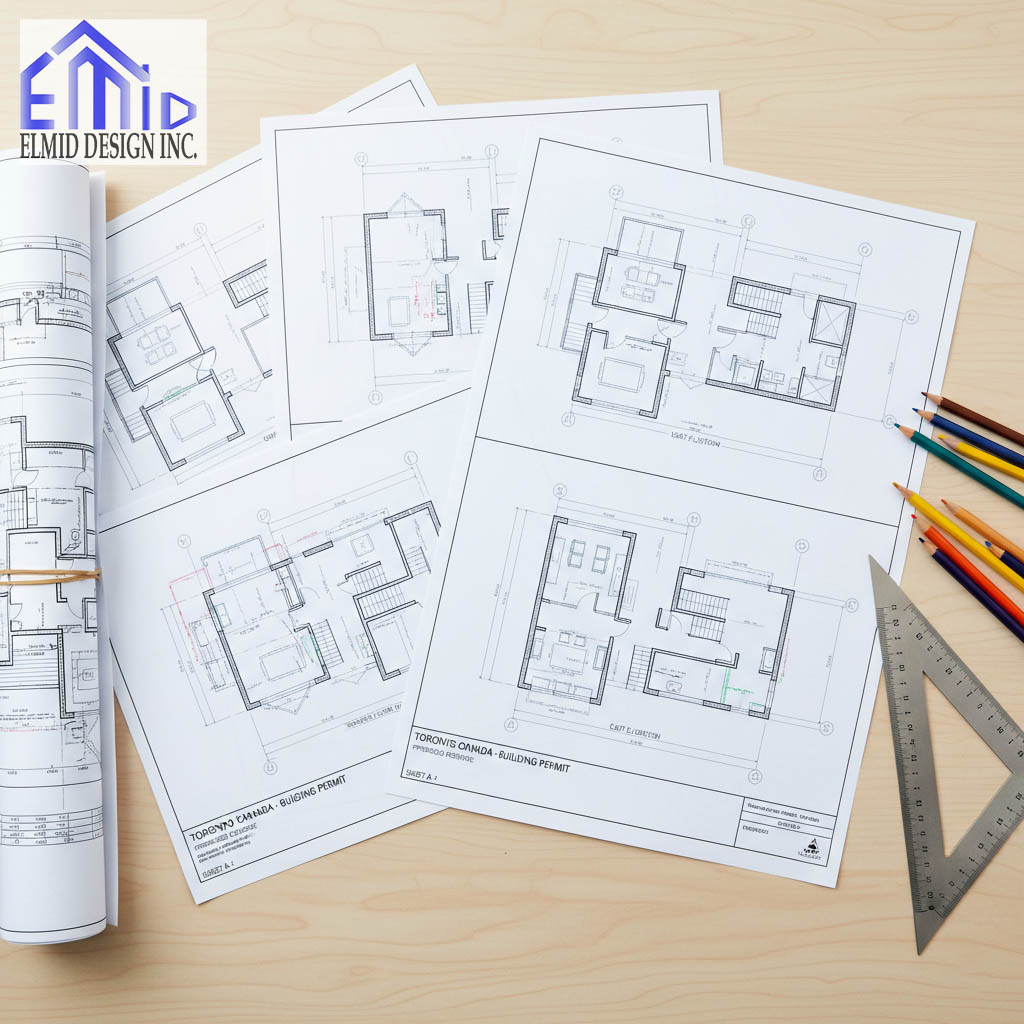
A useful drawing package tells one consistent story about the work. Floor plans show the layout, while sections and details explain information that a plan alone cannot show. The required structural, mechanical, plumbing and site information depends on the project. Not every permit needs the same disciplines or the same number of sheets.
Use the City’s building permit application guides to select the relevant project category. The guides identify documents, forms and fees. The applicant should then confirm whether the particular property or design needs additional material.
Coordinate Toronto building permit drawing sheets
Each view should answer a different question about the Toronto building permit proposal. A site plan explains where the work sits on the property. Floor plans explain rooms and circulation. Elevations show exterior changes, while sections explain vertical relationships and construction assemblies. Details then describe connections or conditions that need a closer view.
Toronto’s small-additions guide asks for coordinated information across site, floor, roof, elevation and section drawings. Among its listed items are property setbacks, building heights, foundation information and the relationship between existing and proposed construction. The exact package depends on the addition. A drawing that looks complete in isolation can still conflict with a related sheet.
Ask the team to compare shared dimensions before submission. A window opening should agree across the floor plan and elevation. A stair location should fit the floor layouts and section. Where several designers contribute, use the same background drawings and identify who will update the combined package when one part changes.
Resolve structural and building-service interfaces early
A beam, duct and drain may all need the same space. Raising a ceiling or moving a bathroom can therefore affect more than the architectural layout. Bring the relevant designers into the discussion before the owner commits to finishes or equipment. The purpose is to identify design conflicts while changes remain easier to manage.
Existing buildings can contain concealed conditions that drawings and photographs do not establish. Ask the responsible professional whether an investigation is needed and who will arrange safe access. Do not remove supports or make exploratory structural changes based on an article. Record what has been confirmed, what remains uncertain and when that uncertainty must be resolved.
Make assumptions and changes visible
Existing and proposed conditions should be easy to distinguish. If a measurement, concealed structural condition or existing service route needs verification, the team should identify it and agree on the appropriate next step. Do not treat a convenient assumption as a substitute for information the design requires.
When the layout changes, ask which related documents are affected. A moved wall may alter more than the floor plan. Keep a clear record of the decision and issue coordinated documents so different participants do not work from incompatible versions.
A practical document check
- Does the package describe the same work as the owner’s current brief?
- Are the relevant drawings and supporting forms identified?
- Is responsibility for each outstanding item clear?
- Do related sheets use consistent dimensions and revision information?
- Have unresolved questions been returned to the appropriate designer?
This is a coordination aid, not the City’s complete checklist or a professional design review. A tidy file set can still contain a technical issue. Conversely, a well-developed design can be delayed at intake if the required application information is missing.
Prepare the application using current City instructions
Follow the submission method linked from the guide for your actual project. Toronto provides online application routes for certain categories, including small residential additions. Avoid treating one submission method as universal, particularly when using instructions saved from an older project.
Toronto’s electronic submission guidelines describe PDF preparation and file organization. Among the requirements are unsecured files, flattened drawing layers and clear file names. Scaled plans remain important; a colour rendering or photograph does not replace the necessary drawings.
Review the applicable privacy instructions too. The City’s small-additions guide asks applicants not to place personal information, such as a homeowner’s name or phone number, on building plans because submitted plans can be disclosed. Supply required applicant details in the appropriate application fields instead.
Keep a copy of your submission, its date and the City’s reference information. If you are working through an authorized agent, agree on who will receive and circulate correspondence. The owner should know when a decision is required rather than discovering it after a response deadline has passed.
Match the forms to the work and the property
Forms help explain who is applying and who takes responsibility for the design. Use the current forms linked from the relevant City guide, not an old package saved from another property. Check names, project descriptions and drawing references for consistency. Where an agent submits for the owner, confirm that the required authorization and contact information are complete.
Toronto’s small-additions guide includes project-dependent documents such as energy-efficiency information, tree declarations and an overhead-electrical-conductor declaration. The interior-alterations guide also identifies a rental-renovation licence screening form. These requirements serve different purposes. A screening form does not establish that every project needs a separate licence, and a tree declaration does not replace any required tree permission.
Make a form register alongside the drawing list. For each applicable document, note who prepares it, who must sign it and what supporting information is needed. Check the live guide again before submission. Forms and submission services can change while a project is being designed.
Use Toronto’s building permit pre-check within its limits
Toronto now offers a voluntary Building Permit Application Pre-Check for eligible residential submissions. It uses AI to flag possible document, formatting and compliance issues within a defined pilot scope. Check the current eligibility rules before using it. The service is hosted on a third-party platform, so review the linked terms and privacy information before uploading documents.
Treat the report as another input to the team’s review. Ask the responsible designer to assess any technical flag rather than changing a drawing automatically. The tool may miss issues and does not replace City staff review, approve a permit or guarantee a review time. Completing the pre-check also does not formally submit the application. You must still finish the City’s application process.
PROJECT SUPPORT
Not sure which service you need?
Elmid Design Inc. provides engineering consulting and design for building and land development projects. Depending on the scope, a project may need building permit design or site grading and drainage design. Share the proposed work and available records so the appropriate engineering services can be discussed.
Set realistic Toronto building permit expectations
Separate the consultant’s design schedule from the City’s review period. An early design may still depend on property information, owner decisions or other approvals. The time needed to obtain those inputs is not automatically included in a municipal review target.
Toronto’s review-stream guidance distinguishes House, Small Building and Large/Complex Building applications. Published review periods apply to complete applications in the relevant stream. The City specifically states that an incomplete House Stream application has no review time frame. A review period is not a promise that a permit will be issued by a particular date.
Use the current Toronto building permit fee schedule for municipal charges. The fee depends on the proposed work and applicable calculation. Consultant fees, surveys, other approvals and construction costs are separate budget items. Avoid using one advertised price as the complete project budget.
Build the schedule around decisions and dependencies
Plan a Toronto building permit schedule in stages: establish the scope, gather property information, develop the design, resolve applicable approvals, submit, respond to review and prepare for construction. Some stages can overlap, but others depend on a decision or document. Ask which missing input controls the next step instead of treating every task as ready to start.
Allow time for the owner to review layouts before detailed coordination. A late decision to move a stair, expand a room or change the number of units can require several drawings to be revised. Agree on a decision date with the consultant and keep a written record of the chosen option. This is more useful than asking for a fixed completion date while the project scope remains open.
Budget in separate categories so you can compare proposals fairly. Property information and investigations support the design. Professional fees cover the agreed design and review services. Municipal fees and other approval costs follow their own rules. Construction pricing belongs to the work carried out on site. Ask which items are included, excluded or allowances, and who will confirm each cost.
A lower initial design quotation may cover fewer revisions or omit a discipline that the project needs. Compare deliverables and responsibilities, not only the total. If the scope changes, request an updated explanation of the added work and its effect on fees and timing before directing the team to proceed.
Respond to comments through the responsible team
When a request for clarification arrives, identify the actual question before changing the design. Some items need an owner decision; others need a drawing correction or technical explanation. Ask the appropriate professional to resolve matters within their responsibility.
Keep the response and revised documents consistent. An explanation in an email should not leave the drawing showing a different arrangement. Follow the City’s instructions for the application and retain a clear record of the latest accepted documents.
Use a response register with the comment, responsible person, proposed answer and affected drawing reference. It helps the applicant see which items are ready and which still require an owner decision. Before uploading a revised package, follow three practical checks:
- Resolve the comment. Confirm the answer with the person responsible for that design or decision.
- Coordinate the revision. Update every affected sheet, then check shared dimensions, references and revision dates.
- Confirm the submitted set. Check that the actual upload includes the agreed corrections and no superseded sheets.
For requested drawing and document resubmissions, follow Toronto’s current File Submission Hub instructions and the assigned examiner’s direction. The City identifies this as a route for documents requested during review. Keep the upload receipt and a copy of the exact files sent. Sending an email about a correction does not, by itself, establish that the required revised documents were received.
Carry the Toronto building permit into construction
Read the issued permit, approved drawings and conditions before construction starts. Confirm that the people doing the work have the correct set. If an unexpected condition or proposed substitution affects the design, raise it with the responsible designer and Toronto Building as appropriate before proceeding with the change.
Toronto’s small-building inspection guidance explains when inspections may be required. It requires stamped permit plans to be available on site and building elements to remain visible for inspection. Confirm the stages that apply to the project before work is concealed.
Agree on inspection and design-question responsibilities
Before work starts, identify who will book inspections, provide access and circulate results. Toronto’s small-building guidance calls for inspection at relevant construction stages, before work is covered. Build those checkpoints into the construction schedule. A finished surface can conceal the very work the inspector needs to see, so an inspection request should not wait until every trade has left.
Keep a site question focused and specific. Identify the drawing number, location, observed condition and proposed change. Add clear photographs where they help, but do not assume they replace a site review. The responsible professional can then determine whether further information, a revised detail or a City submission is needed. Contractors should not improvise structural changes while waiting for a design response.
A consultant’s construction review and a municipal inspection serve their respective roles. Clarify both in advance where they apply. Do not assume that arranging one removes the need to arrange the other.
After the work is finished, follow the City’s permit-closeout instructions. A permit stays open until the required inspections are completed and the City closes it. Request the final inspection and deal with outstanding items rather than treating completed finishes as confirmation that the file is closed.
Retain your Toronto building permit closeout file
Give the owner a clear closeout file rather than leaving the only copy with a contractor or former consultant. Keep related records together so an unresolved item is easier to trace after the active work ends. Useful file groups include:
- Approved work: the issued permit, approved drawing set and later accepted revisions.
- Inspection record: inspection correspondence, outstanding items and the City’s confirmed status.
- Professional documents: applicable review letters or completion records, with the responsible provider identified.
If the project pauses or the scope changes, check the permit’s current status and any City notice. Toronto’s closeout guidance explains that inactive permits can require action, including an inspection or a response to a notice. Follow the instructions that apply to the actual file. Do not assume that stopping work, paying a contractor or deciding against the project automatically closes the permit.
How Elmid Design Inc. Can Help With Toronto Building Permit Design
Elmid Design Inc. provides building permit design and engineering coordination for Toronto projects. Agreed deliverables can include site and floor plans, elevations, sections and structural details that explain the proposed work and its relationship to the existing property.
Share your project brief, available surveys and building records, and any City comments. Elmid Design Inc. can then define the required design drawings, related engineering coordination and technical review-response work within a project-specific proposal.
For example, an addition may need the proposed layout coordinated with foundation, framing and building-service information. An interior alteration may need existing-condition drawings and details for the affected structure. Elmid Design Inc. can define the applicable drawing and engineering assignment from the actual proposal, rather than offering the same package for every Toronto building permit.
A useful design proposal also explains the review stage it supports. Ask whether the assignment includes a zoning submission, permit drawings, technical responses to City comments or construction-stage engineering review. These are related tasks with different inputs. Agreeing on the boundaries helps the owner obtain the right support without confusing design consulting with construction or promising an approval date.
Toronto building permit project examples
Elmid Design Inc.’s public project portfolio documents building-permit design work in Toronto. One residential additions-and-alterations assignment included floor plans, elevations and HVAC duct layouts, including a basement secondary suite. The work coordinated with structural drawings prepared by a separate engineering consultant. This distinction shows why the design team should identify each professional’s responsibility from the outset.
A separate Toronto assignment involved documenting an existing residential canopy for permit and zoning review. Elmid Design Inc. prepared site-layout, elevation and three-dimensional drawings, with additional existing-floor and elevation information supporting coordination with a planning consultant. The relevant service was preparation and coordination of design documentation; these records do not establish a final permit outcome.
For a new property, the drawings and coordination depend on the existing building, proposed changes and site conditions. These examples illustrate different design assignments, not a standard approval path. Start by defining the work and the information needed for a property-specific assessment.
Toronto building permit questions
Does every renovation need a Toronto building permit?
No. The need depends on the actual work, and exemptions have conditions. Check Toronto’s current permit-required guidance and describe the full scope when asking the City. A permit exemption does not remove applicable zoning requirements.
Can engineering drawings guarantee approval?
No. Drawings support the review, but the proposal must satisfy the applicable requirements. Engineering work addresses its defined scope and does not replace unrelated approvals or the City’s decision. Be cautious about promises of automatic or guaranteed approval.
What should I prepare before requesting a proposal?
Gather the property address, a plain description of the work, available surveys and building records, and any City comments. State the project’s current stage. Ask the consultant to identify missing inputs and distinguish included services from work that may need a separate scope.
Organize the available material into a few clearly labelled groups. You do not need to create technical drawings yourself before asking for design advice:
- Property records: the legible survey, existing drawings and earlier permit information you actually have.
- Proposed work: room-use notes, marked photographs and a list of changes that are still optional.
- Review history: complete City comments and correspondence, not only a screenshot of the latest sentence.
Tell the consultant when a record is missing or its accuracy is uncertain. A clear gap is easier to investigate than a document mistakenly presented as current.
Is a Toronto building permit the last approval step?
Permit issuance allows the authorized work to proceed subject to its conditions and other applicable requirements. Inspections, design changes and closeout still need attention. Confirm the requirements that apply to occupancy and to any separate regulated work rather than assuming the building permit covers everything.
Can I use drawings from a similar Toronto project?
Use them only to help explain your preferences, not as a ready-to-submit design. Property dimensions, existing construction, building use and approvals can differ. The responsible designer needs to assess the actual site and proposed work. Copying a neighbour’s layout or an older drawing does not establish that it meets the requirements for your Toronto building permit.
What if the work changes after the permit is issued?
Contact the responsible designer and Toronto Building before carrying out a change that affects the approved work. Explain what changed and ask which revised documents or approvals are required. Keep the accepted revision with the site set. An owner’s instruction, supplier substitution or contractor’s sketch should not silently replace the approved design.
A useful next step
Start with a clear project brief and the matching City guide. Then ask the design team to identify the required inputs, responsibilities and deliverables. This article is general planning information; it does not replace a property-specific Code, zoning or engineering assessment.
Geographic Locations That We Service:
Our Licensed Professional Engineers provide building permit design and related engineering support for Ontario projects. Related services include site grading plans, drainage design and erosion and sediment control plans, where required by the project.
We provide engineering services across a wide range of municipalities, each with its own requirements and review processes.
Toronto and Surrounding Areas
We provide engineering services in Toronto and provide grading engineering resources through our Toronto grading plan page.
Our service area also includes Oshawa, Pickering with our Pickering grading plan resources, and Clarington.
We also provide engineering services in Ajax through our Ajax grading plan resources, Whitby, Brock, Scugog, and Uxbridge, including our Uxbridge grading plan resources.
Halton Region
Within Halton Region, we provide engineering services in Burlington, including projects requiring Burlington grading plans.
We also provide engineering services in Halton Hills, supported by our Halton Hills grading plan resources.
Our service area also includes Milton and Oakville, including our Oakville grading plan resources.
Peel Region
Within Peel Region, we provide engineering services in Brampton, including projects requiring Brampton grading plans.
We also provide engineering services in Mississauga through our Mississauga grading plan resources and Caledon through our Caledon grading plan resources.
York Region
Within York Region, we provide engineering services in Vaughan and provide information about Vaughan grading plans.
We also provide engineering services in Aurora through our Aurora grading plan resources and East Gwillimbury through our East Gwillimbury grading plan resources.
Additional service areas include Georgina with our Georgina grading plan resources, Markham with our Markham grading plan resources, and Newmarket with our Newmarket grading plan resources.
We also provide engineering services in Richmond Hill with our Richmond Hill grading plan resources, Whitchurch-Stouffville through our Whitchurch-Stouffville grading plan resources, and King through our King grading plan resources.
Our service area also includes Bradford West Gwillimbury.
Other Southern Ontario Cities and Towns
We provide engineering services in many additional Southern Ontario communities, including Hamilton, St. Catharines, Niagara-on-the-Lake, Brant, Cambridge, Kitchener, Waterloo, and Woodstock.
We also provide engineering services in Guelph, Centre Wellington, Shelburne, Orangeville, New Tecumseth, Essa, Collingwood, Wasaga Beach, and Barrie, including our Barrie grading plan resources.
Additional service areas include Midland, Orillia with our Orillia grading plan resources, Ramara, Minden Hills, North Kawartha, Kawartha Lakes, Peterborough, Selwyn, and Brighton.