Septic Engineer in Clarington: Design and Permit Planning
A septic engineer in Clarington helps turn a property proposal into a coordinated wastewater design. The work connects the proposed building use, available records and site information to design calculations and septic permit drawings for review. Elmid Design Inc. provides engineering and design consulting, not septic installation or permit issuance.

For a Clarington sewage system subject to Ontario Building Code Part 8, Durham Region Health Department administers the local sewage-system approval process. Confirm the applicable legislation and approval route from the system’s design capacity, discharge method and property arrangement, including any applicable exceptions. Do not assume that every sewage proposal follows the Durham route. Durham Region sewage and septic systems
The practical question is not simply whether a tank fits on the lot. It is whether the proposed use, treatment arrangement, dispersal area, elevations and other site features can work together under the applicable requirements. That answer depends on the property, not a standard sketch copied from a neighbouring address.
Key Takeaways
- Confirm whether the proposal falls under Building Code Part 8 or requires a provincial environmental approval route.
- Distinguish a new system, replacement or repair application from comments on an addition or change of use.
- Provide bedrooms, finished floor area, plumbing fixtures and reliable site information for the residential design review.
- Coordinate the wastewater area with the building, well, grading and access before fixing the layout.
- Elmid Design Inc. prepares engineering documents; the responsible authority decides approval and a separately retained installer carries out installation.
Start septic design in Clarington with the project, not a tank size
Before asking a septic engineer in Clarington for a system recommendation, describe the proposed work. A replacement serving an unchanged house raises different questions from a new home, an addition or a change in building use. The initial brief should explain what exists, what will change and what decisions remain open.
For a new house, the architectural concept and site layout should develop together. The house footprint, driveway, well, grading and wastewater area compete for space. Resolving them independently can leave a design team trying to squeeze a necessary feature into the last available corner.
For a replacement, explain why you are considering the project. An undocumented system, a proposed addition and a reported performance problem are different starting points. Keep design and assessment scopes distinct. A condition assessment does not, by itself, provide an approved replacement design.
For additions and changes of use, provide the current and proposed building plans. The relevant changes may not be obvious from the exterior footprint alone. A useful comparison shows the rooms, fixtures, floor areas and intended uses that the designer needs to assess, rather than only a coloured outline of the addition.
What is changing on the property?
Prepare a short change list in ordinary language. Include proposed buildings, garages, pools, driveway changes and grading work that could affect the available layout. Mark features that are fixed and those that can still move. This lets the design team focus first on the decisions with the greatest consequences.
A wish list is useful, but distinguish the current application from possible future work. Identify a future garage as a planning consideration, not as a completed design or an approved proposal. That distinction helps avoid basing the current wastewater layout on an uncertain proposal.
Confirm the Clarington septic approval route
For on-site sewage systems regulated under the Building Code, Durham Region Health Department administers the Clarington approval process. The municipal building application and sewage-system review are distinct interfaces; confirm what each reviewer needs for the proposal.
The applicable legislation, not the tank size or residential appearance, determines the approval route. Ontario’s guidance identifies provincial approval requirements for on-site sewage works with design capacity above 10,000 litres per day, including the combined capacity of multiple works on one lot or parcel. It also identifies works extending beyond the parcel containing the building or facility they serve, regardless of flow, and sewage works discharging to surface water. Check the full legislative criteria and applicable exceptions with the responsible authority before choosing an application route. Ontario environmental permissions for sewage works
New systems, tank replacements and repairs
Durham lists new systems, septic-tank replacements and repairs under its septic-permit application route. Its submission instructions call for the permit-to-construct-or-demolish application, Schedule A and a sewage-system design drawing. Check the current checklist and payment instructions before submission. Durham applications and submission guidance
Additions, new structures and changes of use
Use Durham’s building-addition/change-of-use route when the building department or another Health Department program requests comments on an addition, new structure or changed building use. Describe the proposed change precisely. This comment pathway is not itself permission to construct or alter a septic system.
Amendments to an existing permit
Durham directs permit-amendment requests to its building-applications channel with the original permit file number. Send the changed design and its supporting information through the appropriate process rather than treating an approved drawing as permission for a different arrangement. Consult the linked current instructions for fees and submission details.
Separate septic engineering, approval and installation roles
The owner supplies project information and authorizes the work. The design consultant prepares the agreed engineering documents. Other qualified providers may supply survey, subsurface or specialist information. The authority reviews the application, while a separately retained installer undertakes authorized installation work.
A clear scope names the party responsible for each input and explains who receives and answers project questions. It also identifies activities outside the assignment. This is more useful than a general promise to handle everything, especially where testing, excavation, installation or inspections require separate arrangements.
Related: Understand the scope of a septic design assignment
What your septic engineer in Clarington needs before drawing
Existing information can reduce uncertainty, but the design team must check its relevance. Gather available septic permits, approved drawings, survey information, building plans and previous review correspondence. Keep complete documents where possible, including dates, legends and revision information.
A plan showing an earlier house layout may not represent today’s building. Likewise, an old site sketch may show intended system locations rather than measured current conditions. Ask the design team to identify what each record establishes and what remains unknown.
Organize the information by subject rather than sending disconnected screenshots. A folder for the building proposal, a folder for property information and a folder for approvals makes discrepancies easier to detect. Use descriptive file names, including the drawing date or revision where known.
If records are missing, say so early. Do not fill gaps by copying information from a nearby property. The next step may be a records request, a site-information review or a specifically scoped investigation. The appropriate response depends on which uncertainty is preventing a design decision.
Information checklist for your septic engineer
- Property address and a clear description of the proposed work.
- Available survey or other reliable base drawing.
- Existing and proposed architectural plans.
- Available septic permits, drawings and approval correspondence.
- Known locations of wells, buildings, access routes and site features.
- Any existing soil or groundwater information, with its author and date.
- Questions already raised by the municipality or Health Department.
The checklist is a starting point, not a universal submission standard. A designer may need more information, and an authority may request a different format. Use it to distinguish the records you already have from those you still need to obtain.
How a septic engineer evaluates Clarington site information
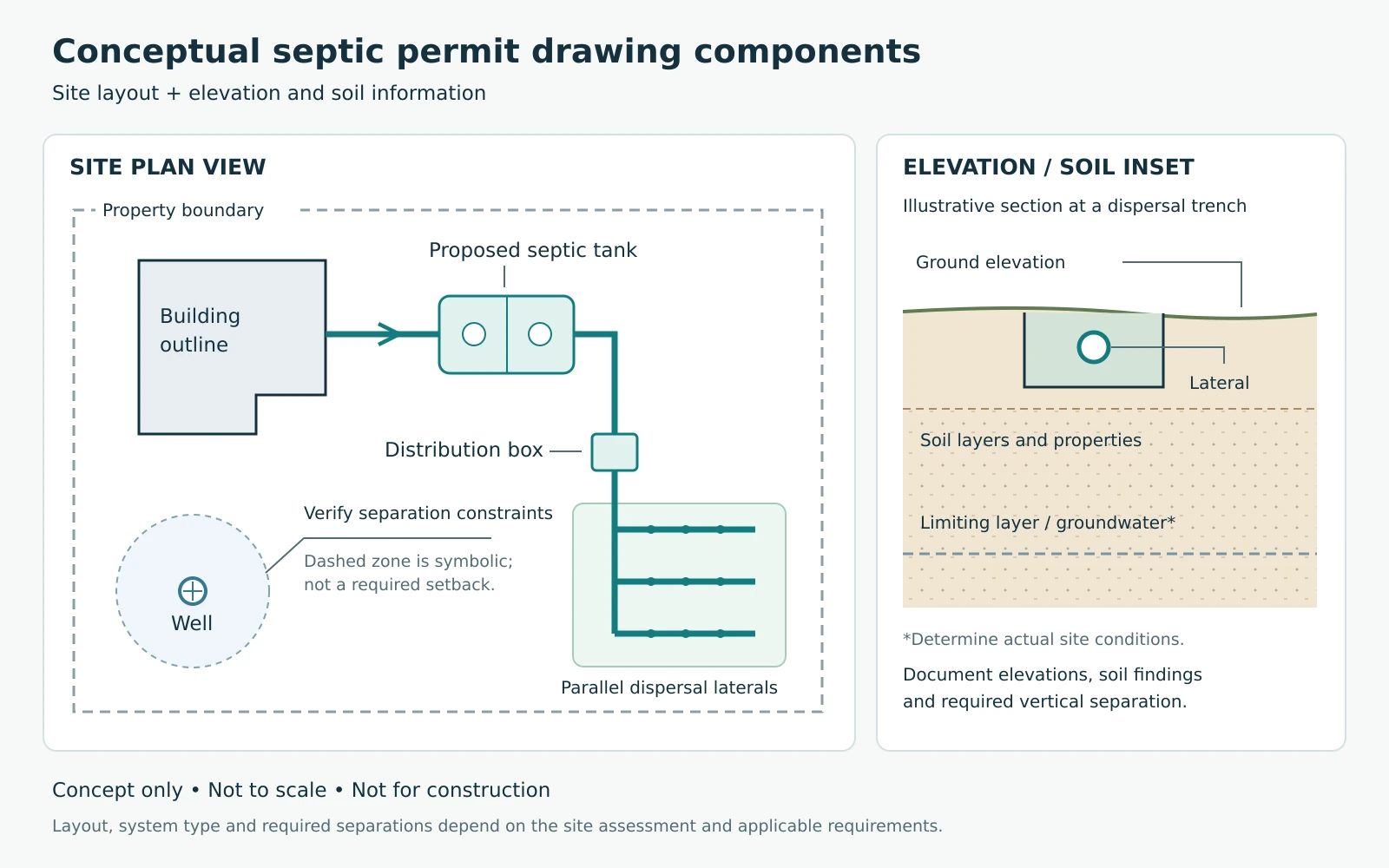
A septic layout is three-dimensional. The plan view shows where components fit, but elevations and subsurface conditions help determine whether the arrangement is workable. A drawing can look generous on paper while leaving unresolved vertical constraints.
Site information should support the specific decisions the design team needs to make. A broad regional soil description cannot substitute for relevant property information. Neither an attractive lawn nor the apparent dryness of a site on one visit establishes the subsurface conditions needed for design.
Identify who will provide required soil and groundwater information and how that provider will document it. Elmid Design Inc.’s engineering scope should clearly distinguish the use and interpretation of third-party information from any separately contracted field investigation. Do not assume the engineering fee covers testing merely because the project requires it.
The same care applies to property boundaries and elevations. An informal sketch may help explain an idea, but do not treat it as a survey. Where dimensions or levels affect feasibility, the design team needs a suitable basis for using them.
Separate facts, assumptions and open items
A useful project record labels each input as confirmed, preliminary or outstanding. For example, a surveyed building corner is different from an approximate location supplied in an email. A proposed finished floor elevation is different from an existing measured level.
This does not mean every early concept must wait for every detail. It means the concept should clearly state its limitations. Decisions that depend on missing information should remain conditional until the relevant evidence is available.
PEO Certificate of Authorization
Elmid Design Inc. provides engineering and design consulting for building and land development projects. For a septic proposal, that work concerns the engineering documents and coordination needed to evaluate a site-specific wastewater arrangement, rather than the physical installation of the system.
Elmid Design Inc. holds an active Certificate of Authorization from Professional Engineers Ontario.
How a septic engineer establishes design flow in Clarington
The septic engineer should establish the wastewater design basis from the applicable criteria and proposed building, not simply an owner’s estimate of present water consumption. A household’s habits may change. Evaluate the arrangement against the use described in the application.
Your septic engineer needs consistent building information to establish the design basis for your Clarington proposal. For a residential proposal, identify the existing and proposed bedrooms, finished floor area and plumbing fixtures. Supply the plans and a clear account of intended uses, not just current household occupancy. The applicable calculation determines how the designer uses those inputs. This guide does not prescribe a flow rate or substitute tank size. If the plans change, ask the designer whether the wastewater calculations need revision.
An owner’s priorities still matter. They can explain the proposed use, the expected project sequence and any constraints on the property. However, preferences do not replace the criteria used for design. A smaller household is not, by itself, a reason to assume a smaller system will be acceptable.
Keep the calculations connected to the drawings. The building description, system selection and layout should all refer to the same proposal. Even a correct calculation can confuse the review if it accompanies an outdated site plan. Submit calculations and drawings that describe the same requested work.
How building changes affect septic design
An architectural change may affect more than one engineering document. A revised building layout can alter the wastewater design basis while a shifted footprint changes the space available for the system. The design team should consider both effects together.
Before finalizing an addition, ask the designer which building decisions you need to settle before septic review. That question can prevent repeated redesign without suggesting that the initial concept guarantees feasibility.
Coordinate septic design with your Clarington lot
The proposed system belongs on the same coordinated base plan as the building, well, driveway and other relevant site features. A design team should be able to trace the relationship between the wastewater area and the remainder of the property without switching between conflicting sketches.
Show existing and proposed conditions distinctly. Label each feature that you plan to remove, retain or relocate. Ambiguous linework can make a planned clearance look available when an existing feature actually remains in place.
Grading also needs attention. Proposed surface levels and drainage routes can affect how the wastewater layout fits the site. Conversely, the septic arrangement can constrain grading decisions. Coordinating these items early is different from promising that engineering can eliminate every site limitation.
Consider access without confusing engineering design with installation planning. The drawings can identify relevant spatial relationships and coordination questions, while the installer remains responsible for its authorized work and methods. The consultant’s deliverables should identify the access questions they address and those outside the assignment.
Related: Coordinate grading and drainage with your site layout
Compare septic design options for your Clarington property
Where more than one arrangement appears feasible, compare the options using the same project assumptions. The comparison should explain the space each option needs, the information still required and its relationship to the proposed building and other site features.
- Avoid choosing a system solely from an image or product description. A compact-looking component does not establish that the full arrangement fits the property. The designer must consider treatment, distribution and dispersal together with the applicable design requirements.
- Likewise, a higher-priced option is not automatically better for every site. The useful question is which option is appropriate for the verified conditions and proposed use. The designer should explain the reasoning and limitations, not offer an unsupported universal ranking.
- At this stage, distinguish a concept comparison from a completed design. Preliminary options may help an owner decide where to place a building or whether to obtain further information. Do not use preliminary options as permit-ready drawings or instructions to begin work.
Record the septic design basis and conditions
After selecting an option, document the reasons and assumptions. Identify the architectural plan, base drawing and site information that informed the decision. If later information changes those assumptions, the team can revisit the decision deliberately rather than trying to reconstruct an informal conversation.
This record can be short. Its purpose is to preserve the design basis and unresolved conditions, not create paperwork for its own sake.
What to expect from a septic engineer in Clarington
A useful package explains the proposal and its design basis to someone unfamiliar with the project. The drawings and supporting information should identify the property, the building proposal, the relevant site features and the intended wastewater arrangement.
The exact deliverables depend on the assignment and review requirements. They may include a coordinated site layout, design calculations, component information, elevations, details and notes. Confirm the required content for the actual application instead of treating a generic checklist as sufficient.
Legibility is part of technical clarity. Use consistent labels, readable dimensions and a clear distinction between existing and proposed work. Notes should support the drawing rather than contradict it. Avoid burying an important limitation in a paragraph that is disconnected from the affected feature.
Septic permit drawings and supporting reports should clearly identify their issue and date. If an application includes an old architectural plan alongside a newer septic layout, correct that mismatch before submission.
Check septic permit drawings against the building and grading plans
Ask your septic engineer to compare the wastewater documents for your Clarington proposal with the building and grading plans. Check that the footprint, orientation, relevant elevations and site features agree. Confirm that the project description in the application reflects the same scope.
Then review outstanding inputs. A complete-looking PDF can still rely on an unverified assumption. If a missing item affects the proposed design, identify it openly and resolve it through the appropriate process rather than hiding it in a broad disclaimer.
Coordinate septic design revisions and review comments
Answer review comments against a stable document set. Keep the original comment, the proposed response and the affected drawing or calculation together. This makes it easier to distinguish a clarification from a design change.
Not every comment requires a redesign. Some concern missing information, inconsistent labels or an unclear explanation. Others may identify an assumption that the design team needs to reassess. The response should address the actual issue instead of adding unrelated material.
When the owner changes the proposal during review, identify that separately from the authority’s comments. A revised addition or relocated driveway may affect the design even if the reviewer did not request it. Combining all changes without explanation can obscure the reason for a revision.
Do not equate resubmission with acceptance. The authority decides whether the revised material satisfies its requirements. The consultant can prepare a clear response and supporting documents, but cannot guarantee approval, a review duration or an absence of further questions.
Prepare a residential comparison that answers the review question
For an addition or conversion, put existing and proposed building information side by side. Identify bedrooms, finished floor areas and fixtures on the same plan revision that the septic designer receives. If a room changes use without a change to the footprint, describe that change rather than leaving the designer to infer it from a room label.
Keep measured or documented information separate from owner estimates. An approximate basement area may be useful during an inquiry, but the design calculation needs an appropriate basis. Similarly, a plan labelled “existing” should not include work that is only proposed. These distinctions help the reviewer understand the scope of the assessment.
The building comparison and the site comparison answer different questions. Building information supports the wastewater design basis. Site information shows where components, wells, buildings and other relevant features lie. A proposal can change one without changing the other, so provide both where relevant.
When the existing system information is incomplete
Explain whether the available record is an approved design, a later drawing or an informal sketch. Do not describe a proposed arrangement in an old file as the verified current installation. Identify the missing fact and discuss how the team can establish it for the present assignment.
For example, an owner may have a drawing but no reliable confirmation of the current component locations. That gap is different from having a complete layout but no information adequate to assess a changed building use. The next task should address the actual uncertainty, not repeat a generic inspection or redesign recommendation.
Keep one current submission set
Retain the drawing dates, application identity and reviewer comments together. When a plan changes, identify the affected calculation or site relationship and replace the superseded document in the submission set. Keep the earlier issue in the project history, clearly marked as superseded. This provides a practical record for review without implying that document control establishes technical acceptance.
Avoid three common planning shortcuts
The first shortcut is assuming an old permit proves the present proposal is suitable. A historic approval can be valuable evidence, but its scope and underlying building information may differ from today’s project. Compare the records with the current proposal before relying on them.
The second shortcut is reserving wastewater space only after you settle the building and landscape layout. Even where the site appears large, the useful area can be shaped by several interacting constraints. Bringing septic planning into the early layout discussion makes those interactions visible.
The third shortcut is treating engineering as a promise that every constraint can be solved. Some sites require further investigation, a revised building proposal or a different approach. A candid explanation of those limits is more useful than a guaranteed outcome that the evidence cannot support.
Working with Elmid Design Inc. on Clarington septic design
Elmid Design Inc. supports septic design in Clarington through engineering consulting focused on the property’s proposed use and the information available for review. The starting point is a defined assignment: what needs to be evaluated, which documents are required and which inputs must come from other parties.
When you engage a septic engineer in Clarington, define how the assignment connects building plans, wastewater calculations and layout constraints. Elmid Design Inc. can prepare coordinated engineering documents within the agreed scope. Where grading or building-design questions affect the wastewater arrangement, coordinate those disciplines rather than commissioning disconnected drawings.
The engineering deliverables should make the proposal understandable. Depending on the agreed scope, these can include a site-specific layout, supporting design calculations, relevant details and responses to technical review comments. The scope should identify the intended application stage and any limitations on the information used.
Elmid Design Inc. does not issue municipal or Health Department approvals. Engineering documents support the review process; the applicable authority makes the approval decision. Installation, excavation and other contractor activities are separate from the consulting role described here.
An early inquiry is most useful when it includes the property address, project description, available plans and any review comments. There is no need to disguise gaps in the information. Identifying them at the start helps establish a realistic next step and a clearer engineering scope.
Compare septic engineering scopes before fees
Ask what the engineering fee includes rather than comparing a single total in isolation. A concept assessment, a detailed design and a review-response assignment are not interchangeable. Confirm whether the fee covers coordination, additional revisions and particular site-information inputs, or prices them separately.
Similarly, distinguish consultant fees from authority charges and work by other providers. A design proposal should not imply that every project cost is included. The owner should understand the deliverable, the assumptions behind the fee and the circumstances that could change the scope.
PROJECT SUPPORT
Not sure which service you need?
Elmid Design Inc. provides engineering consulting and design for building and land development projects. Share your proposed work and available information so Elmid Design Inc. can identify the engineering support that fits the project.
Explore septic design, site grading and building permit design.
Another residential septic-design project outside Clarington
Elmid Design Inc.’s public portfolio describes another residential septic-design project outside Clarington. The recorded engineering scope includes tank and pump arrangements, a leaching-bed layout, calculations and revisions responding to regional review. This example illustrates the type of engineering documents involved; it is not presented as a Clarington project, an installation service or proof of an approval outcome. View the public project portfolio
Illustrative septic planning examples
The following examples explain design coordination. They are hypothetical, not claims about completed Elmid Design Inc. projects or approvals. Elmid Design Inc. provides septic engineering and design consulting that can translate project information into layouts, calculations and coordinated drawings within an agreed scope.
Example: an addition beside an existing system
An owner proposes a larger living area and supplies an old septic drawing. The first task is to compare the current building, the proposed plans and the available system records. The design team identifies any further information it needs before evaluating the proposal.
A useful output is a coordinated plan showing the addition and the relevant wastewater features, supported by the design-basis review appropriate to the assignment. The example does not assume the old system is suitable, nor that replacement is inevitable. It shows why those conclusions should follow evidence rather than a guess.
Example: a new home with an unsettled driveway
A preliminary house location leaves several possible access routes. Choosing the driveway without considering the wastewater area could constrain the later design. Instead, the team reviews the building, access and septic concept on a common base drawing.
The owner can then compare the consequences of each layout before committing to one. The engineering exercise identifies constraints and remaining information needs; it does not establish that every arrangement can be approved.
Example: a replacement proposal with incomplete records
An owner knows a system exists but lacks a reliable drawing of its arrangement. The replacement design team first identifies the available facts, the remaining gaps and the providers who will supply missing information. It records the uncertainty rather than assuming a component location.
The result is a clearer basis for the next design stage. This approach also makes the scope easier to understand: obtaining information, evaluating options and preparing an application package are related but distinct tasks.
Related: Bring your building proposal and engineering plans together
Frequently asked questions
Who reviews septic applications for Clarington properties?
Durham Region Health Department administers the Clarington approval process for sewage systems subject to Ontario Building Code Part 8. First confirm which legislation applies using the design capacity, discharge method and property arrangement, including the combined design capacity of multiple systems on one lot or parcel and applicable exceptions. Some proposals require provincial approval instead. Official Durham guidance
Does a home addition always mean a new septic system?
No. An addition does not automatically establish the need for a new system. The designer must consider the proposed building changes, available system information and applicable review requirements. That review may identify further information or design work; do not assume its outcome in advance.
Can a septic engineer in Clarington design from a photograph?
A photograph may help explain the site, but it does not establish boundaries, elevations, subsurface conditions or the design basis. It can be useful supporting information, not a substitute for the inputs needed for the engineering assignment.
Does Elmid Design Inc. install septic systems?
The services described here are engineering and design consulting. Installation and excavation are separate contractor activities. The proposal should clearly identify the engineering deliverables and any third-party information or work required.
Is soil testing included in an engineering quote?
Do not assume it is. Confirm who provides any required site investigation, what information the designer needs and whether the engineering quote includes that work. Ask the designer to check whether existing information remains relevant to the current proposal.
Can the engineer guarantee approval or a completion date?
No. An engineering consultant can prepare documents and respond to technical comments within its agreed scope. Approval rests with the reviewing authority, and timing depends on information, project changes, review requirements and other participants.
What should I send a septic engineer in Clarington?
Send the property address, a concise description of the work, available building and site plans, septic records and any authority comments. Identify missing information and decisions still open. That gives the design team a practical basis for discussing the scope.
Can I use the same design as my neighbour?
A neighbouring design does not establish suitability for your property. Building use, layout, elevations and site information may differ. Ask the designer to review your property before relying on an arrangement from a different address.
Sources and next steps
Start with Durham Region’s sewage and septic guidance for the local application route and linked current forms. Use the Ontario Building Code information page to locate the provincial framework, and confirm the applicable technical requirements with the project designer and reviewing authority.
To discuss your proposal with a septic engineer in Clarington, assemble the available project information and contact Elmid Design Inc. A clear description of the proposed work is the most useful first step toward a defined septic-design assignment.
Geographic Locations That We Service:
Elmid Design Inc. provides septic engineering and design consulting to support site-specific wastewater proposals and applicable review processes. Related grading and drainage resources for our service areas are linked below.
We provide engineering services across a wide range of municipalities, each with its own requirements and review processes.
Toronto and Surrounding Areas
We provide engineering services in Toronto and provide grading engineering resources through our Toronto grading plan page.
Our service area also includes Oshawa, Pickering with our Pickering grading plan resources, and Clarington.
We also provide engineering services in Ajax through our Ajax grading plan resources, Whitby, Brock, Scugog, and Uxbridge, including our Uxbridge grading plan resources.
Halton Region
Within Halton Region, we provide engineering services in Burlington, including projects requiring Burlington grading plans.
We also provide engineering services in Halton Hills, supported by our Halton Hills grading plan resources.
Our service area also includes Milton and Oakville, including our Oakville grading plan resources.
Peel Region
Within Peel Region, we provide engineering services in Brampton, including projects requiring Brampton grading plans.
We also provide engineering services in Mississauga through our Mississauga grading plan resources and Caledon through our Caledon grading plan resources.
York Region
Within York Region, we provide engineering services in Vaughan and provide information about Vaughan grading plans.
We also provide engineering services in Aurora through our Aurora grading plan resources and East Gwillimbury through our East Gwillimbury grading plan resources.
Additional service areas include Georgina with our Georgina grading plan resources, Markham with our Markham grading plan resources, and Newmarket with our Newmarket grading plan resources.
We also provide engineering services in Richmond Hill with our Richmond Hill grading plan resources, Whitchurch-Stouffville through our Whitchurch-Stouffville grading plan resources, and King through our King grading plan resources.
Our service area also includes Bradford West Gwillimbury.
Other Southern Ontario Cities and Towns
We provide engineering services in many additional Southern Ontario communities, including Hamilton, St. Catharines, Niagara-on-the-Lake, Brant, Cambridge, Kitchener, Waterloo, and Woodstock.
We also provide engineering services in Guelph, Centre Wellington, Shelburne, Orangeville, New Tecumseth, Essa, Collingwood, Wasaga Beach, and Barrie, including our Barrie grading plan resources.
Additional service areas include Midland, Orillia with our Orillia grading plan resources, Ramara, Minden Hills, North Kawartha, Kawartha Lakes, Peterborough, Selwyn, and Brighton.