
Phased Development FSR: Interim and Ultimate Servicing
A phased development FSR coordinates interim servicing and ultimate water, sanitary and stormwater infrastructure, from first occupancy to final buildout.
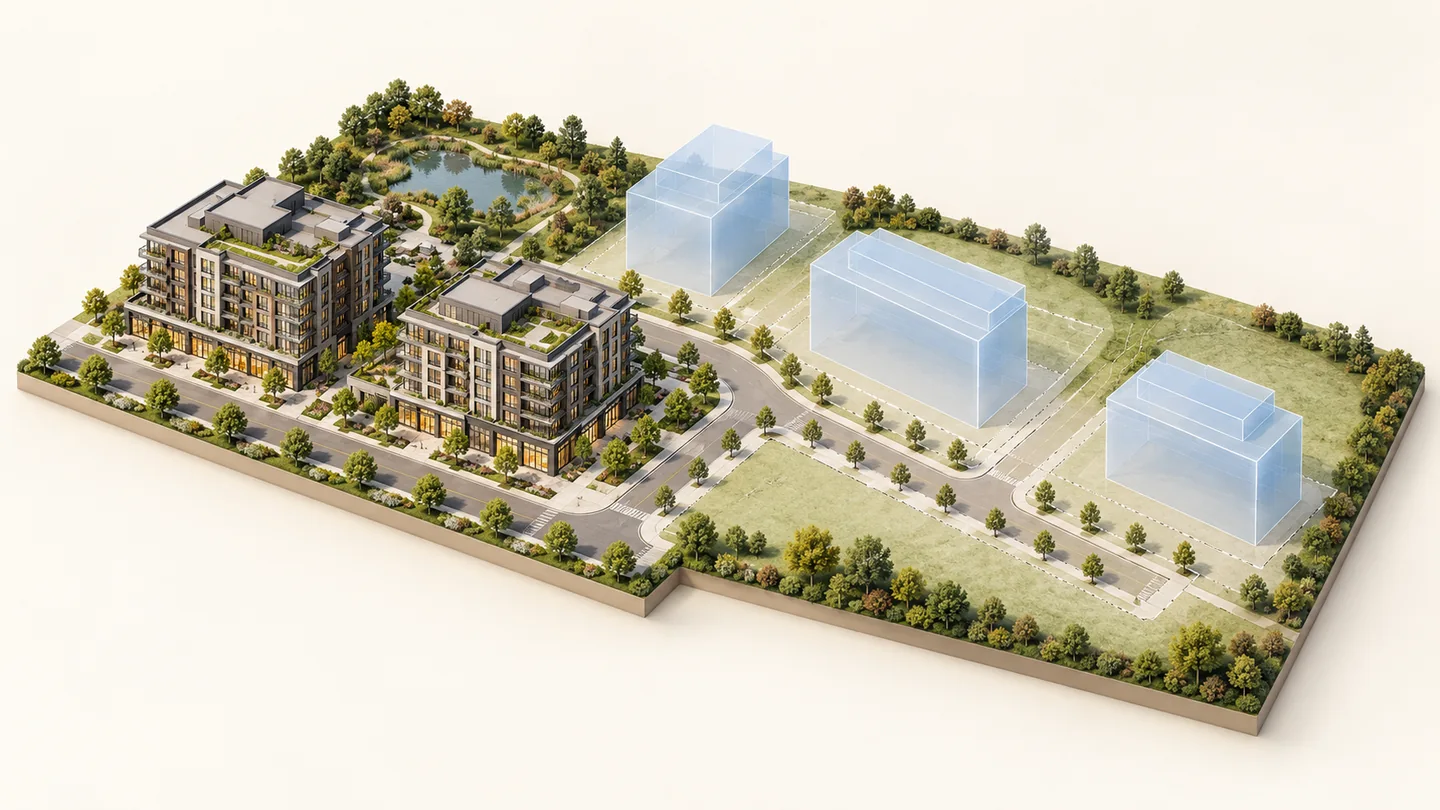
The servicing strategy connects the first occupied buildings, interim infrastructure and ultimate layout. For Ontario owners, the key question is practical: can each phase function with the infrastructure actually available at that time?
A completed master plan may show enough infrastructure for the finished site. However, that does not establish whether the first phase can open before a future watermain loop, sewer extension or stormwater facility exists. The report must make those dependencies visible so the project team can plan the next decision.
Key Takeaways
- Assess the first operating phase and later transitions, as well as ultimate development.
- Use the same phase boundaries, development statistics and issue dates across all three servicing systems.
- Identify infrastructure, access and approvals that each phase depends on before setting its release milestone.
- Update the servicing assessment when the building programme, sequence or connection strategy changes.
What should a phased development FSR establish?
A phased development FSR should describe a workable servicing arrangement for each relevant stage of the proposal. That means identifying what exists, what will operate, what remains temporary and what must happen next. The level of analysis depends on the application and reviewing authority.
Start with a clear distinction between development phasing and construction sequencing. Development phasing describes the portions of the project brought forward or occupied over time. Construction sequencing describes how work proceeds within or between those portions. They interact, but they are not interchangeable.
For example, the first building may need a permanent sanitary outlet before the second parcel is developed. The construction team may therefore install part of the ultimate sewer through that future parcel early. The report should identify that dependency, while the detailed design and construction documents explain the authorised work.
Define Each Phase in the Phased Servicing Report
Record the proposed units, floor areas, uses and servicing limits for each phase. Also identify buildings that remain in operation while redevelopment proceeds. These existing demands may continue alongside the new development rather than disappearing when construction starts.
Use the same phase names on the site plan, calculations and servicing drawings. If the architect calls an area “Block B,” avoid silently calling it “Stage 2” elsewhere. A short phase register can connect both labels when the project needs them.
Next, record the issue date of the development statistics. An FSR based on an earlier unit count may no longer represent the current application. Therefore, make the calculation basis easy to trace instead of burying it in an appendix.
Separate Interim and Ultimate Servicing in the Phased FSR
Interim servicing supports an identified temporary development condition. Ultimate servicing supports the defined final development scenario. Neither term establishes that the works have approval, capacity allocation or permission to operate.
Describe what changes between the two arrangements. A temporary connection may be removed, a permanent main may gain a second connection, or a stormwater catchment may expand. The report should explain these changes in words and on coordinated plans.
A useful phased development FSR also states the limits of the current application. Later phases can remain concept-level where appropriate, but their infrastructure dependencies must still be understandable. Otherwise, the first phase can inadvertently occupy land or capacity needed for the rest of the project.
Start with the authority’s submission requirements
Ontario municipalities do not use one identical FSR checklist. Confirm the applicable terms of reference, engineering criteria and pre-application comments for the property. Regional servicing responsibilities may also affect who reviews the connections and supporting analysis.
Toronto’s Servicing Report terms of reference, effective June 2, 2025, include proposed development phasing in watermain and sanitary analyses. Its stormwater requirements also address interim conditions for phased Site Plan Control and Plan of Subdivision applications. These are Toronto requirements, not a universal checklist for every Ontario project.
Similarly, Markham’s Annex 2 engineering report outlines include proposed phasing in the FSR scope. The document also contains separate study outlines. Therefore, do not copy a Master Environmental Servicing Plan requirement into an FSR without confirming its relevance.
Turn comments into a scope register
Collect the authority’s comments in one register before commissioning the assessment. Identify the requested analysis, responsible consultant, supporting information and intended submission. This makes differences between a planning report and detailed engineering design easier to manage.
Where a comment is unclear, seek clarification on the required decision rather than preparing unrelated calculations. For instance, a reviewer may need evidence of first-phase water supply, not simply an ultimate demand total. The right scope addresses that specific issue.
Also distinguish study acceptance from subsequent permissions. A favourable servicing conclusion does not itself authorise a connection, construction or occupancy. The project team should track those requirements through the applicable approval process.
Water servicing in a phased development FSR
Water analysis should relate each development stage to the network that will actually serve it. Begin with the available main records, connection locations and relevant pressure information. Then assess the demand scenarios required by the reviewing authority.
The first occupied phase may have fewer users than the final development. However, it may also have a less connected network. A future loop shown on the ultimate plan cannot be treated as operating during the first phase unless it will be available then.
Accordingly, show the active mains and connections for each assessed condition. Identify whether a proposed connection depends on off-site work, another parcel or a municipal project. Record the evidence for that dependency rather than assuming a completion date.
Coordinate demand and fire-protection inputs
Calculate demands from the current development programme and accepted criteria. Keep domestic demand separate from the fire-flow assessment, then combine scenarios where the adopted method requires it. Use consistent units and identify the source of each assumption.
Building size, use, construction and fire-protection information can affect the relevant fire-flow inputs. Therefore, coordinate these matters with the architect and appropriate specialist. A change in the first-phase building may matter even when the total development area remains unchanged.
For each phase, make the water-analysis summary identify:
- The demand scenario and current development statistics.
- The mains and connections available in that phase.
- The assessment boundary and technical conclusion.
- Any outstanding test, model input or authority confirmation.
Check early-phase operation, not only peak capacity
An ultimate-sized network can face a different operating condition when only a few buildings are occupied. Water turnover, incomplete looping and operational arrangements may need attention alongside demand and pressure. These questions should be raised early with the system owner.
Ontario’s drinking-water distribution guidance addresses hydraulic performance and water-quality considerations. Applying that guidance to a staged development requires professional judgement and the relevant municipal criteria. It does not create a single standard flushing or temporary-water solution for every site.
For a more focused discussion of demand, pressure and fire flow, see the FSR water capacity assessment guide. Here, the emphasis is how those findings affect the sequence of the wider development.
Sanitary Servicing in a Phased Development FSR
The sanitary component of a phased development FSR should connect each phase’s wastewater contribution to a defined receiving system. Calculating the site’s final flow is not enough. The report also needs to explain where the first-phase flow goes and which downstream works are available.
Identify retained uses, new uses and the timing of any disconnections. This helps prevent double-counting a demolished use or omitting a retained building. The same principle applies where a temporary arrangement serves an occupied part of the site during redevelopment.
Next, distinguish the proposed service connection from the broader downstream assessment. A pipe at the property line does not by itself demonstrate spare system capacity. The analysis boundary and required evidence should follow the authority’s criteria.
Keep flow assumptions consistent
Use the accepted basis for occupancy, wastewater generation, peaking and applicable infiltration or inflow allowances. Explain which components change with each phase. Avoid applying a final-site allowance to one phase without showing why that approach is appropriate.
A concise schedule can show existing retained flow, each proposed increment and the cumulative development condition. However, peak-flow methods may not be simply additive. The engineer should apply the accepted calculation method to the correct combined condition.
Ontario’s sewage works design guidance addresses design flows, capacity, staged construction and continued operation. Local criteria and applicable approvals still determine the project’s specific requirements. Do not import numerical assumptions from an unrelated municipality.
Identify the practical outlet dependency
An early phase may depend on a sewer through land scheduled for later development. In that case, confirm the route, elevation basis and access needed for the connection. Property rights and operational responsibility also require coordination with the appropriate parties.
If an outlet cannot be available in time, the team should evaluate the consequences before committing to a release date. Options may involve advancing permanent infrastructure, revising the sequence or assessing another acceptable strategy. Each option needs its own technical and approval review.
Do not present temporary pumping or storage as a simple default. Such arrangements can introduce reliability, operation, ownership and approval questions. A phased servicing strategy should make those responsibilities explicit if the project proposes them.
Stormwater Planning in a Phased Development FSR
Stormwater conditions change as land is cleared, graded, paved and occupied. A phased development FSR should therefore coordinate the relevant interim drainage conditions with the separate stormwater analysis. The final catchment plan cannot automatically represent every earlier stage.
Start by mapping the contributing areas for each important condition. Include retained surfaces, new roofs and pavement, disturbed land and any external drainage. Then identify where the runoff travels and which controls operate at that time.
Also check major overland routes. A route through a future parcel may be acceptable only while that land remains available and suitably graded. A later building, stockpile or access change can alter the arrangement, so the transition must be planned.
Connect the drainage plan to the actual sequence
A permanent facility may need to operate before every development block is complete. Alternatively, an interim measure may be proposed until permanent works become available. In both cases, explain the drainage area, function and transition in the relevant design documents.
Ontario’s stormwater planning guidance supports integrating stormwater decisions with site and subdivision planning. The project still needs current local criteria and receiving-system requirements. No single pond volume or release rate applies to all phased developments.
Toronto’s applicable stormwater terms of reference specifically address interim catchments, outlets, overland routes and flow-management strategies for phased proposals. For a Toronto application, use those requirements alongside the current servicing submission. Elsewhere, confirm the equivalent local scope.
Keep temporary ESC and permanent servicing coordinated
Erosion and sediment control measures manage construction-stage sediment and related runoff risks. Permanent stormwater infrastructure serves a different design role. The project team should coordinate them without treating one as automatic evidence that the other is adequate.
For example, a permanent facility used during construction may need protection, maintenance and an agreed transition before its intended long-term operation. The detailed approach depends on the facility and authority. Identify the issue early rather than assuming construction use has no effect.
The stormwater management report service explains the broader design scope. A phase-specific assignment can coordinate that work with the FSR, grading and construction-stage controls.
One phase, three coordinated questions
- Water
- Can the available network support the required demand and operating conditions for this phase?
- Sanitary
- Can this phase discharge through its actual connection and assessed receiving system?
- Stormwater
- Can this phase manage runoff through the catchments, routes and controls available at that stage?
The answers should refer to the same development plan, not three different design revisions.
Build the Phased Servicing Report Around Dependencies
A dependency plan links the technical findings to decisions the owner can act on. It should explain what must be resolved before a phase can rely on a particular servicing arrangement. Keep these dependencies distinct from an assumed construction programme.
For each issue, identify the required evidence, responsible party and affected phase. Examples include a capacity confirmation, an accepted connection route or completion of a related infrastructure component. The engineer should describe the technical dependency without promising another party’s delivery date.
This approach is especially helpful where multiple owners or authorities control different parts of the system. A line on a concept plan does not establish permission to use neighbouring land or infrastructure. Coordinate the relevant rights and responsibilities through the proper project advisers.
Plan transitions without interrupting occupied uses
A transition is a change from one operating arrangement to another. It might involve commissioning a new main, redirecting drainage or replacing a temporary outlet. The FSR should identify the servicing implications and the further design or operational coordination needed.
Where occupied buildings remain, consider how the proposed works relate to their continuing services. The detailed construction and commissioning procedures belong with the appropriately scoped team. However, the servicing strategy should not overlook that occupied condition.
Record which assumptions need confirmation before the transition. This gives the project team a usable handoff instead of a general statement that matters will be resolved later. It also helps avoid treating the ultimate arrangement as available too soon.
What should the phased development FSR deliver?
The deliverable should make its conclusions traceable. A reviewer should be able to connect each phase’s development statistics to the calculation basis, plan and stated dependency. Clear organisation matters more than repeating the same general conclusion throughout the report.
Include a coordinated phase plan and concise system summaries appropriate to the assignment. The drawings should distinguish existing, proposed, interim and ultimate elements clearly. Avoid relying only on colour where line types and labels can reinforce those differences.
Also explain unresolved information in practical terms. State what is missing, why it matters and which decision depends on it. This is more useful than either hiding uncertainty or filling the report with broad disclaimers.
Prepare a useful owner information package
Send the current survey, site plan, development statistics and proposed phasing to the consultant. Include previous reports, available servicing records and authority correspondence. Where information is preliminary, identify that status so the scope reflects it.
Explain which buildings or operations must remain active during the work. Also identify known off-site projects, property arrangements or infrastructure commitments that influence the sequence. The engineer can then separate confirmed inputs from matters needing further investigation.
Finally, state the immediate submission objective. An early feasibility review and a detailed application response are different assignments. A clear objective helps Elmid Design Inc. propose the relevant analysis and deliverables.
Make the phased development FSR evidence easy to follow
A useful evidence register separates measured information, authority records and design assumptions. Those sources do not carry the same certainty. For example, an old record drawing can identify a potential sewer route without confirming its present condition or a connection elevation.
Give important inputs a source, date and purpose. A survey supports site geometry and levels within its scope. A hydrant test provides observations at identified locations and conditions. A municipal comment identifies a review requirement, but it may not confirm capacity or allocation.
Next, connect each significant uncertainty to the analysis it affects. If a connection elevation is uncertain, identify the design decision that needs confirmation. If external demand information is incomplete, explain how that limits the capacity assessment rather than describing the entire project as unworkable.
Use a phase register that records decisions
The register below illustrates useful headings, not a prescribed municipal form. Keep the actual entries specific to your site. A short, maintained register is more valuable than a large table that no longer matches the current drawings.
| Record | What the entry should explain |
|---|---|
| Development basis | Phase boundary, proposed uses, units or floor area, retained uses and source drawing date. |
| Operating services | The water connection, sanitary outlet and drainage arrangement available during that phase. |
| Dependency | The infrastructure, evidence or decision required before relying on the arrangement. |
| Transition | What changes for the next phase and which consultant or authority input is needed. |
| Status | Confirmed information, current assumption or outstanding action, with its latest source. |
Use clear status wording. “Shown on concept plan” is different from “assessed in the current report” or “accepted by the authority.” Keeping those distinctions visible helps the owner understand progress without overstating it.
Coordinate Disciplines in the Phased Servicing Report
The civil report and building design meet at specific interfaces. Water-service entry locations, sanitary discharge elevations and roof-drainage connections should correspond across the relevant drawings. A change on one side can affect routing, available levels or demand assumptions on the other.
Landscape and access designs also influence the servicing strategy. A tree-protection area can constrain a corridor, while a revised driveway may change a surface drainage route. Bring these matters into coordination before treating the phase plan as fixed.
During review, ask each discipline to identify the information it has issued and the assumptions it still relies on. This avoids a circular handoff where every consultant assumes someone else has confirmed the same detail. The FSR can then describe a coherent basis for the proposed stage.
Compare alternatives on the same basis
When the first arrangement has a constraint, compare alternatives using the same development statistics and criteria. Otherwise, one option may appear better simply because it uses a different demand or drainage assumption. Record the differences that genuinely drive the result.
For example, advancing permanent works may reduce one servicing dependency while creating an earlier land-access requirement. Revising the phase boundary may simplify a connection but change the drainage catchment. The comparison should explain both effects rather than presenting either option as an automatic solution.
Bring cost and programme inputs from the responsible advisers into the owner’s decision separately. Engineering analysis can identify the works and investigations an option needs. It should not invent a construction price or guarantee a review timeline.
When should a phased development FSR be updated?
Review the report when a change could affect its assumptions or conclusions. Typical triggers include a revised unit count, different use, altered phase boundary or new connection location. A change in the order of development can matter even if the final buildout remains the same.
New infrastructure information can also change the assessment. For example, updated records or authority comments may identify a constraint that the earlier concept did not resolve. Reconcile that information before relying on the previous conclusion.
Keep a clear document register showing the current report, calculations and drawings. Then check that each submission uses the same coordinated issue. This reduces the risk of a reviewer comparing current drawings with superseded servicing assumptions.
Phased development FSR support from Elmid Design Inc.
Elmid Design Inc. can review your development concept and prepare a project-specific functional servicing scope. For a phased proposal, that work starts by understanding the intended sequence, retained uses and known infrastructure constraints. The aim is a clear engineering basis for the next design or application decision.
The agreed assignment can include reviewing available records, establishing phase-specific development inputs and coordinating water, sanitary and stormwater findings. Where related studies are separate, Elmid Design Inc. can identify the information each study must exchange. This keeps the FSR connected to the actual site plan rather than treating it as a standalone narrative.
Deliverables tied to the phased servicing decision
Depending on the scope, deliverables may include the servicing report, supporting calculations, conceptual connection plans and coordinated engineering drawings. A phase summary can identify the operating arrangement and infrastructure dependencies for each stage. Responses to municipal comments can then address the reviewer’s specific questions.
Elmid Design Inc. can also coordinate relevant grading and stormwater design within the agreed services. That coordination is important when a future road, drainage corridor or connection must remain available during early development. Where specialist investigations or other professional inputs are needed, responsibilities should be defined before the team relies on them.
The service is engineering and design consulting. Construction, installation, system operation and authority decisions remain with the responsible parties. A clear scope helps owners understand what the engineering package provides and what the wider project team must arrange.
Illustration: a first phase that depends on later land
Consider a conceptual three-phase development. The first phase contains occupied buildings, the second contains future building pads and the third remains undeveloped. The ultimate concept places a watermain loop and part of the drainage corridor through the later land.
The phased development FSR would first test the first-phase arrangement on its own stated basis. It would identify the available water connections, sanitary outlet and interim drainage routes. Next, it would explain which infrastructure must precede occupation or further development under the applicable review process.
Resolve the dependency before fixing the sequence
If the first phase relies on a later connection, the team must address that dependency. Advancing permanent infrastructure may be one option; revising the development sequence may be another. The suitable response depends on the technical assessment, land arrangements and authority requirements.
Elmid Design Inc. can review the concept, prepare the scoped servicing assessment and coordinate related drawings for this type of decision. The useful deliverable is a documented relationship between the phase plan and its services. It is not an assumption that the final master plan automatically makes every intermediate condition workable.
Frequently Asked Questions
Does every phased development need the same FSR?
No. The scope depends on the proposal, application stage and reviewing authority. Confirm the current submission requirements and pre-application comments, then define the analysis needed for the relevant phases.
Can the ultimate servicing plan cover the first phase?
Only where the assessment demonstrates that the first phase can rely on the infrastructure available at that time. Future connections or controls should not be treated as operating before they exist and can be used.
Is interim servicing always temporary infrastructure?
No. An interim development condition may use permanent works installed early. The report should distinguish the operating condition from the infrastructure’s intended lifespan and explain any later changes.
Can a phased development FSR replace detailed design?
No. The FSR establishes the scoped servicing assessment and strategy. Detailed drawings, connection requirements, construction coordination and other approvals may still be needed for the proposed works.
What if the proposed development order changes?
Review the servicing implications before relying on the previous report. The revised order may change available connections, cumulative demands, drainage routes or infrastructure dependencies, even when the final layout is unchanged.
What should I send Elmid Design Inc. first?
Send the property address, current survey or available plans, development statistics, proposed phases and authority comments. Explain retained operations and your immediate submission goal so the engineering scope can address the right questions.
Geographic Locations That We Service:
Elmid Design Inc. provides functional servicing reports and coordinated engineering design for water, sanitary and stormwater servicing across Ontario. The project-specific scope reflects the proposed development and the reviewing authority’s requirements.
We provide engineering services across a wide range of municipalities, each with its own requirements and review processes.
Toronto and Surrounding Areas
We provide engineering services in Toronto and provide grading engineering resources through our Toronto grading plan page.
Our service area also includes Oshawa, Pickering with our Pickering grading plan resources, and Clarington.
We also provide engineering services in Ajax through our Ajax grading plan resources, Whitby, Brock, Scugog, and Uxbridge, including our Uxbridge grading plan resources.
Halton Region
Within Halton Region, we provide engineering services in Burlington, including projects requiring Burlington grading plans.
We also provide engineering services in Halton Hills, supported by our Halton Hills grading plan resources.
Our service area also includes Milton and Oakville, including our Oakville grading plan resources.
Peel Region
Within Peel Region, we provide engineering services in Brampton, including projects requiring Brampton grading plans.
We also provide engineering services in Mississauga through our Mississauga grading plan resources and Caledon through our Caledon grading plan resources.
York Region
Within York Region, we provide engineering services in Vaughan and provide information about Vaughan grading plans.
We also provide engineering services in Aurora through our Aurora grading plan resources and East Gwillimbury through our East Gwillimbury grading plan resources.
Additional service areas include Georgina with our Georgina grading plan resources, Markham with our Markham grading plan resources, and Newmarket with our Newmarket grading plan resources.
We also provide engineering services in Richmond Hill with our Richmond Hill grading plan resources, Whitchurch-Stouffville through our Whitchurch-Stouffville grading plan resources, and King through our King grading plan resources.
Our service area also includes Bradford West Gwillimbury.
Other Southern Ontario Cities and Towns
We provide engineering services in many additional Southern Ontario communities, including Hamilton, St. Catharines, Niagara-on-the-Lake, Brant, Cambridge, Kitchener, Waterloo, and Woodstock.
We also provide engineering services in Guelph, Centre Wellington, Shelburne, Orangeville, New Tecumseth, Essa, Collingwood, Wasaga Beach, and Barrie, including our Barrie grading plan resources.
Additional service areas include Midland, Orillia with our Orillia grading plan resources, Ramara, Minden Hills, North Kawartha, Kawartha Lakes, Peterborough, Selwyn, and Brighton.