
Sewer CCTV Reports for Redevelopment Design in Ontario
A sewer CCTV report can help redevelopment teams understand visible pipe condition, but it is only one design input. Match the recording to the intended connection, check coverage and keep survey, hydraulic capacity and reuse approval questions separate. This Ontario guide explains existing sewer condition evidence, sewer connection reuse report checks and CCTV limits for servicing design. Elmid Design Inc. supports servicing design; specialist inspection, cleaning and installation are separate responsibilities.
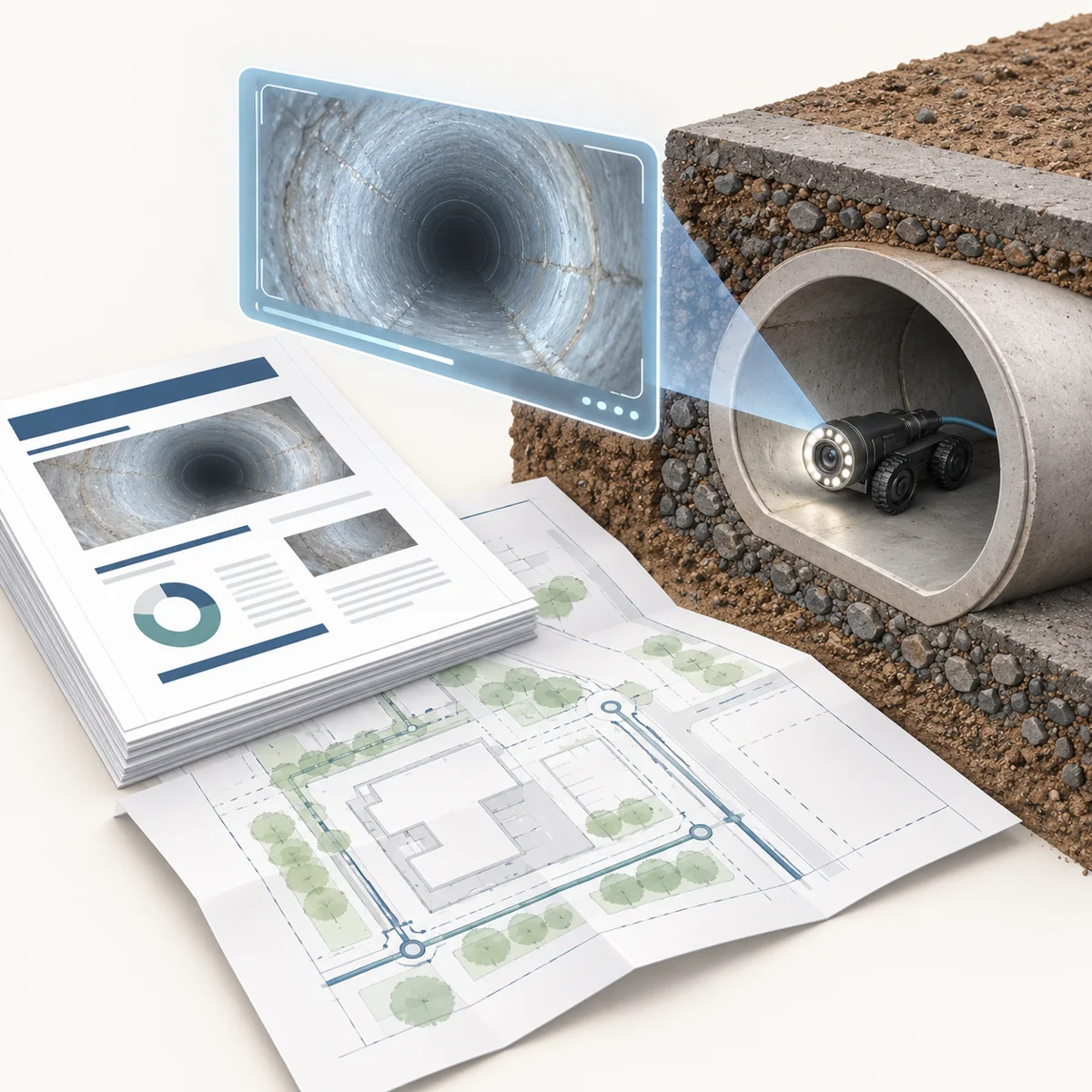
What a sewer CCTV report contributes to redevelopment design
A sewer CCTV report records observations made during a camera inspection of an identified pipe or connection. For redevelopment, its value lies in connecting those observations to the engineering questions facing the project. It can help the team understand visible condition and identify information gaps. It does not, by itself, establish the pipe’s full location, suitable design capacity or permission to reuse a connection.
Start by defining the decision. Is the team considering an existing service for a replacement building? Is an uncertain connection affecting the layout? Does a reviewer need condition information before considering a proposal? These questions can require different evidence. Ordering a video without explaining the design question may leave the owner with a recording that does not answer it.
This guide explains how owners can organize sewer condition records for professional review. It is not an inspection procedure or a repair guide. Field access, inspection methods and any maintenance work belong with the appropriately qualified parties and required permissions. Elmid Design Inc.’s role discussed here is engineering and design consulting.
Keep four different kinds of evidence separate
Condition, location, hydraulic performance and authority acceptance are related, but they are not interchangeable. A clear video may show a particular surface well without resolving the pipe’s elevation relative to a new basement. A surveyed connection can have a known position while its condition remains uncertain. An apparently sound connection may still need a different assessment for the proposed use.
| Evidence question | What the project needs to establish | What not to assume |
|---|---|---|
| Observed condition | What the inspection records within its documented coverage and limitations | That an unseen section is defect-free |
| Location and elevation | Reliable coordinates, levels and reference information where required for design | That camera travel distance is a surveyed pipe alignment |
| Hydraulic suitability | Whether the assessed system can serve the proposed flows under applicable criteria | That a clear-looking pipe proves sufficient capacity |
| Reuse acceptance | The responsible authority’s applicable process and decision | That an inspection report grants permission to retain the connection |
Use this distinction in meetings and correspondence. Instead of asking whether the sewer “passed,” ask which question was assessed and what the finding establishes. If the answer concerns visible condition only, keep the other questions open. This makes the next investigation or design task more precise.
The distinction also improves budgeting. Specialist inspection, survey information, engineering analysis and authority applications are different activities. Confirm which are included in each appointment rather than assuming one quotation covers the entire route from investigation to construction.
Confirm which pipe the sewer CCTV report describes
Before interpreting a defect or a favourable finding, establish the asset identity. A property may have more than one buried connection or records from different periods. A file named with the street address is useful, but it does not necessarily distinguish a sanitary connection from another pipe. Ask how the report identifies its start, end and inspection direction.
Compare the report references with available plans and records. Check whether the connection under consideration is actually the one inspected. If the inspection began at a different access point from the one shown on the design, ask the team to reconcile the relationship. Do not quietly relabel the report to fit the proposed arrangement.
Record the inspection date and the source of the files. Keep the issuing organization’s report together with its recording, photographs and any relevant explanation. A detached screenshot loses the surrounding context and can be mistaken for evidence about another location. The original report should remain available when someone prepares a summary for the design team.
Where identification remains uncertain, describe the uncertainty plainly. “Likely the existing sanitary service” is not equivalent to a confirmed connection reference. The engineer can identify which decision is affected and what clarification is needed before relying on the information.
Existing sewer condition evidence depends on coverage
A recording must be interpreted within the part of the system it actually covers. Determine the intended inspection extent and compare it with the reported completed extent. If the camera did not reach the intended end, the remaining section has not become acceptable simply because the observed section appears satisfactory.
Ask whether the report records visibility limitations, an interrupted inspection or uncertainty about the endpoint. Those facts can affect how the engineer uses the evidence. A summary should preserve them rather than reducing the findings to a single reassuring sentence. The difference between “no defect recorded in the inspected portion” and “the entire connection is suitable” is substantial.
Coverage also has a boundary across connected assets. A lateral inspection does not automatically assess the downstream municipal sewer. A recording of one run may not cover every branch, connection or structure relevant to the redevelopment. Define the engineering question first, then ask whether the available investigation reaches the necessary locations.
Do not attempt to overcome access or visibility problems yourself. Refer unresolved inspection scope to the specialist and the responsible project team. The owner’s useful role is to preserve the limitation, understand its design consequence and ensure that any further authorized work addresses the actual gap.
Read the sewer CCTV report alongside its recording
A written sewer camera inspection report should help the reader find the observations in the accompanying media. Check that the file names, asset references and dates agree. If the report refers to photographs or a separate recording, confirm that those files were supplied and can be opened by the intended reviewer.
Technical codes may classify observations using a particular reporting system. Ask the specialist to explain the relevant findings within that system rather than guessing the meaning from an abbreviation. A code is not automatically a design instruction. Its significance for the proposed development requires the appropriate professional interpretation.
Toronto’s dated TS 409 specification, September 2019, illustrates formal requirements for identified assets, dated recordings, inspection information and reporting. The City’s current sewer and watermain specifications index links that edition. Confirm the requirements applicable to the actual assignment; do not assume this construction specification governs every private inspection.
A polished report layout cannot compensate for missing coverage or uncertain identity. Conversely, a technical recording can be useful even when the owner does not understand every code. The goal is a complete, traceable package that the responsible professionals can review, with material limitations kept visible.
CCTV limits for servicing design include survey and elevation questions
A camera view is not the same as a coordinated survey. The engineer may need reliable information about the connection’s position and elevation relative to the proposed building and other services. The type and extent of verification depend on the design question. Keep source quality visible rather than presenting every line on a drawing as equally certain.
An invert is the internal bottom level of a pipe. When an invert elevation is used in design, the reference system and measurement basis matter. A number reported without a datum or clear location may not be directly comparable with the building or survey levels. Ask the design team to reconcile those references before treating the geometry as settled.
Distance along a recording can help identify an observation within that inspection. It does not automatically establish a surveyed horizontal position or the entire pipe profile. Bends, uncertain routes and incomplete records can complicate the relationship. The engineer should identify what further location information is needed, without converting an estimate into an apparently precise design dimension.
Similarly, a visual impression of standing water should not become an owner-calculated pipe slope. Refer the observation to the qualified team. Determining the significance may require other information. This guide does not provide measurement, access or field-testing instructions.
Once verified information is available, carry it consistently into the relevant plan, profile and supporting report. If it differs from an earlier assumption, review the affected design rather than merely updating one label. A connection level can influence the building interface and the available servicing route.
A clear-looking pipe is not hydraulic-capacity proof
Condition evidence helps answer what was visible at the time of inspection. Hydraulic assessment asks a different question: whether the proposed discharge and relevant system can meet the applicable design criteria. A pipe can look unobstructed while the redevelopment changes the flow assumptions. Its downstream receiving system also needs consideration where required.
Give the engineer the current development description. Explain changes in use, building arrangement, units or other relevant operating assumptions. Do not assume that a connection serving the earlier building is sufficient for the new proposal because its general size looks familiar. The appropriate design basis belongs in the engineering assessment.
The scope may distinguish the on-site connection from the downstream network. Ask which part is being assessed and what information supports the conclusion. If a municipal capacity response or further analysis is required, keep that dependency separate from the camera inspection findings.
A useful review summary can therefore contain different statuses: condition information received, connection elevation unresolved and capacity assessment pending. That is more informative than a single “sewer checked” entry. It tells the project team what work can proceed and what remains dependent on evidence.
A sewer connection reuse report does not itself authorize reuse
Reuse is a project decision involving the applicable authority requirements as well as engineering suitability. Establish who owns and reviews the relevant infrastructure. Ask which application, inspection or supporting evidence applies to the proposed work. Do not assume that a process described for a replacement house also covers a different redevelopment type.
Toronto’s water and sewer service connection reuse page limits its stated route to construction of a new residential home, subject to City inspection and approval. Its sanitary criteria address standards, shared connections, backup history and structural or operational defects. The page also describes CCTV review and maintenance-history review within its inspection-fee explanation.
This is a Toronto-specific example, not an Ontario-wide entitlement. Confirm current applicability for the actual property and proposal. An owner-supplied video should not be assumed to replace the City’s process. Other municipalities or infrastructure owners may have different requirements.
Keep the authority’s written response with the project records. Distinguish an acknowledgement that material was received from a decision allowing the proposed connection arrangement. If the response includes conditions, identify how each affects the design or subsequent work. A report summary should not remove those conditions to make the outcome sound more definite.
Turn observations and uncertainties into review questions
An owner does not need to diagnose a pipe from video footage. A more useful contribution is to help the team connect each reported issue to a responsible reviewer and an unresolved design question. The following matrix is an organizing aid, not a defect-grading standard or a repair prescription.
| Reported information | Question to take to the qualified team | Evidence or decision to record |
|---|---|---|
| The inspection ended before the intended endpoint | Which part remains unobserved, and does it affect the proposed design? | Coverage limitation and agreed further information scope |
| The report identifies a structural concern | How does the specialist’s finding affect consideration of the existing connection? | Professional assessment and any authority requirement |
| An operational concern is recorded | What additional assessment is needed before relying on the connection? | Defined investigation or design action, without assuming a remedy |
| Asset references conflict with the plan | Does the report concern the intended pipe? | Reconciled identification or explicit unresolved status |
| The connection elevation remains uncertain | What verified level information does the design need? | Source, reference system and design consequence |
| The new proposal changes discharge assumptions | What hydraulic review is applicable? | Current development inputs and assessment scope |
Avoid translating every observation into a predetermined construction response. The appropriate next step may be clarification, additional evidence, an alternative design or a decision by the authority. Repairs and field methods require their own professional and contractor responsibilities.
Give each unresolved item an owner and a clear closure criterion. “Discuss sewer” is difficult to close. “Confirm whether the report covers the proposed retained connection” identifies a specific question. Record the answer and the supporting reference so the issue does not return when another consultant joins the project.
Prepare a sewer CCTV report checklist for engineering review
Send one coherent package rather than a series of unlabelled screenshots. Begin with a short description of the proposed redevelopment and the immediate decision needed. State whether the team is exploring feasibility, responding to a review comment or coordinating detailed drawings. The same inspection evidence may serve different purposes at those stages.
- The property reference and current development concept.
- The complete camera inspection report and available original recordings.
- Inspection date, issuing organization and identified pipe or connection references.
- Any coverage, access or visibility limitations recorded by the specialist.
- Available servicing records, survey information and current drawings.
- Relevant authority comments, reuse correspondence and known connection history.
- A concise list of changes since the earlier servicing information was prepared.
Identify missing material rather than filling gaps with assumptions. If the video is available but the written report is not, say so. If the report refers to an attachment that cannot be found, request the complete package. The engineer can then explain whether the missing evidence prevents a particular decision or merely requires clarification.
Protect the original documents. Keep an unaltered copy and label any owner-prepared summary as a summary. Do not remove a limitation, revise a specialist’s conclusion or merge excerpts in a way that changes their meaning. The reader should be able to return to the source behind each important statement.
- Identify the pipe and source record.
- Map the observed extent.
- Keep unobserved sections explicitly unresolved.
- Refer the design consequence to the responsible engineer.
Condition evidence informs a decision; it does not grant reuse approval.
Define responsibilities before additional investigation
The inspection provider, surveyor, engineering designer, infrastructure owner and approving authority may each address a different question. Clarify those roles before arranging further work. An engineering assignment should identify the investigation information it needs and who is responsible for obtaining it, rather than implying that every specialist service is included.
Access and permissions also require coordination. Owners should not enter sewers, chambers or other confined spaces, open infrastructure or attempt to clear an obstruction to improve a recording. Qualified parties must manage field work through the applicable access, permission and safety arrangements. This article intentionally provides no operational instructions.
If a report identifies a concern requiring prompt specialist attention, pass it to the responsible parties rather than waiting for the next drawing issue. Keep the distinction between addressing an immediate operational problem and developing the redevelopment design. One task does not automatically complete the other.
For appointments and budgets, separate inspection costs, survey or other investigation, engineering design, authority charges and construction. Ask what triggers additional scope and how it will be authorized. A short sewer CCTV report can identify a substantial information gap; its page count does not determine the work necessary to resolve that gap.
Carry sewer CCTV report findings into coordinated drawings
Once the engineering team has assessed the evidence, the design should communicate the resulting arrangement clearly. Identify which existing services are proposed to remain and which decisions are still subject to confirmation. Do not allow a provisional reuse assumption to become an unconditional construction note simply because the drawing reaches a later revision.
Coordinate the connection with the building outlet, relevant grades and other buried services. If the preferred arrangement changes, review the affected plans and supporting reports together. A revised civil line can conflict with an unchanged building-services drawing or a utility crossing shown elsewhere in the package.
Retain references to the evidence used. A drawing note or design record can identify the relevant sewer CCTV report without reproducing every observation on the plan. The goal is traceability: a reviewer should understand which information supports the design and where material qualifications can be found.
Where a lot division or phased redevelopment is involved, check which property or stage depends on the existing connection. A report about the present arrangement does not automatically settle how the future parcels or phases will operate. The engineering scope should address those dependencies explicitly.
Conceptual examples of sewer condition evidence in design
A replacement building with an incomplete camera record
Consider a conceptual replacement-building proposal. The owner has a recording labelled with the property address, but the report states that the inspection ended before the intended endpoint. The visible portion appears generally clear. The design team should not convert that observation into a conclusion about the entire connection.
The useful next step is to identify the unobserved extent and its relationship to the proposed retained service. The engineer and inspection specialist can clarify what further information is needed. The authority’s reuse requirements remain a separate question. Until those matters are resolved, the layout should show the relevant assumption rather than promise that retention is accepted.
A redevelopment with favourable condition findings but changed flows
In another conceptual scenario, a report provides clear condition information for the intended connection. The redevelopment changes the building use and the discharge assumptions. The report remains useful, but it does not establish hydraulic suitability for the new proposal or the receiving network.
The engineering review therefore separates the available condition evidence from the required flow and capacity assessment. It also checks connection geometry against the current building. If a different arrangement is needed, the design team considers it using the complete evidence, not by discounting an otherwise useful inspection because it answered only one part of the problem.
These scenarios illustrate evidence coordination. They are not project histories or standard approval outcomes. Their common lesson is to match each conclusion to the information that actually supports it.
How Elmid Design Inc. supports redevelopment servicing design
Elmid Design Inc. provides engineering and design consulting for site servicing. For a redevelopment with existing sewer information, a project-specific assignment can identify the engineering questions, review supplied records within the agreed scope and coordinate the proposed servicing arrangement with the current building and site plans.
Relevant deliverables can include site servicing drawings, connection and elevation coordination, supporting engineering analysis where commissioned, and responses to identified review comments. The scope should state which specialist investigation results the design relies on and which inputs remain outstanding. See Elmid’s site servicing plan services for the broader drawing and coordination role.
This is not an offer of sewer-camera inspection, drain cleaning, excavation, pipe repair or installation. Those activities require separate appointments and appropriate qualifications. Elmid Design Inc.’s engineering role does not replace the authority’s decision on connection reuse or guarantee municipal acceptance.
For an initial discussion, provide the current concept, complete available inspection package, relevant drawings and authority correspondence. Explain the decision that is holding up the project. A useful first scope identifies what the evidence establishes, what remains uncertain and which engineering deliverables can help the team move forward.
Compare successive sewer CCTV reports carefully
A project may receive more than one sewer CCTV report. Before interpreting a difference as improvement or deterioration, establish whether the records concern the same asset and comparable extents. Different starting points, direction references or incomplete coverage can make two reports difficult to compare directly. Ask the inspection specialist to explain the relationship where it is unclear.
Preserve the dates and stated conditions of each investigation. Do not combine a favourable observation from one recording with a coverage statement from another and present them as one complete inspection. The engineering review needs to know which evidence supports each finding and whether later work or changed conditions affect its relevance.
If an earlier report identifies a concern and a later report does not mention it, ask whether the later scope actually examined that location. Silence is not automatically a documented resolution. The project record should identify the evidence that closes the issue, or retain it as unresolved until the responsible parties explain the difference.
Comparison also matters when the development changes. An inspection can remain a useful record of observed condition while the engineering decision it supported needs reconsideration. For example, a new connection location may rely on a different section than the one previously reviewed. Update the evidence map alongside the layout rather than assuming every earlier conclusion transfers to the new arrangement.
Finally, distinguish a specialist’s corrected report from an owner’s annotation. Keep the actual issued versions and their explanations. If a report is superseded, identify the replacement without deleting the historical record needed to understand earlier decisions.
Keep the final sewer CCTV report evidence trail usable
Before issuing the package, compare the report references, drawing revisions and submission index. Check that the current design relies on the intended inspection issue and that the reviewer has the necessary supporting files. A link to a folder that later changes is less dependable than a clearly identified issued set.
Record delivery separately from technical acceptance. A portal acknowledgement confirms receipt, not that the authority agrees with the reuse proposal or engineering conclusions. When comments arrive, connect each response to the relevant document and preserve any conditions in the next submission.
If new information changes the design basis, return it to the responsible engineer. Do not alter a report summary informally to match the revised layout. The updated package should explain the effect of the information and identify the current supporting evidence. This closes the coordination loop without pretending that an earlier inspection predicted every later site condition.
Frequently asked questions about sewer CCTV reports
Does a sewer CCTV report prove a pipe has enough capacity?
No. Camera condition evidence and hydraulic assessment answer different questions. The proposed flows, connection arrangement and relevant receiving system need the engineering review applicable to the project. An unobstructed appearance is not a capacity calculation.
Can a sewer camera survey replace a topographic survey?
No. The evidence serves a different purpose. The design may require verified location and elevation information on a consistent reference system. Ask the engineer which survey or investigation inputs are needed rather than treating video distances as surveyed coordinates.
Is Toronto’s reuse process available for every redevelopment?
The City’s cited page describes reuse for construction of a new residential home, subject to inspection and approval. Do not extend that statement to every building type or another municipality. Confirm the route for the actual proposal with the responsible authority.
What if only part of the sewer was inspected?
Preserve the reported coverage limit and identify the unobserved portion. The qualified team should assess whether it affects the design decision and what additional information is required. Do not describe the whole connection as verified based on a partial recording.
How old can a sewer CCTV report be?
This guide establishes no universal validity period. Give the engineer the inspection date, known subsequent changes and current proposal. Confirm any recency requirement with the relevant authority or assignment requirements. Age is one consideration, not the only measure of usefulness.
Does Elmid Design Inc. perform CCTV inspection or drain cleaning?
The service described here is engineering and design consulting using relevant supplied information. Camera inspection and cleaning are separate specialist activities, not services promised by this article. Clarify appointments before arranging field work.
Can an owner decide on a repair by watching the video?
Do not treat this guide or a video impression as a repair design. Refer reported concerns to the qualified specialists and engineering team. The appropriate action depends on the asset, assessment and applicable permissions; no repair method is prescribed here.
What is the most useful first question to ask?
Ask: “Which redevelopment decision does this evidence support, and what remains unverified?” That question helps separate a documented observation from an engineering conclusion or authority approval. It also makes the next information request more specific.
Geographic Locations That We Service:
Our Licensed Professional Engineers provide site servicing engineering and design consulting for Ontario projects, coordinated with site grading plans and erosion and sediment control plans where required by the agreed scope.
We provide engineering services across a wide range of municipalities, each with its own requirements and review processes.
Toronto and Surrounding Areas
We provide engineering services in Toronto and provide grading engineering resources through our Toronto grading plan page.
Our service area also includes Oshawa, Pickering with our Pickering grading plan resources, and Clarington.
We also provide engineering services in Ajax through our Ajax grading plan resources, Whitby, Brock, Scugog, and Uxbridge, including our Uxbridge grading plan resources.
Halton Region
Within Halton Region, we provide engineering services in Burlington, including projects requiring Burlington grading plans.
We also provide engineering services in Halton Hills, supported by our Halton Hills grading plan resources.
Our service area also includes Milton and Oakville, including our Oakville grading plan resources.
Peel Region
Within Peel Region, we provide engineering services in Brampton, including projects requiring Brampton grading plans.
We also provide engineering services in Mississauga through our Mississauga grading plan resources and Caledon through our Caledon grading plan resources.
York Region
Within York Region, we provide engineering services in Vaughan and provide information about Vaughan grading plans.
We also provide engineering services in Aurora through our Aurora grading plan resources and East Gwillimbury through our East Gwillimbury grading plan resources.
Additional service areas include Georgina with our Georgina grading plan resources, Markham with our Markham grading plan resources, and Newmarket with our Newmarket grading plan resources.
We also provide engineering services in Richmond Hill with our Richmond Hill grading plan resources, Whitchurch-Stouffville through our Whitchurch-Stouffville grading plan resources, and King through our King grading plan resources.
Our service area also includes Bradford West Gwillimbury.
Other Southern Ontario Cities and Towns
We provide engineering services in many additional Southern Ontario communities, including Hamilton, St. Catharines, Niagara-on-the-Lake, Brant, Cambridge, Kitchener, Waterloo, and Woodstock.
We also provide engineering services in Guelph, Centre Wellington, Shelburne, Orangeville, New Tecumseth, Essa, Collingwood, Wasaga Beach, and Barrie, including our Barrie grading plan resources.
Additional service areas include Midland, Orillia with our Orillia grading plan resources, Ramara, Minden Hills, North Kawartha, Kawartha Lakes, Peterborough, Selwyn, and Brighton.