
Stormwater Thermal Mitigation in Ontario
Stormwater thermal mitigation starts with temperature, flow and a clear receiving-water objective. Here, stormwater thermal load describes the heat carried by runoff. Stormwater cooling design compares ways to reduce that heat before discharge. Understand the evidence needed to compare cooling measures and coordinate a defensible design.
Key takeaways
- Evaluate temperature alongside flow, duration and receiving conditions.
- Confirm the project-specific objective before selecting a cooling measure.
- Compare treated, bypass and residual discharge pathways.
- Keep engineering evidence, authority acceptance and operating responsibility distinct.
Stormwater thermal mitigation: the short answer
Stormwater thermal mitigation reduces the heat that runoff adds to a receiving watercourse. A useful assessment considers discharge temperature, flow, timing and the receiving stream together. In Ontario, the design objective must reflect the actual site, receiving habitat and applicable review requirements.
Review the whole pathway, from runoff sources to the receiving stream. A single outlet reading cannot describe every operating condition.
A cooler outlet reading alone does not establish a successful design. The proposal should explain how much water leaves the system, when it arrives downstream and which conditions the assessment covers. It should also identify what happens during bypass, equipment failure and maintenance.
For an owner, the first decision is the investigation scope. Identify the concern, collect the available drainage records and ask which missing evidence affects the choice of measures. Then compare alternatives against the same baseline. This approach makes a design recommendation easier to review and less dependent on an attractive product claim.
This guide focuses on evidence and engineering coordination. It does not prescribe a universal temperature limit, cooling percentage, trench size or pond modification. It also does not replace aquatic ecology, hydrogeology or site-specific engineering input where those disciplines are needed.
Separate temperature, thermal load and exposure
Temperature describes the water at a particular location and time. Thermal load connects temperature with the quantity of flowing water. Exposure adds another question: how long, how often and during which conditions does the receiving habitat experience the change?
For a simple heat-transfer comparison, the rate of heat removal equals water density multiplied by specific heat capacity, flow rate and temperature reduction. The units must be consistent. An energy total also requires integration over time. Therefore, a flow record and a temperature record need matching time references.
Consider two hypothetical discharges at the same temperature. If one carries twice the flow, its heat-transfer rate relative to the same reference temperature is twice as large. Conversely, a short warm pulse and a long warm discharge can have different implications even when their highest temperature matches.
That arithmetic is a useful explanation, not a receiving-stream prediction. Real streams exchange heat with their surroundings and may not mix uniformly at the outfall. Groundwater inputs, shade and the timing of upstream flow also matter. State the reference temperature whenever a report presents an excess heat load.
The STEP thermal-mitigation guide distinguishes thermal loading from temperature alone. Use that distinction to ask better questions, rather than treating a single measurement as proof of ecological protection.
A simple thermal-load calculation, with clear limits
Consider a hypothetical flow of 2 litres per second. Assume water density is 1,000 kilograms per cubic metre and specific heat capacity is 4,180 joules per kilogram per degree Celsius. Suppose the comparison examines a 3-degree temperature reduction across one treatment stage.
First, convert the flow to 0.002 cubic metres per second. Multiplying the four inputs gives a heat-removal rate of 25,080 joules per second, or about 25.1 kilowatts. If that condition persisted unchanged for 30 minutes, the transferred energy would be about 45.1 megajoules.
These are deliberately simple assumed conditions. The 3-degree reduction is not a recommended target, a predicted trench result or an Ontario approval threshold. The calculation explains why the same temperature change requires more heat transfer when flow increases.
Actual assessment needs a time series when flow and temperature vary. It also needs a clear system boundary. Heat removed between two monitoring points is different from the total excess heat delivered to a stream relative to an agreed reference condition.
Before accepting a calculation, therefore, check the units, reference temperature, assessed pathway and duration. Ask whether all water passes through the measured stage. Also check whether the reported result describes a peak rate or an accumulated energy total. These questions prevent an apparently precise number from answering the wrong engineering question.
Map the heat pathway for stormwater cooling design
Stormwater thermal mitigation needs a complete drainage-pathway assessment. Begin with the contributing surfaces, then trace conveyance, storage, treatment and discharge. Include any alternative route that operates when a control fills, clogs or reaches its capacity.
Warm weather can heat paved surfaces and stored pond water. However, the hottest visible surface is not automatically the largest source of downstream heat. Its drainage connection, runoff volume and release timing influence its significance. STEP’s thermal-mitigation overview describes measures across the catchment, pond and outfall pathway.
Mark each proposed assessment point on one current plan. Give it a unique name that also appears in the monitoring file and calculations. For example, distinguish the pond’s primary outlet from a secondary discharge and an emergency overflow. Calling all three “outlet” can conceal an unmeasured pathway.
Next, note which relationships are verified and which remain assumptions. A record drawing may show a buried connection, while current observations establish only the surface discharge. The report should not quietly convert one kind of evidence into the other.
For an existing facility, also distinguish restoring its documented function from changing that function. The scope and supporting records may differ substantially.
Set stormwater thermal mitigation objectives in Ontario
A stormwater thermal mitigation project needs an identifiable objective before it can demonstrate performance. Record the source of that objective, its applicable location and the decision it supports. Do not adopt a number from another municipality’s report merely because the receiving feature looks similar.
The objective might address a particular receiving-water concern, a baseline condition or an authority’s project-specific requirement. Ecological input may be needed to establish the relevant habitat and seasonal sensitivity. The engineer should distinguish those inputs from assumptions made for preliminary option screening.
Describe how compliance or performance will be evaluated. Does the criterion refer to an instantaneous maximum, a daily statistic, an event measure or a duration of exposure? At which point is it assessed? A statement such as “the water will be cooler” does not resolve these questions.
Also separate the status of each requirement. A consultation comment, a proposed design target and an issued approval condition are different records. Keep the current wording and document date with the design file so later revisions remain traceable.
Where the review route is uncertain, request clarification before selecting a final design basis. Thermal-mitigation research supports engineering judgment. It does not itself authorize work in a pond, watercourse or regulated area.
Monitor stormwater temperature for thermal mitigation
A stormwater thermal mitigation monitoring brief should explain the question each measurement will answer. It should identify the locations, equipment responsibilities, proposed period and data-quality checks. The monitoring specialist can then design a suitable programme rather than simply placing a logger wherever access is easy.
Temperature and flow data should represent the same discharge pathway and time period. Record sensor position, changes in water level and any period when a sensor was exposed to air. Also retain inspection notes, maintenance interruptions and missing records. These details can change the meaning of an apparent warm spike.
Plan how the analysis will distinguish storm events from dry-weather discharge. A dataset limited to rainfall peaks may miss another important operating condition. Likewise, one cool week does not establish summer performance. The sampling period should match the question and the agreed assessment basis.
Keep original data separate from corrected and screened data. Explain exclusions, time adjustments and gap-filling methods. If flow estimates rely on a rating relationship, identify its basis and the range over which it applies.
Finally, require a concise limitations statement. A useful conclusion might identify which conditions the data supports and which require more investigation. It should not turn incomplete coverage into a confident annual claim.
Stormwater thermal mitigation through source control
Start the stormwater thermal mitigation alternatives review upstream. Could the layout avoid unnecessary connected pavement, retain appropriate vegetation or manage runoff closer to its source? These questions belong beside downstream cooling options, not after a single device has already been selected.
Infiltration and other low-impact development measures can influence runoff volume as well as temperature. Their suitability depends on the property and intended function. Soil information, groundwater conditions, available space and potential constraints require investigation rather than assumptions based on a nearby successful installation.
Keep infiltration evidence separate from the thermal conclusion. A soil test result is an input to design; it is not the finished design rate or proof of long-term performance. Similarly, a predicted volume reduction does not establish the temperature of every remaining discharge.
For each candidate, explain the controlled drainage area and residual routes. Include overflow and underdrain flows where relevant. Then state which quantities the model or monitoring actually evaluates. This avoids giving the entire site credit for a measure that treats only one portion.
Owners should also ask how the proposed layout preserves access for maintenance and replacement. A promising early option may become impractical if later building or servicing changes occupy its required space.
Review pond outlets for stormwater cooling
Subsurface draw outlets are one recognized thermal-mitigation approach. They seek to draw from water below the sun-warmed surface. However, changing an outlet needs more than a preferred depth on a sketch.
The engineering review should reconcile the actual pond geometry, water levels, sediment condition and outlet arrangement. It should also consider other water-quality concerns, hydraulic behaviour and maintenance access. A thermal objective cannot simply displace the facility’s flood-management or treatment responsibilities.
Ask what evidence supports the assumed temperature profile. A uniformly deep water body, a small local depression and a heavily sedimented pond are different physical situations. Likewise, an outlet that appears deep on an old drawing may no longer have the intended relationship to the current sediment surface.
The 2019 TRCA/CVC thermal-mitigation synthesis examines outlet behaviour and other measures using southern Ontario evidence. Its findings are useful for screening, but a study’s observed performance is not a warranty for another pond.
For a retrofit, document the existing and proposed arrangements separately. Identify the calculations and drawings that require revision, then confirm the applicable review process before implementation.
Define the operating envelope for stormwater cooling trenches
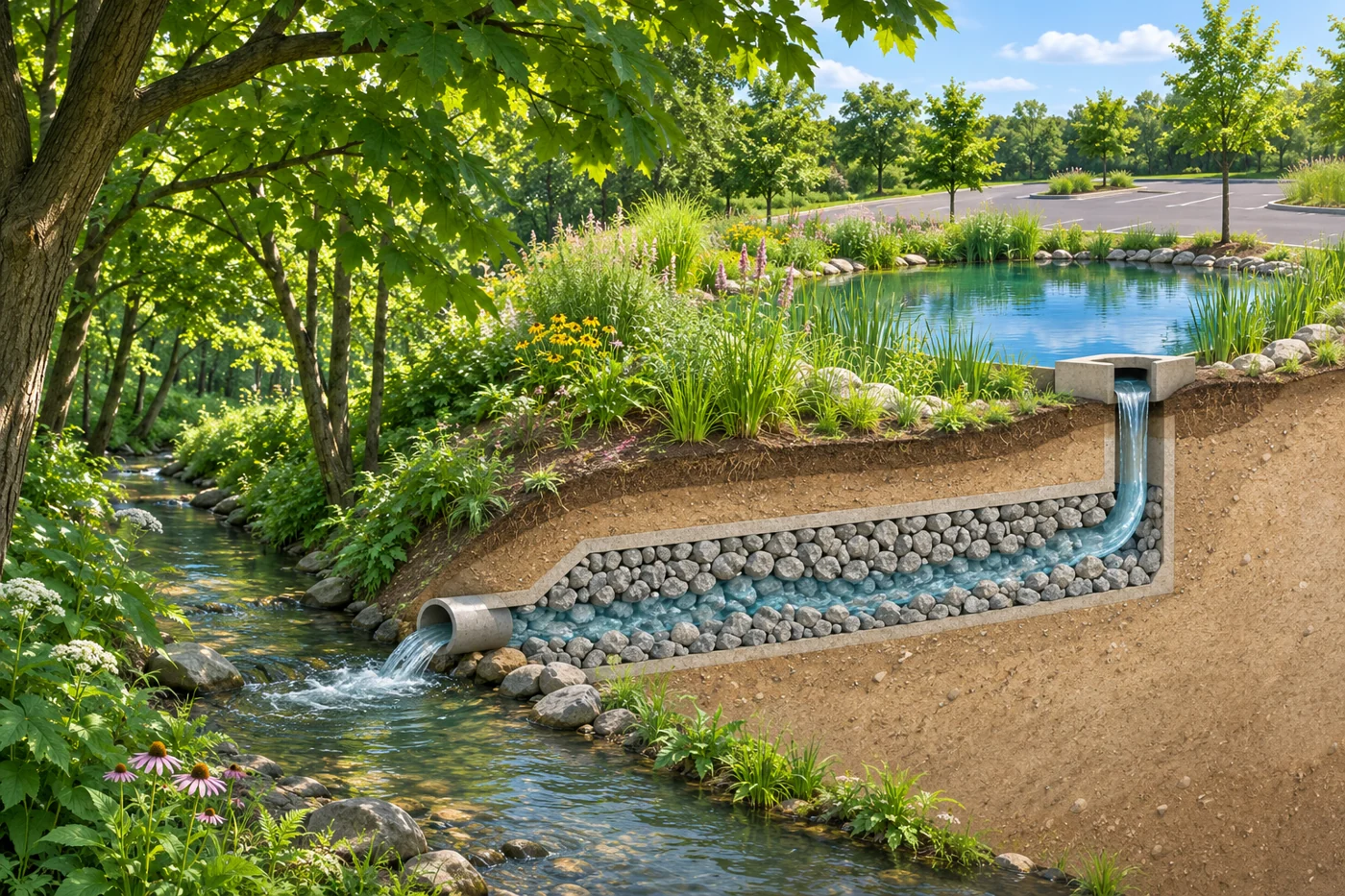
A buried cooling trench can transfer heat from flowing water into surrounding materials. Its usefulness depends on how the actual system operates, including the entering water, flow pathway, available heat exchange and bypass conditions.
A product name or trench volume alone is not enough to compare proposals. Request a plan and section showing how water enters, moves through and leaves the system. Identify whether infiltration forms part of the claimed function. Then establish the supporting soil and groundwater evidence.
Maintenance deserves equal attention. Explain how sediment reaches the system, what pretreatment is proposed and how the owner can inspect or service it. The proposal should address access without assuming that the entire feature can remain permanently hidden beneath inaccessible improvements.
STEP has evaluated cooling and baseflow-augmentation systems in Markham. The published project overview describes controlled pond discharge through a cooling/infiltration arrangement. That is evidence of a studied approach, not permission to copy its dimensions or operating rate.
For the proposed site, show which flows receive treatment and which bypass it. Report the residual discharge condition alongside the treated result. Otherwise, a favourable figure can describe only a small fraction of the water leaving the facility.
Assess active and geothermal stormwater cooling
Timed releases and geothermal heat exchange add operational choices to stormwater thermal mitigation. They also add dependencies. A comparison should make those dependencies visible before the owner commits to equipment, controls or a long-term operating arrangement.
For an active outlet, identify the proposed operating logic and its interaction with storage, forecast uncertainty and safe discharge. Explain what happens during power loss, communications failure, sensor faults and manual intervention. A cooler release window is not automatically a safe release window.
For geothermal cooling, the assessment needs a heat-load basis and a coordinated heat-exchange design. STEP’s Brampton pilot overview describes a closed-loop approach. The associated published research distinguishes the pilot’s constraints from full-scale system sizing.
Therefore, do not treat a pilot’s equipment count, borehole depth or observed result as a standard specification. Ask which site inputs the proposed design uses and which specialist responsibilities remain separate.
The owner also needs a clear operating plan. Identify who maintains the equipment, responds to faults and retains the records. A technically credible system still needs an achievable long-term management arrangement.
Compare stormwater cooling options using the same evidence
A useful stormwater thermal mitigation options comparison begins with a common baseline. Use the same drainage areas, climate inputs, receiving assumptions and reporting locations unless a difference is itself part of the option. Explain every changed assumption that affects the conclusion.
Separate feasibility from demonstrated performance. One option may fit the available land but lack enough evidence for final sizing. Another may have strong supporting data but conflict with maintenance access. A simple ranking should not hide these distinct limitations.
Present both thermal and non-thermal effects. Ask whether the option changes peak flows, water levels, overflow routes, erosion concerns or other water-quality functions. Include coordination with grading and servicing drawings so the preferred arrangement remains physically possible.
Compare lifecycle responsibilities as well as initial works. Identify inspection, sediment management, replacement access and any electrical or control-system support. Costs and timing need project-specific proposals; generic price ranges can mislead when investigation and construction constraints differ.
Finally, state why a candidate was excluded. A brief documented reason helps later reviewers understand the decision. It also prevents a previously unsuitable option from returning when project personnel or layout revisions change.
Document stormwater thermal mitigation modelling
A stormwater thermal mitigation model is useful when its inputs, boundaries and limitations can be inspected. It should explain the physical system it represents, the scenarios assessed and the outputs used in the design decision. Software output alone is not a reviewable engineering conclusion.
Keep observed and assumed inputs clearly labelled. Identify which temperature records, flow estimates and geometry inform the analysis. Where an input is transferred from another location, explain why it is relevant and what uncertainty the transfer introduces.
Also distinguish calibration from validation. Adjusting a model against one dataset does not establish its performance under all other conditions. The report should describe any separate comparison and the conditions that remain outside the available evidence.
Sensitivity testing can help identify influential uncertainties. For example, the designer may examine how a changed inflow assumption affects the preferred option. The appropriate tests depend on the model and decision. Avoid a routine checklist of scenarios that adds pages without answering the project’s actual questions.
Report results at meaningful locations and time scales. Include bypass and residual routes, rather than only the most favourable treated flow. Most importantly, explain how the result supports the recommendation and where additional evidence could change it.
Read the evidence for stormwater temperature mitigation
A stormwater thermal mitigation monitoring summary should let an owner trace each conclusion to the underlying record. Start with the period covered and the proportion of valid data. Then review how the author separated events, dry-weather periods and equipment interruptions.
Averages are useful, but they can hide short excursions or long warm periods. Maximum values can reveal a concern, yet they need context about duration, sensor condition and corresponding flow. Ask for the combination of statistics that matches the stated objective rather than requesting every available chart.
For an inlet-to-outlet comparison, consider travel time and storage. Measurements taken at the same clock time may describe different parcels of water. The appropriate analysis should acknowledge the system’s behaviour instead of treating every simultaneous difference as immediate cooling.
Likewise, compare upstream and downstream stream records cautiously. Other inflows and exchanges may affect the downstream result. A useful report explains how those influences were considered and what can reasonably be attributed to the assessed discharge.
If two monitoring periods used different methods, retain that distinction. A changed sensor position or flow-estimation method may affect comparability. The strongest summary makes uncertainty understandable and identifies the next decision. It does not bury limitations beneath an unexplained percentage or a single favourable graph.
Coordinate stormwater thermal mitigation with other design work
A thermal recommendation can affect several design disciplines. Reserve space for the proposed feature on the current site plan, then check the grading, servicing and landscape interfaces. A solution that fits an earlier layout may conflict with the next drawing issue.
Use one coordination record for material changes. For each change, identify its author, date and affected assumption. For example, relocating an outlet can change the available route to the receiving stream. Adding a driveway may alter the drainage area assigned to a source control.
Assign responsibilities before submitting the package. The civil designer, monitoring specialist, ecologist and equipment designer may each supply different parts of the evidence. Their scopes should explain who integrates those inputs and who answers comments on the combined proposal.
Construction-stage arrangements also need coordination where they affect the permanent works. Temporary drainage, sediment protection and access should not leave the completed treatment feature unable to perform its intended function. The relevant designers and constructor must resolve those interfaces within their agreed responsibilities.
Finally, retain the accepted design basis with the operating information handed to the owner. This helps future maintenance staff recognize a material change and obtain the right advice. It also prevents an old preliminary sketch from becoming the informal instruction for later alterations.
Verify and maintain stormwater thermal mitigation
The design file should say how the completed system will be checked. Separate construction documentation from operating evidence. A component installed in the intended position does not, by itself, establish seasonal thermal performance.
Define the verification responsibility, locations and reporting approach before work proceeds. This makes it easier to preserve monitoring access and identify the records needed for later evaluation. If post-construction monitoring is outside the assignment, name that boundary and establish who will arrange it.
Operational checks should also explain how the owner recognizes a changed condition. Examples include an obstructed flow path, unexpected bypass, damaged controls or sediment affecting an inlet. The appropriate response depends on the system; an owner should not alter outlet controls solely to obtain a lower temperature reading.
Keep inspection and operating records with the current design documents. When a repair or landscape change affects the drainage pathway, the responsible professional should consider whether the existing assessment still applies. The review should focus on the actual change rather than automatically repeating an entire study.
Finally, agree what would trigger further investigation. A clear response process is more useful than a broad promise of permanent performance. It connects observations to accountable decisions while preserving the original design intent.
Engineering examples: connect the observation to the decision
Hypothetical pond-outlet temperature concern
Assume an owner has several warm outlet readings and an old pond drawing. The first useful deliverable is an evidence review, not a selected cooling trench. Match the measurement location to the actual discharge route and identify when each reading occurred.
Next, establish whether corresponding flow records and receiving-water objectives exist. Review the pond’s present geometry and operating arrangement. These steps show which information is missing before an alternative can be sized or compared credibly.
Hypothetical redevelopment with less connected pavement
Assume a proposed layout changes paved area and introduces source controls. Compare the current and proposed drainage boundaries first. Then identify the controlled volume, residual discharge and overflow pathways using the evidence appropriate to the site.
A lower predicted runoff volume may support the thermal assessment. However, it does not independently establish downstream temperature or ecological acceptance. The report should explain exactly which conclusion follows from the analysis and which still needs specialist or authority input.
Relevant Elmid Design Inc. design experience
Elmid Design Inc.’s published project portfolio includes a residential stormwater assignment with drainage analysis, runoff-storage calculations and infiltration-gallery layouts coordinated with grading. This example from another project shows experience in connecting stormwater evidence and site design. It is not presented as a measured thermal-mitigation project.
For the situations described above, Elmid Design Inc. can scope stormwater engineering analysis, coordinated design drawings and reporting around the available evidence. Thermal monitoring, ecology, hydrogeology and specialized equipment design require clearly assigned responsibilities where needed.
Prepare an engineering package that reviewers can follow
A clear stormwater thermal mitigation package connects the concern, evidence, alternatives and recommendation. Begin with a short description of the existing and proposed drainage systems. Identify the property, receiving system, drawing revisions and relevant consultation records without mixing superseded and current information.
The technical discussion should then show how the objective was selected, which inputs support the assessment and which limitations remain. Keep monitoring figures, calculation outputs and drawings consistent. A reviewer should not need to guess whether two differently named outfalls represent the same location.
Include the preferred measure’s physical interfaces and operating responsibilities. Show where it connects to the grading and servicing design, how residual water leaves and which access must remain available. State who owns each outstanding specialist deliverable.
For review comments, use a response record that identifies the changed document and location. Explain whether a response changes the design, clarifies an existing assumption or adds missing evidence. This makes subsequent review more efficient without promising a particular approval outcome.
Keep the final decision status explicit. A submitted report, a technically supported recommendation and an authority’s acceptance are separate milestones. None should be described as another merely because the package has been issued.
How Elmid Design Inc. supports stormwater thermal mitigation
Elmid Design Inc. provides professional engineering and design consulting, including stormwater reports and coordination with grading and servicing plans. For a thermal concern, the starting point is a defined question and a review of the available site information.
Depending on the agreed assignment, deliverables may include a drainage-basis review, an assessment of feasible measures, supporting calculations, coordinated drawings and responses to review comments. The scope should identify which thermal analysis is included and what information other specialists must supply.
Send the current survey, site plan, stormwater records and relevant authority correspondence when available. If monitoring already exists, include the original data, location plan and method description rather than only a summary chart. Also explain whether the project concerns an existing pond, redevelopment or a proposed new facility.
This information helps establish the next engineering step. It does not remove the need for investigations or approvals. Elmid Design Inc.’s role is consulting and design, separate from construction, installation and the authority’s decision to accept the proposed works.
Frequently Asked Questions
Is there one stormwater discharge temperature limit for all Ontario sites?
No universal limit is established by this guide. Confirm the applicable objective with the responsible authorities and relevant specialists. Its wording, assessment location and time basis matter as much as the number itself.
Does a lower outlet temperature prove successful thermal mitigation?
No. A lower temperature is one part of the evidence. Flow, discharge timing, bypass, receiving conditions and the agreed objective also affect the assessment. Compare the same locations and periods before drawing conclusions.
Can infiltration replace a cooling trench?
It may be an alternative or part of a combined approach when site evidence supports it. Soil and groundwater conditions, available area, water-quality concerns and applicable requirements need review. Neither measure is automatically suitable for every property.
Can we copy a successful Ontario pilot design?
A pilot can inform option screening, but it does not establish another site’s design. Check the original study’s purpose, inputs, operating range and limitations. Then assess the proposed site’s own heat load, physical constraints and responsibilities.
What should an owner provide before requesting a proposal?
Provide the property location, proposed work, available plans, existing stormwater records and review comments. Include original monitoring data and its location information if available. Clearly identify missing records rather than supplying assumptions as verified facts.
Does a thermal assessment authorize pond or watercourse work?
No. An assessment supports design decisions and the relevant review process. The property, activity and applicable requirements determine the needed permissions. Confirm those requirements before implementation.
Sources and further reading
The following official and primary resources inform the technical context. Study results apply to their documented conditions; they are not universal design targets.
Geographic Locations That We Service:
Our Licensed Professional Engineers provide stormwater engineering and design services, including runoff analysis and stormwater management reports. We coordinate this work with Site Grading Plans, erosion and sediment control plans, and drainage design where relevant to the Ontario project.
We provide engineering services across a wide range of municipalities, each with its own requirements and review processes.
Toronto and Surrounding Areas
We provide engineering services in Toronto and provide grading engineering resources through our Toronto grading plan page.
Our service area also includes Oshawa, Pickering with our Pickering grading plan resources, and Clarington.
We also provide engineering services in Ajax through our Ajax grading plan resources, Whitby, Brock, Scugog, and Uxbridge, including our Uxbridge grading plan resources.
Halton Region
Within Halton Region, we provide engineering services in Burlington, including projects requiring Burlington grading plans.
We also provide engineering services in Halton Hills, supported by our Halton Hills grading plan resources.
Our service area also includes Milton and Oakville, including our Oakville grading plan resources.
Peel Region
Within Peel Region, we provide engineering services in Brampton, including projects requiring Brampton grading plans.
We also provide engineering services in Mississauga through our Mississauga grading plan resources and Caledon through our Caledon grading plan resources.
York Region
Within York Region, we provide engineering services in Vaughan and provide information about Vaughan grading plans.
We also provide engineering services in Aurora through our Aurora grading plan resources and East Gwillimbury through our East Gwillimbury grading plan resources.
Additional service areas include Georgina with our Georgina grading plan resources, Markham with our Markham grading plan resources, and Newmarket with our Newmarket grading plan resources.
We also provide engineering services in Richmond Hill with our Richmond Hill grading plan resources, Whitchurch-Stouffville through our Whitchurch-Stouffville grading plan resources, and King through our King grading plan resources.
Our service area also includes Bradford West Gwillimbury.
Other Southern Ontario Cities and Towns
We provide engineering services in many additional Southern Ontario communities, including Hamilton, St. Catharines, Niagara-on-the-Lake, Brant, Cambridge, Kitchener, Waterloo, and Woodstock.
We also provide engineering services in Guelph, Centre Wellington, Shelburne, Orangeville, New Tecumseth, Essa, Collingwood, Wasaga Beach, and Barrie, including our Barrie grading plan resources.
Additional service areas include Midland, Orillia with our Orillia grading plan resources, Ramara, Minden Hills, North Kawartha, Kawartha Lakes, Peterborough, Selwyn, and Brighton.